Safety Toe vs Soft Toe: What Professionals Need for Desk and Site
75% of foot injuries happen when workers aren't wearing compliant boots. Here's how to pick the right toe for every shift.
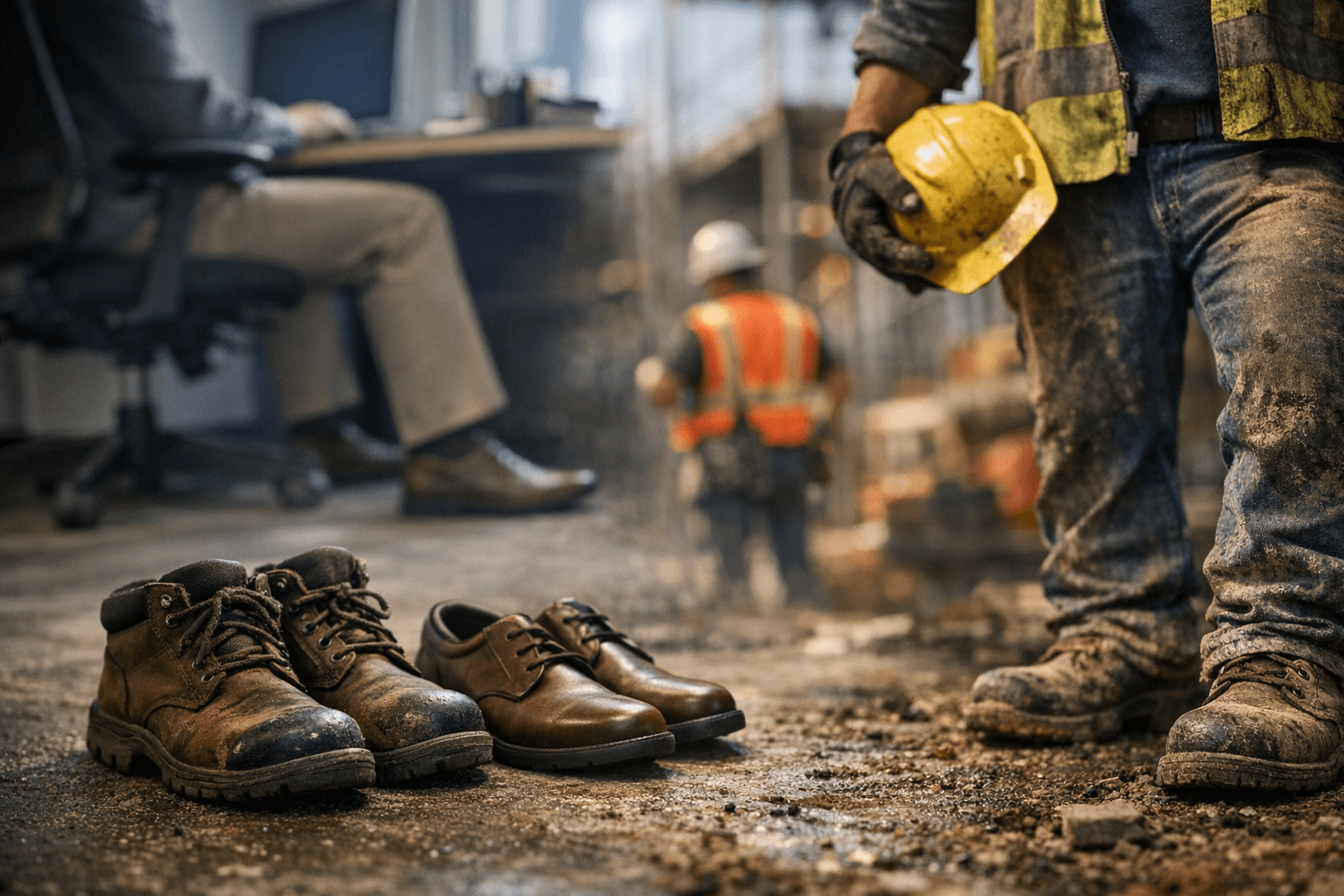
More than 53,000 foot injuries happen in U.S. workplaces every year, and 75% of them occur when workers aren't wearing compliant boots. For professionals who split their days between a desk and a job site, that stat lands differently: the footwear decision isn't just about comfort or dress code, it's about whether your shoes can actually do the job when the environment changes under your feet.
The right footwear choice balances safety compliance, comfort, and presentability. Getting that balance wrong in either direction, either wearing a clunky steel-capped boot to a client meeting or strolling onto a construction site in soft-toe sneakers, creates problems. One is a professional optics issue; the other can end your week.
What's Actually Inside Your Boot
Toe caps come in five main material categories: soft, aluminum, composite, carbon, and steel. Each exists because different jobs create different hazards, and no single material wins across every context. The ASTM standard doesn't require that the toe cap be made of a specific material; steel, aluminum, and composite toe caps can all provide the required protection. That flexibility matters because it means the decision is yours to make based on actual job conditions, not just whatever your employer stocked in the supply room.
Think of a safety toe cap the way you'd think of a hard hat: just as a hard hat protects your head from bumps and dropped objects, safety toe caps protect the front of your feet. They're part of a complete PPE kit, alongside safety glasses, a reflective vest, and gloves.
The Case for Soft Toes
Not all jobs require a safety toe. If your day involves lighter-duty tasks like carpentry, light framing, truck driving, DIY projects, or office-to-site hybrid work, soft-toe work shoes can be a genuinely practical choice. Soft toe styles look identical to their safety toe counterparts from the outside, which matters when you're walking into a boardroom at 10am and a warehouse floor at 2pm.
The functional advantages are real. No structural safety toe means no added weight, which adds up significantly over a full shift. Soft-toe styles also flex evenly across the whole forefoot, much like a pair of sneakers or hiking boots, which makes them noticeably more comfortable during long days of walking or standing. KEEN Utility's San Jose Soft Toe for men and women is designed exactly for this kind of all-day versatility, described as equally at home going from jobsite to campsite.
The limitation is straightforward and non-negotiable: soft toe boots offer abrasion resistance and will guard against minor impacts, but they don't provide a secondary source of crush or impact resistance. If your site work puts you anywhere near heavy or compressive objects, a structural safety toe is not optional.
Steel Toes: The High-Risk Standard
Steel remains the strongest toe cap material available and is the most popular choice among construction workers facing elevated risk for both impact and compression injuries. The tradeoff is weight and conductivity. Steel conducts cold, which matters in certain environments, and it adds measurable heft to every step.
For workers operating in high-impact zones, that weight penalty is worth paying. Steel's tensile resistance is proven, and in environments where something heavy genuinely might fall on your foot, the ceiling protection steel provides is hard to argue against.
Aluminum: The Hybrid Professional's Best Friend
Aluminum's popularity in the aircraft industry, where it's valued for being extremely lightweight and strong, translated naturally into safety footwear. For professionals who move between office and site regularly, aluminum toe boots may represent the most practical daily compromise.
KEEN Utility claims aluminum safety toes run about 30% lighter than steel while offering the same protection. Unlike steel, aluminum also won't rust, which matters if your site work involves wet conditions. Both the KEEN San Jose work boots and the Sparta 2 work sneakers are available with aluminum toe caps, and the sneaker silhouette in particular speaks directly to the desk-to-site professional who needs to look put-together in both settings.
Many workers consider alloy the ideal balance between lightweight comfort and strong protective performance, and it's easy to see why: you're not sacrificing compliance for comfort, you're finding a material that delivers both.
Composite Toes: Cold Storage and Beyond
Composite safety toes are the lightest option across all structural toe cap materials and carry a specific thermal advantage that steel and aluminum can't match. Composite doesn't conduct cold as well as steel or aluminum, making composite the preferred choice for cold storage and temperature-controlled food processing workers who spend shifts walking on frozen surfaces.
For professionals working in mixed environments that include cold facilities, electrical hazard zones (composite is non-metallic and won't conduct electricity), or settings where metal detectors are in use, composite is often the only logical answer.
Start with Hazard Assessment, Not Aesthetics
Choosing the right safety boot starts with identifying the hazards you face every day. Some workplaces involve high-impact risks, while others expose workers to sharp debris, wet surfaces, electrical hazards, chemicals, or prolonged exposure to concrete. Understanding those conditions determines whether you need stronger impact protection, better traction, waterproofing, puncture resistance, heat resistance, or protection against electrical hazards.
A clear hazard assessment prevents the most common mistake in work boot selection: choosing a boot that looks durable but fails to offer the correct level of protection. The toe cap material is the starting point, not the whole picture. The best boots combine protection, comfort, job-specific features, and durable construction. Outsole and traction rating, waterproofing, puncture resistance, and thermal properties all factor into whether a boot actually works for your specific job.
Running a Footwear Program That Actually Works
For safety managers and employers, issuing boots is the beginning of the process, not the end. A successful safety footwear program requires planning, fit, function, and proactive replacement. With OSHA's recent rule requiring properly fitting PPE and safety workwear, getting fit right is now a compliance matter, not just a comfort preference.
That means asking vendors and distributors for fit information and recommendations on footwear that meets jobsite requirements while delivering an inclusive range of sizes. It means exploring try-before-you-buy programs or on-site fittings where experts help employees find boots that actually fit correctly. Slip resistance ratings, typically designated SR and SRO, are another performance category that footwear programs need to evaluate and match to specific site conditions.
Field testing for proper function is equally important: a boot that performs in the store may behave differently after a full shift on a specific surface or in a specific climate. Proactive replacement, rather than waiting for boots to visibly fail, keeps compliance and protection levels consistent across the workforce.
Matching Boot to Role
The simplest framework for desk-to-site professionals: if your site time is genuinely light duty and involves no heavy equipment or compressive hazard, a quality soft-toe boot gives you mobility, comfort, and a cleaner silhouette. If your site work involves any meaningful crush or impact risk, the toe cap needs to be structural. Between steel, aluminum, and composite, the choice comes down to weight tolerance, environment (wet, cold, electrical hazard), and daily wear pattern.
Getting this decision right isn't about trend or preference. With 10% of all disabling workplace injuries being foot-related, the boot on your foot is load-bearing in more ways than one.
This article was produced by Prism’s automated news system from verified source data, official records, and press releases, then run through automated quality and moderation checks before publishing. The system is built and supervised by the people who set the standards it runs under. Read our full AI policy.
Did this article answer your question?