SHINYAKOZUKA turns Dickies work pants into oversized statement pieces
SHINYAKOZUKA turns Dickies into a full-volume flex, with deep pleats, T/C twill, and a $200 price tag that pushes workwear into collector territory.
The work pant, stretched to breaking point
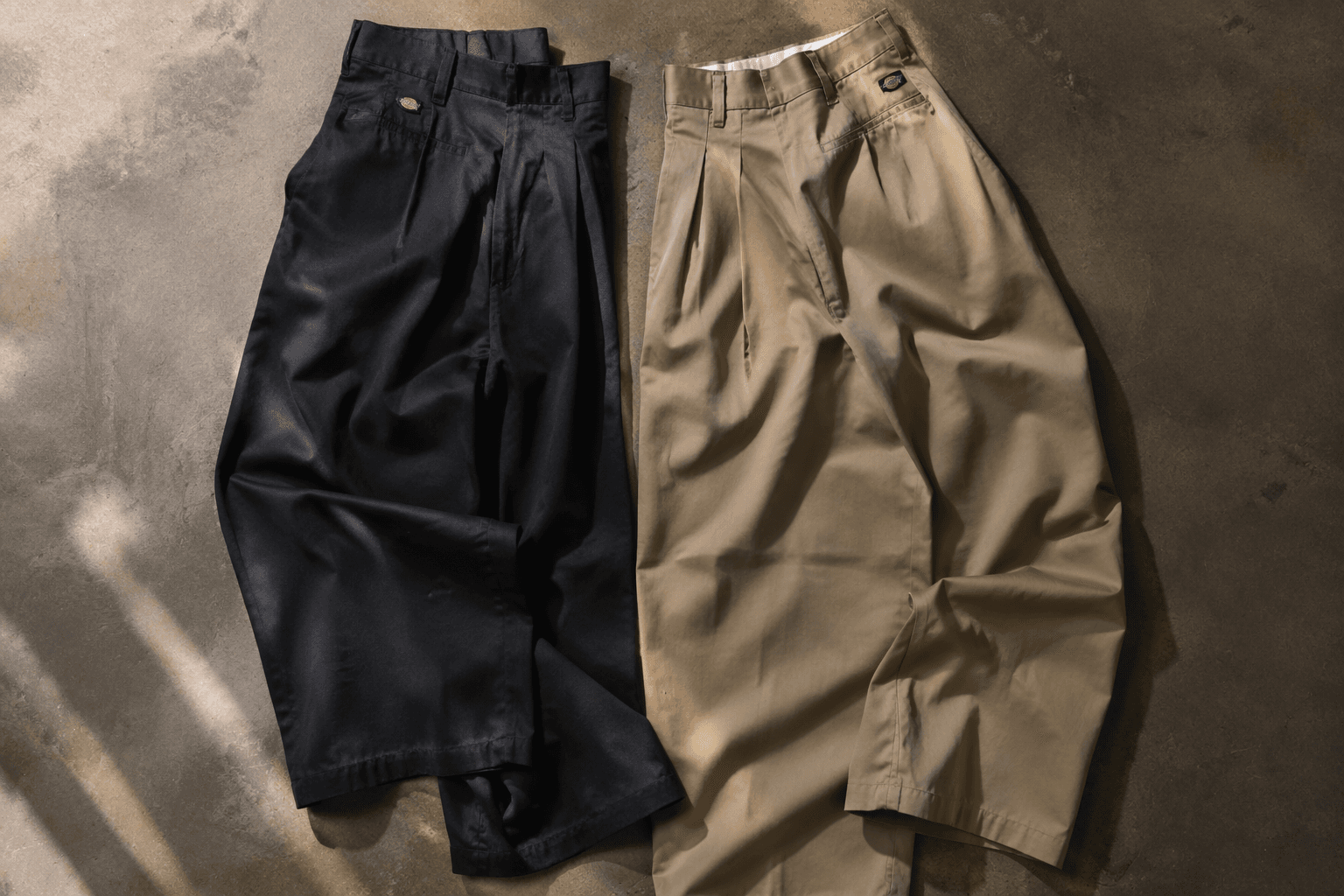
Dickies has been making durable workwear since 1922, but SHINYAKOZUKA treats that history like a launching pad, not a boundary. The brand’s BAGGY WITH DICKIES takes the most familiar work pant on earth and blows it out into something closer to wearable sculpture, with JNCO-level volume, deep pleats, and a silhouette that looks like it was designed to take up space on purpose.
That is exactly why this collaboration keeps landing. Dickies brings the credibility of a century-old uniform, while SHINYAKOZUKA keeps bending it until it feels strange again. The result is not nostalgia, and it is not basic utility with a fashion stamp on top. It is workwear translated for people who want their clothes to announce the shape of the body before they explain the outfit.
What changes when Dickies goes oversized
The original Dickies work pant is built to behave. It sits clean at the waist, keeps the line straightforward, and exists to survive abrasion, movement, and repetition. SHINYAKOZUKA flips that logic by keeping the waistline neat while exploding everything below it: two deep tucks, a longer middle seam, and a broad, baggy leg that turns the pant into a volume study.
That construction matters because the shape is not just big, it is engineered to read big. SHINYAKOZUKA says the silhouette is even more pronounced before washing, when the fabric still holds its stiffness, which gives the pant a sharper, more architectural feel out of the gate. Once the cloth softens, the shape will settle, but that first hit is the point: this is workwear with an attitude problem.
The fabric choice keeps the joke grounded. The BAGGY WITH DICKIES uses Dickies’ standard T/C twill, a 65 percent cotton and 35 percent polyester blend, so the piece still carries the practical DNA of the original uniform. You can feel the tension immediately, because the material says workhorse while the cut says fashion experiment.
This is not just about the pants
The wider collaboration pushes the idea further than one pair of trousers. Highsnobiety also points to matching slouchy Dickies blazers and an experimental informal suit, which makes the collection feel like a full silhouette system rather than a one-off styling trick. Once the pant is paired with a blazer that shares the same looseness, the whole look shifts from “statement bottom” to “new kind of uniform.”
That broader approach matters because SHINYAKOZUKA is not treating Dickies as a gag. The brand describes the BAGGY as a way to “redefine the relationship between uniform and fashion,” and that line lands because the clothes actually do the work. The 2024 collaboration already showed the idea in a more literal way, with an EISENHOWER JK WITH DICKIES jacket and pants that could connect at the waist and be worn like a jumpsuit. That kind of engineering turns workwear into a modular fashion object, something between coverall and runway proposition.
There is also a sustainability undertone here, with upcycled fabrics folded into the collaboration’s language. That keeps the project from feeling like pure excess, even as the proportions get louder. SHINYAKOZUKA is proving that experimental workwear does not have to choose between craft, reuse, and visual drama.
Why SHINYAKOZUKA can pull this off
Part of the appeal is that SHINYAKOZUKA already thinks like a visual artist. Designer Shinya Kozuka graduated from Central Saint Martins in 2013, launched the label in 2015, and built the brand around “picturesque scenery,” with collections inspired by drawings and paintings. That background explains why the clothes often feel narrated rather than merely designed; they read like scenes, not just products.
Rakuten Fashion Week Tokyo says the label has become a distinctive force in Japan’s men’s market, with sales growing at a rate of 30 percent every year. That kind of momentum gives the brand room to keep pushing proportion, because it has already proven that its audience wants more than safe tailoring. The SHINYAKOZUKA customer is buying into a point of view, and this Dickies collaboration is one of the clearest expressions of it.
The 11th Dickies collaboration, released on June 23, 2024, showed how deep that relationship had become, with the EISENHOWER JK WITH DICKIES and BAGGY WITH DICKIES positioned as a connected set. The pants were priced at ¥31,900, with a no-paint version at ¥29,700, which put the project firmly in the designer-collab lane rather than the workwear aisle. That same logic carries into the newer BAGGY, which keeps the price conversation just as sharp in the U.S. and Europe.
What the current BAGGY says about the market
The latest BAGGY WITH DICKIES is listed at $200 in the United States and €169.95 in Europe. It comes in black, khaki, navy, and brown, with sizes from XS through XXL, which is a smart range for a silhouette that relies on proportion as much as fit. Black and navy make the shape look even more severe, while khaki and brown drag it back toward Dickies’ utilitarian roots.
At $200, this is not a pant for someone looking to quietly replace a beat-up pair of work trousers. It is for the collector who wants the 11th collaboration in the series, the fashion insider who reads proportion as a language, and the everyday wearer who wants to push the body line into something looser, stranger, and more deliberate. The original Dickies pant is about durability; SHINYAKOZUKA’s version is about presence.
That is where experimental workwear is now: not at the level of adding pockets or roughing up a hem, but at the point where a century-old uniform can be rebuilt into a shape that changes the entire silhouette of an outfit. SHINYAKOZUKA’s Dickies pant does exactly that, and it does it with enough conviction to make volume feel like a point of view, not just a trend.
Know something we missed? Have a correction or additional information?
Submit a Tip