World Cup becomes a style platform for fashion brands
World Cup branding is becoming a uniform system, with jerseys, color-coded sneakers and athlete-led underwear translating football codes into everyday dress.

The 2026 World Cup is already operating like a fashion season, not just a sporting event. With 48 teams, three host countries and a final set for July 19 in New York New Jersey, the tournament has become a clean commercial grid for brands that want instant recognition, built-in national color stories and the emotional pull of team loyalty. The smartest executions are not broad nods to “football style” but highly legible products that behave like uniforms, from hotel jerseys to team-specific sneakers to performance underwear.
The World Cup as a merchandising system
What makes this tournament so useful to fashion is its structure. FIFA’s 2026 edition opens on June 11, runs through the summer and is the first men’s World Cup with 48 teams and the first co-hosted by Canada, Mexico and the United States. The final draw took place in Washington, D.C., on December 5, and FIFA confirmed a record 1,248 players representing 48 nations on June 2 after final squad lists were submitted. That scale gives brands a ready-made language of repetition: 48 nations, 48 squads, 48 color stories, 48 ways to turn identity into product.
That is why the strongest brand moves around this World Cup feel less like fan merch and more like a merchandising architecture. National palette, athlete association and jersey syntax are doing the work of branding in a way that needs almost no explanation. In fashion terms, that means high readability, easy capsule logic and a clear path from stadium dressing to streetwear to staff uniforms.
Rosewood turns football culture into luxury housekeeping polish
Rosewood’s World Cup-linked project, The Spirit of Celebration, is the most elegant example of the uniform idea being translated into hospitality. The brand commissioned an exclusive limited-edition jersey with British artist and sportswear designer Christian Jeffery, and the piece will be worn by members of the Rosewood community around the world, from luxury hotels and resorts. That is the key shift: the jersey is not merely merchandise, it is a branded work uniform with cultural cachet.
For luxury hospitality, that matters. A jersey can easily become kitsch, but Rosewood’s version sits closer to a modern staff layer, one that borrows the visual language of football without losing the polish expected in a five-star setting. Joanna Gunn, Rosewood’s chief brand officer, framed the project around cultural moments that bring people together, and Jeffery’s football references are filtered through the brand’s own lens rather than through literal club-copying. This is the kind of execution most likely to spill into retail uniforms and branded servicewear because it is scalable, symbolic and instantly readable from a distance.
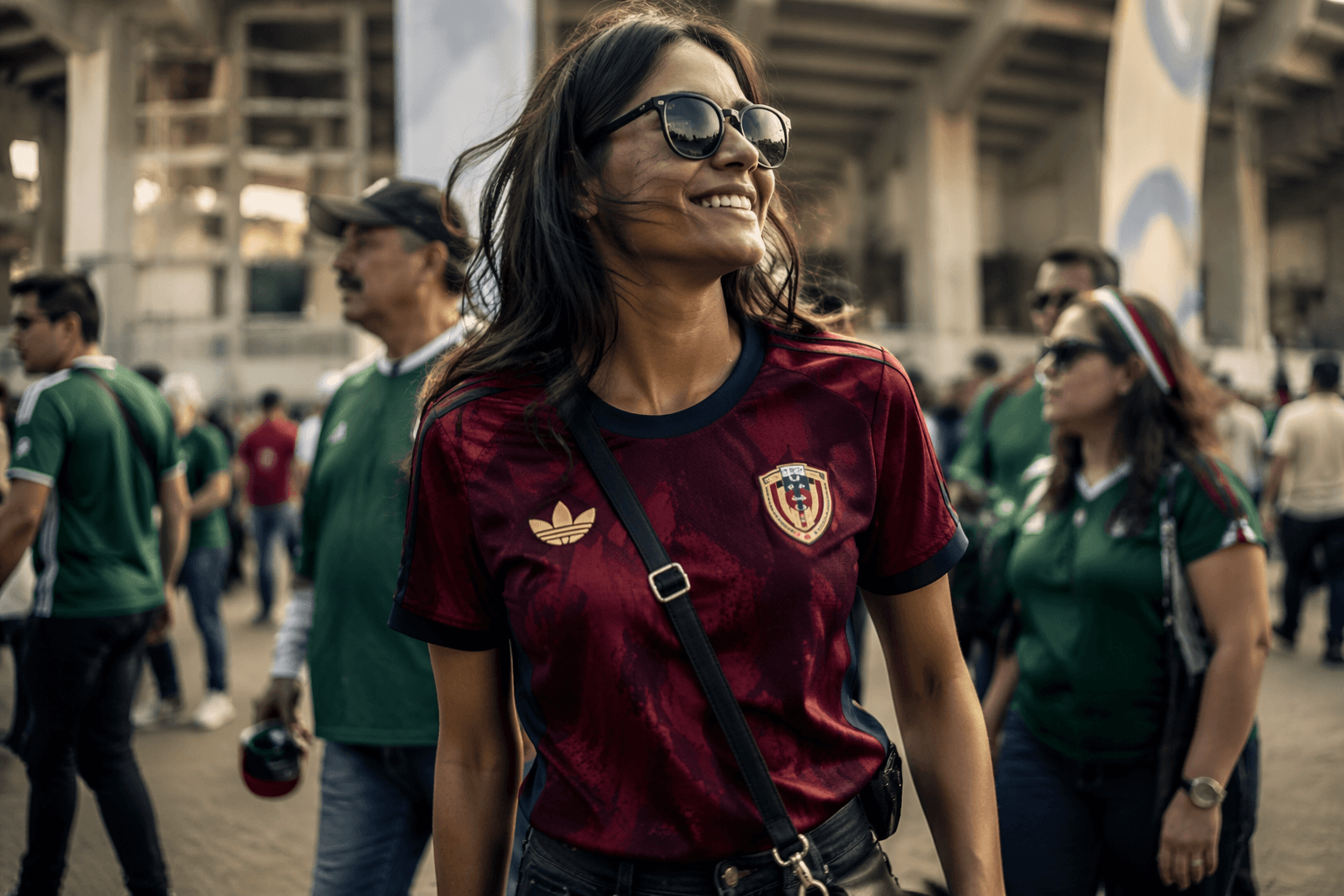
BAPE and KidSuper build the clearest retail code: 48 team colors, 48 pairs of meaning
If Rosewood is the polished uniform play, BAPE and KidSuper are the most commercially explicit. Their SuperBape Cup collection is tied to the World Cup and the 25th anniversary of the Bape Sta, with 48 distinct Bape Sta colorways, one for each team in the 2026 tournament. That one-to-one mapping is the story: a sneaker range that behaves like a national league of capsules, each pair a collectible in a broader system of visual shorthand.
WWD reported the Bape Sta pairs retail for $325, and other sneaker coverage said the first 10 pairs were scheduled to launch on June 11, 2026. That price point places them firmly in the premium sneaker lane, where scarcity, color coding and collab culture do most of the selling. KidSuper and BAPE are also being described as reuniting after an earlier 2025 collaboration, which gives the project a sequel energy that collectors understand immediately.
This is the collection most likely to ripple outward into everyday wear because it already speaks the language of repeat purchase and team affiliation. The colorways can be read like uniforms, but they are not uniforms in the strict corporate sense. They are branded capsule drops with a sports logic, and that is exactly the kind of format that can be translated into store uniforms, venue staff sneakers, regional product stories and limited-run retail capsules.
Calvin Klein uses Raphinha to sell performance before it sells fandom
Calvin Klein’s World Cup-adjacent push takes a different route: athlete authority rather than team symbolism. The brand’s Spring 2026 campaign stars Brazilian footballer Raphinha, shot by Daniel Sannwald, and launched globally on March 3 across retail, calvinklein.com, social platforms and out-of-home placements. The campaign is built around motion, strength and comfort, with the Intense Power collection positioned as a performance story rather than a standard underwear ad.
That framing matters because underwear is the nearest thing fashion has to a true base layer uniform. When Raphinha says the underwear is designed for performance, Calvin Klein is linking the product to athletic credibility without dressing it in overt football graphics. It is a subtler kind of sports merchandising, but one that can travel easily into daily life: the same visual grammar that sells on an athlete can sell in a gym bag, a commuter wardrobe or a travel kit.
Among the three projects, this is the most directly wearable beyond the event itself. It does not require a fan to understand a club crest or a team color. It relies on body confidence, technical comfort and a clean, athletic silhouette, which is why it has a stronger chance of moving into mainstream workwear-adjacent dressing, especially for consumers who want foundation pieces that feel engineered rather than decorative.
Why these moves matter for workwear and branded dress codes
The commercial pattern is unmistakable. Fashion brands are borrowing team codes, athlete associations and jersey language to make product that reads instantly, whether it hangs in a hotel lobby, sits on a sneaker wall or appears in a campaign shot. The World Cup is giving them a rare combination of scale and clarity: a fixed number of teams, a global audience and a summer-long attention cycle across Canada, Mexico and the United States.
For workwear style, the spillover is likely to come in three directions:
- hospitality and retail uniforms that use jersey construction, piped trims or team-like color blocking
- capsule footwear and accessories built around national palettes or repeatable team systems
- performance base layers and technical essentials sold through athlete-led campaigns
The brands that will benefit most are the ones that understand the difference between costume and code. Rosewood makes the jersey feel like a polished uniform. BAPE and KidSuper turn the tournament into a collectible color system. Calvin Klein uses one of the sport’s most recognizable figures to sell performance through the body itself. Together, they show that the World Cup is no longer just a sponsor’s playground. It is a style platform where the most valuable product is a look people can identify in a second and wear long after the final whistle.
This article was produced by Prism’s automated news system from verified source data, official records, and press releases, then run through automated quality and moderation checks before publishing. The system is built and supervised by the people who set the standards it runs under. Read our full AI policy.
Know something we missed? Have a correction or additional information?
Submit a Tip

