Personalized Jewelry Gifts Are Reshaping How Couples Celebrate Anniversaries
Personalized jewelry has quietly become the anniversary gift couples actually want, replacing generic luxury with pieces that carry real meaning.

Something has shifted in the way couples mark their years together. The anniversary gift that once defaulted to a bouquet, a dinner reservation, or a department store box tied with ribbon is being replaced by something more considered: jewelry that says a specific name, holds a specific date, or traces the exact coordinates of where two people fell in love. This isn't a passing trend. It reflects a deeper change in what consumers want from the objects they wear and keep.
Why identity is driving jewelry choices
The core shift is about personal expression. Consumers increasingly want jewelry that reflects their identity rather than someone else's idea of what a gift should look like. A diamond tennis bracelet from a glass case is beautiful, but it could belong to anyone. A necklace engraved with the date of a first apartment, a ring stamped with initials in a font chosen by the giver, a bracelet with a child's birthstone added on each anniversary: these pieces belong to one person, in one relationship, at one specific moment in time.
This move toward identity-driven jewelry changes the emotional calculus of gift-giving entirely. The question is no longer "what's an appropriate price point for a fifth anniversary?" It becomes "what detail about our relationship is worth wearing every day?" That's a much more interesting question, and the answers tend to produce gifts that get kept for decades rather than quietly relegated to a jewelry box.
What personalization actually means in practice
Personalization in jewelry covers a wide spectrum, and understanding the range helps you give more precisely. At one end, there's simple engraving: a date on the back of a watch, initials inside a band, a short phrase along the edge of a pendant. This is accessible, relatively affordable, and often deeply effective. A plain gold band engraved with coordinates means nothing to a stranger and everything to the person wearing it.
Moving further along the spectrum, you find jewelry built around specific design choices: birthstones selected for their meaning rather than their month, mixed metals that reflect a partner's aesthetic rather than a jeweler's default, or layered pieces designed to be added to year after year. The anniversary gift that comes with the intention of being continued, a charm added each year, a new stone set alongside the last, creates a ritual around the relationship itself.
At the most bespoke end, custom-designed pieces commissioned from independent jewelers or ateliers give couples something that has never existed before. This level of personalization requires more lead time and a higher budget, but the result is an object that carries a story no other piece of jewelry can replicate.
The anniversary context: why this matters now
Anniversary gifts occupy a particular emotional register. They're not spontaneous gestures; they're premeditated declarations. You've had time to think, and what you choose reflects how seriously you took that time. A personalized piece of jewelry signals intentionality in a way that off-the-shelf gifts, regardless of price, simply cannot.
The traditional anniversary gift lists, paper for year one, silver for twenty-five, gold for fifty, have always acknowledged this. They pointed couples toward materials that carry meaning and age well. Personalized jewelry sits in the same tradition but updates it: instead of defaulting to the material, you default to the meaning. The metal or stone becomes the vehicle; the engraving, the design, the specific choice of detail is what actually marks the occasion.
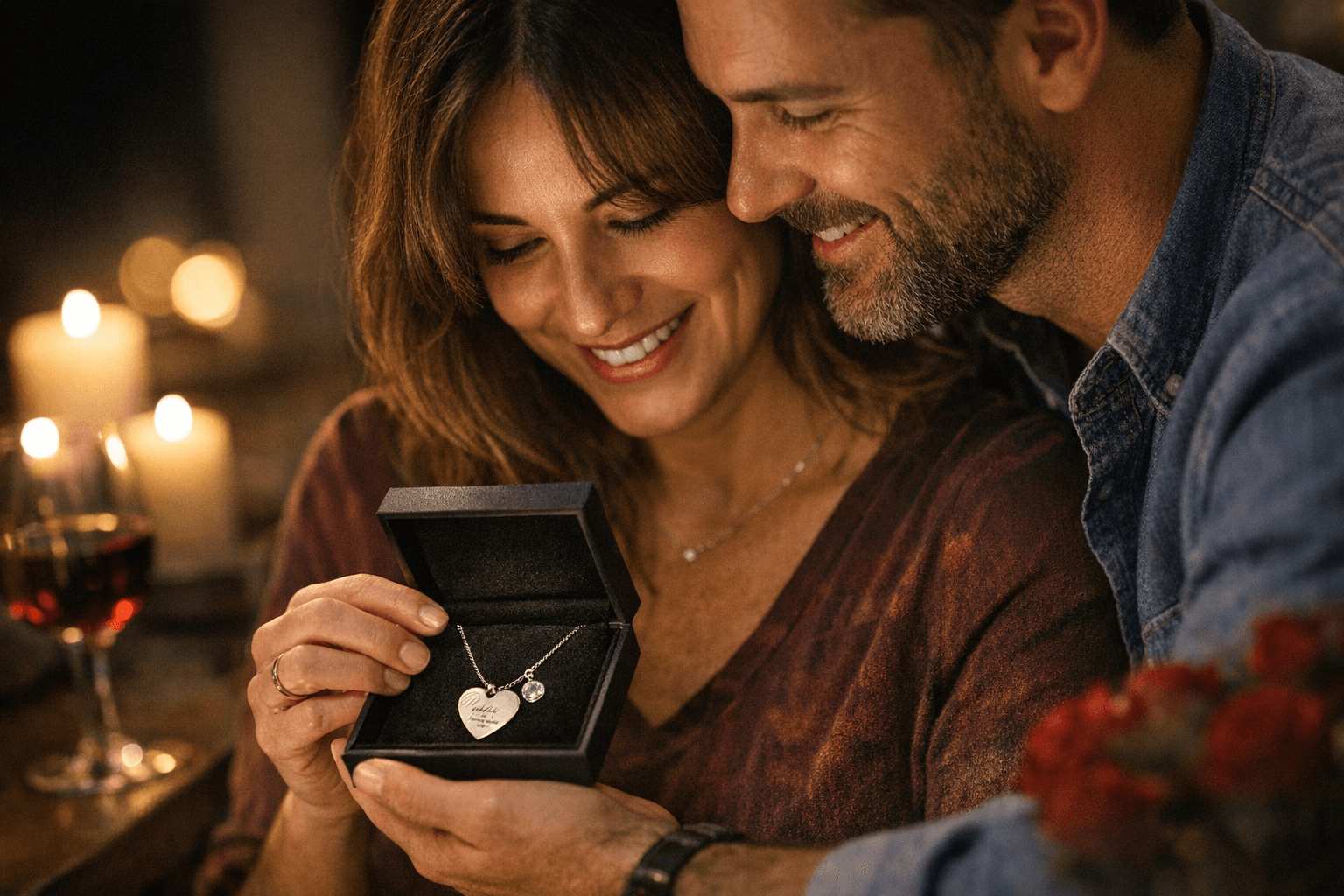
This matters particularly at milestone anniversaries, where the gift needs to hold the weight of everything a couple has built. A tenth anniversary piece that incorporates the birthstones of any children born in that decade, or a twenty-fifth anniversary ring that resets the original engagement stone into a new design, carries far more narrative than something purchased from a display case.
Giving it well: what separates a good personalized gift from a great one
The personalization itself is not enough. Execution matters enormously, and there are a few principles worth holding.
- Start with what the person actually wears. A partner who layers delicate gold chains every day will not suddenly love a chunky silver cuff, no matter how beautifully engraved. Personalization should amplify their existing style, not override it.
- Be specific in a way that requires knowledge. Anyone can engrave "with love" on the back of a pendant. The gifts that land are the ones where the detail could only have come from paying attention: the time of a first meeting, the name of a street, the number of a hotel room. Specificity is what transforms a personalized piece into a deeply personal one.
- Choose a maker whose work you've seen in person or in detailed photographs. The quality of engraving, the weight of a chain, the setting of a stone: these vary widely between jewelers, and the wrong execution can undermine even the most thoughtful concept.
- Give it with context. A small card that explains the choice, why this date, why this stone, why this phrase, makes the gift legible in a way that matters when the piece is worn years later and the story needs to be told again.
The longer arc
What personalized anniversary jewelry does, at its best, is create an object that grows more valuable with time, not in the financial sense, but in the way that objects accumulate meaning the longer they're part of a life. A piece chosen with care in year ten becomes part of the story told in year thirty. The date stamped into the metal doesn't fade. The stone chosen for its meaning doesn't change.
That durability, emotional rather than material, is what separates the best anniversary gifts from the merely expensive ones. Price is a floor, not a ceiling. The ceiling is set by how well you know the person you're giving to and how much of that knowledge you're willing to put into the object itself.
This article was produced by Prism’s automated news system from verified source data, official records, and press releases, then run through automated quality and moderation checks before publishing. The system is built and supervised by the people who set the standards it runs under. Read our full AI policy.
Did this article answer your question?

%3Amax_bytes(150000)%3Astrip_icc()%2Fjackieandadam-7120280829b248d8bea28c8f9d73aabc.jpg&w=1920&q=75)