Smart Haptic Gifts Help Long-Distance Couples Stay Connected on Anniversaries
Research on 338 couples links haptic gadgets to measurable well-being gains. The Bond Touch 4 at $70 leads a no-subscription category built for long-distance anniversaries.
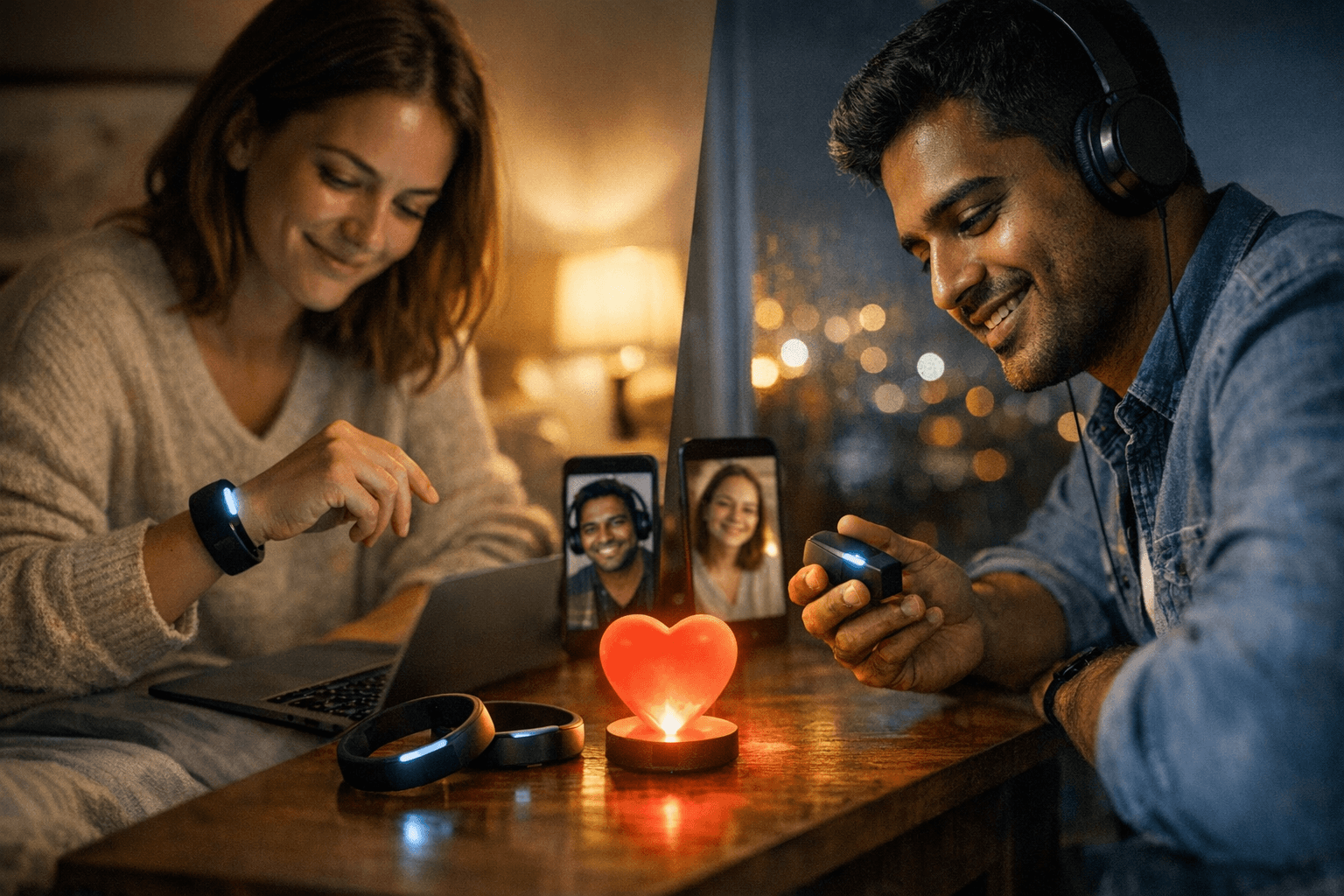
Few rituals in a long-distance relationship carry as much weight as the anniversary. Video calls cover the face, and voice carries tone, but touch, the most primal channel of intimacy, has been the hardest to replicate across miles.
Mengshi Yang's master's thesis at Aalto University offers the most rigorous academic case yet for haptic-tech gifts as meaningful anniversary presents. Yang's research combined semi-structured interviews with long-distance couples and a 338-respondent questionnaire, analyzed via PLS-SEM statistical modeling, to establish a direct, measurable link between haptic feedback and psychological well-being. The prototype Yang developed is named Onni: a smart hugging pillow that delivers both synchronous feedback (real-time and simultaneous) and asynchronous feedback (recorded touches replayed later, like a voicemail felt on the skin). The distinction between those two modes is the most useful design framework available when choosing a haptic gift.
The Bond Touch 4 is the clearest expression of synchronous haptics on the market today. At $70 per bracelet, the stainless-steel wearable pairs via app and transmits vibration patterns the moment a partner taps their wrist. Battery life runs four days on a single charge, and there is no monthly subscription; this is a one-time hardware purchase. The app does retain a record of touch exchanges, which is a privacy consideration worth reading the terms on before treating tap patterns as intimate shorthand between partners.
The Friendship Lamp by Filimin operates in a different emotional register. It is not a wearable but a Wi-Fi connected ambient lamp that glows in any of 256 programmable colors when a partner touches theirs. Sold as pre-paired sets with a 30-day return window, it maps naturally to what Yang describes as the asynchronous, keepsake-style interaction mode. For couples spanning dramatically different time zones, where real-time synchrony is impractical, the lamp is the more honest option.
Totwoo occupies a middle ground, combining Bluetooth-connected bracelets with both vibration and light signals. The brand was co-founded by Jieming Wang and Italian jewelry designer Marco Dal Maso, which shows in the aesthetic: these read as statement jewelry first and gadgets second. The Bluetooth architecture, however, limits true long-distance performance; the device excels at proximity-range notifications more than continent-spanning haptics, which is worth knowing before gifting it to someone three time zones away.
Yang's research also draws a clear line around what haptic technology cannot do. No current commercial product replicates the warmth, pressure distribution, or full emotional register of physical touch. What these devices do reliably is signal presence: the real-time knowledge that someone is thinking of you right now. For couples separated by distance, that signal can carry genuine psychological weight, and the PLS-SEM data from Yang's 338-person study supports that claim at scale.
The decision criteria that matter most rarely appear in product listings. App dependency is the biggest long-term risk: if Bond Touch or Totwoo shuts down its platform, the hardware loses its function entirely. The Friendship Lamp runs on wall power, eliminating the charging discipline both wearers in the Bond Touch pair must maintain. Return windows matter too; the Friendship Lamp's 30-day guarantee provides enough time for both partners to test the ritual before fully committing.
This category rewards couples in sustained long-distance situations who are willing to build a small daily ritual around a device and accept that the technology is a sincere approximation, not a replacement for presence. It is not the right fit for partners who are rarely apart, or anyone who objects to app permissions and behavioral data collection. The emotional return on a haptic gift is proportional to both partners' willingness to use it consistently. One-sided adoption turns a $70 bracelet into a one-way signal with nowhere to land.
This article was produced by Prism’s automated news system from verified source data, official records, and press releases, then run through automated quality and moderation checks before publishing. The system is built and supervised by the people who set the standards it runs under. Read our full AI policy.
Did this article answer your question?


%3Amax_bytes(150000)%3Astrip_icc()%2Fjackieandadam-7120280829b248d8bea28c8f9d73aabc.jpg&w=1920&q=75)