Research Shows Practical Gifts Create Stronger Bonds Than Flashy Ones
Behavioral scientists at Harvard, Stanford, and Carnegie Mellon agree: the gifts people keep are practical ones, not impressive ones.
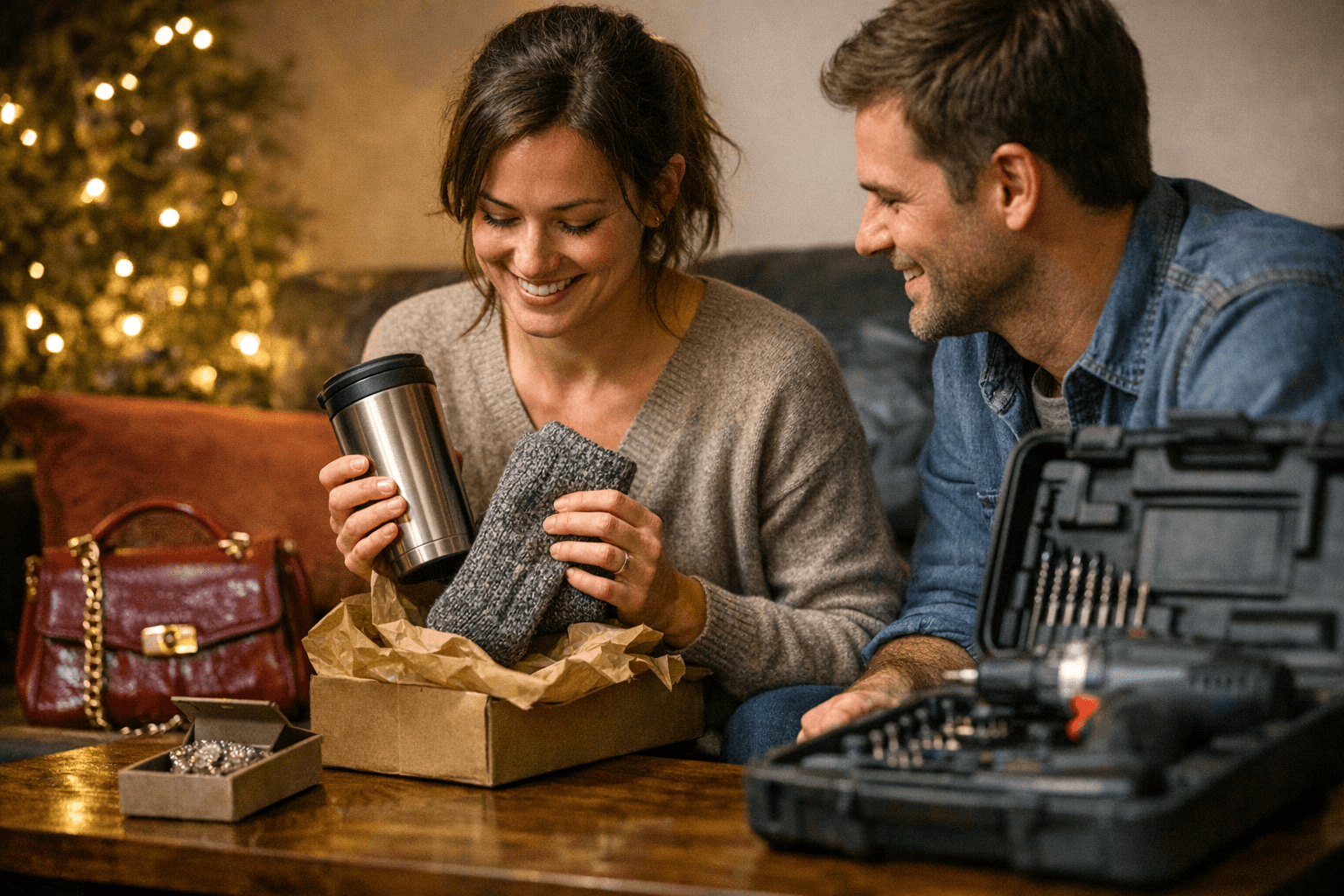
Researchers handed study participants two pens: one heavy, high-quality, and visually impressive; the other ordinary, lightweight, and easily carried anywhere. The attractive pen cost more and looked far more like a "real gift." Yet in every version of the experiment, summarized in a behavioral science primer from UC Berkeley's Greater Good Science Center, participants reported feeling closer to whoever gave them the portable, usable pen. Not fonder of the pen, but closer to the person who chose it.
That finding, replicated across multiple experiments using gifts ranging from restaurant certificates to everyday objects, distills into a single actionable principle: practicality builds bonds more durably than flash. If you have ever spent real money on something she smiled at and never touched again, the research explains exactly why.
Why givers and receivers want fundamentally different things
The root of most gifting failures is psychological distance. When you choose a gift, you imagine it in someone else's hands, which places you at an abstract remove from the object. Researchers Ernest Baskin and Nathan Novemsky of Yale, along with Cheryl J. Wakslak of USC and Yaacov Trope of NYU, found that this distance causes givers to think in abstract terms and focus on attractiveness and perceived prestige, while ignoring convenience and ease of use. "Gift givers imagine the receiver using the gift when they are choosing it," the four researchers wrote. "Since the giver is imagining the gift in another person's hands, their psychological distance from the gift will be relatively high."
The recipient, by contrast, is psychologically close to the gift from the first moment. She thinks concretely: Will I use this? Does it actually fit my life? The giver optimizes for the moment of giving. The recipient cares about the months after.
The rules most givers break
You are optimizing for the unwrapping, not the using
Carnegie Mellon's Jeff Galak and co-authors at Indiana University's Kelley School documented this asymmetry with precision. "What we found was that the giver wants to 'wow' the recipient and give a gift that can be enjoyed immediately, in the moment, while the recipient is more interested in a gift that provides value over time," Galak explained. His research showed the gap plays out predictably across product categories: givers reach for gifts designed to land well in the room, while recipients would have quietly preferred the thing they actually needed. The wow moment fades in hours. Utility compounds.
You avoid asking because you think it ruins the romance
In a 2011 study, Harvard's Francesca Gino and Stanford's Francis Flynn found that in close relationships, givers will go out of their way to avoid the obvious choice: simply asking. The desire to demonstrate deep, intuitive understanding of the recipient overrides a more effective instinct, which is to give her what she actually wants. When Gino and Flynn designed experiments in which some givers selected from a recipient's Amazon wish list while others generated their own ideas in the same price range, recipients consistently appreciated the requested gifts more. "The strange thing is that this breakdown between givers and receivers happens all the time," Flynn noted, "even though most people have been both givers and receivers often in the past."
You spend more, assuming it signals more
The Greater Good experiments showed repeatedly that recipients did not feel closer to givers who spent more. The variable that moved the needle was usability. A restaurant certificate to a modest nearby spot outperformed one to a trendy destination that required a long drive. Price was essentially irrelevant; practicality was the predictor of emotional closeness after the exchange.
You treat relationship-signaling and recipient satisfaction as the same goal
They often are not. Researchers at Yale identified two distinct motivations that drive gift selection: strengthening the bond with the recipient, and signaling the kind of thoughtful, attentive person you are. When givers prioritize the second goal, they avoid requested gifts and instead try to predict preferences, which the research shows they do poorly. Deprioritizing relationship signaling and focusing instead on what the recipient genuinely prefers produces measurably better outcomes for both the gift and the relationship.
You mistake novelty for lasting satisfaction
Gifts optimized for momentary novelty create a brief spike of excitement that dissipates quickly. Something genuinely useful becomes associated with the giver every single time it is used. That psychological link between the object and the relationship compounds quietly over months and years. The gifts that build the strongest bonds are often the ones that eventually stop feeling like gifts at all because they are so woven into daily life.
The 5-minute decision tree: before you buy anything
Work through these four questions before completing any purchase:
- Will she use this at least a few times a week? If yes, strong candidate. If no, move on.
- Has she mentioned it, hinted at it, or added it to a list? If yes, trust that signal without second-guessing it.
- Are you choosing this because it will impress her when she opens it, or because she will reach for it in six months? If the honest answer is the former, reconsider.
- Is the primary value in the experience of receiving it, or in the experience of using it? Long-term utility wins consistently.
If a gift clears all four, buy it. If it fails the first three, it is likely a gift chosen for the room, not for her.
Ready-to-copy: how to ask what she wants without killing the moment
The research is unambiguous: asking outperforms guessing. The key is how you ask. These prompts preserve the warmth of the gesture while gathering the information that makes giving actually land:
- "I want to get you something you'll love and reach for all the time. Tell me three things on your wish list, no price limit."
- "If you were going to treat yourself to something this month, what would you splurge on?"
- "Is there something you've been wanting but have kept putting off buying for yourself?"
- "If I were getting you something for [your routine / travel / your kitchen], what would make you most excited?"
- "Give me a category or a feeling you want from a gift. I'll figure out the details."
Each of these prompts does something the research recommends: it positions the recipient as the authority on her own preferences, which is where the authority actually belongs. The giver still controls the execution, the presentation, and the surprise within whatever category she names. That negotiated middle ground is where the science and the sentiment of gift-giving finally align.
The most durable gifts are the ones that show up in ordinary life long after the occasion has passed. A great gift is not the one that produces the best moment at the table; it is the one used so often she stops thinking of it as a gift at all. That is when it has done its real work.
Know something we missed? Have a correction or additional information?
Submit a Tip

