20+ College Care Package Ideas to Send from Home (Evergreen / recently updated)
Time your care packages to move-in, week two, and midterms and every item you send will actually get used — here's exactly what to send when.
You know your student, you know your budget, and you want a package that lands at the right moment rather than a pile of duplicates sitting under a lofted bed. The difference between a care package that gets texted home about and one that quietly migrates to the recycling bin is almost never what's inside. It's *when* it arrives. This guide splits the first 30 days of college into three distinct shipping windows, gives you five copy-paste formulas that different relatives can use without overlapping, and is direct about what not to waste money on.
Phase 1: Ship Before Move-In Day (Arrive in the Mailroom, Day 1)
The best move a parent can make is to have a package waiting when a student arrives on campus for the first time. Ship these 1 to 2 weeks before move-in so the mailroom has it ready. Stick to compact, immediately useful items only.
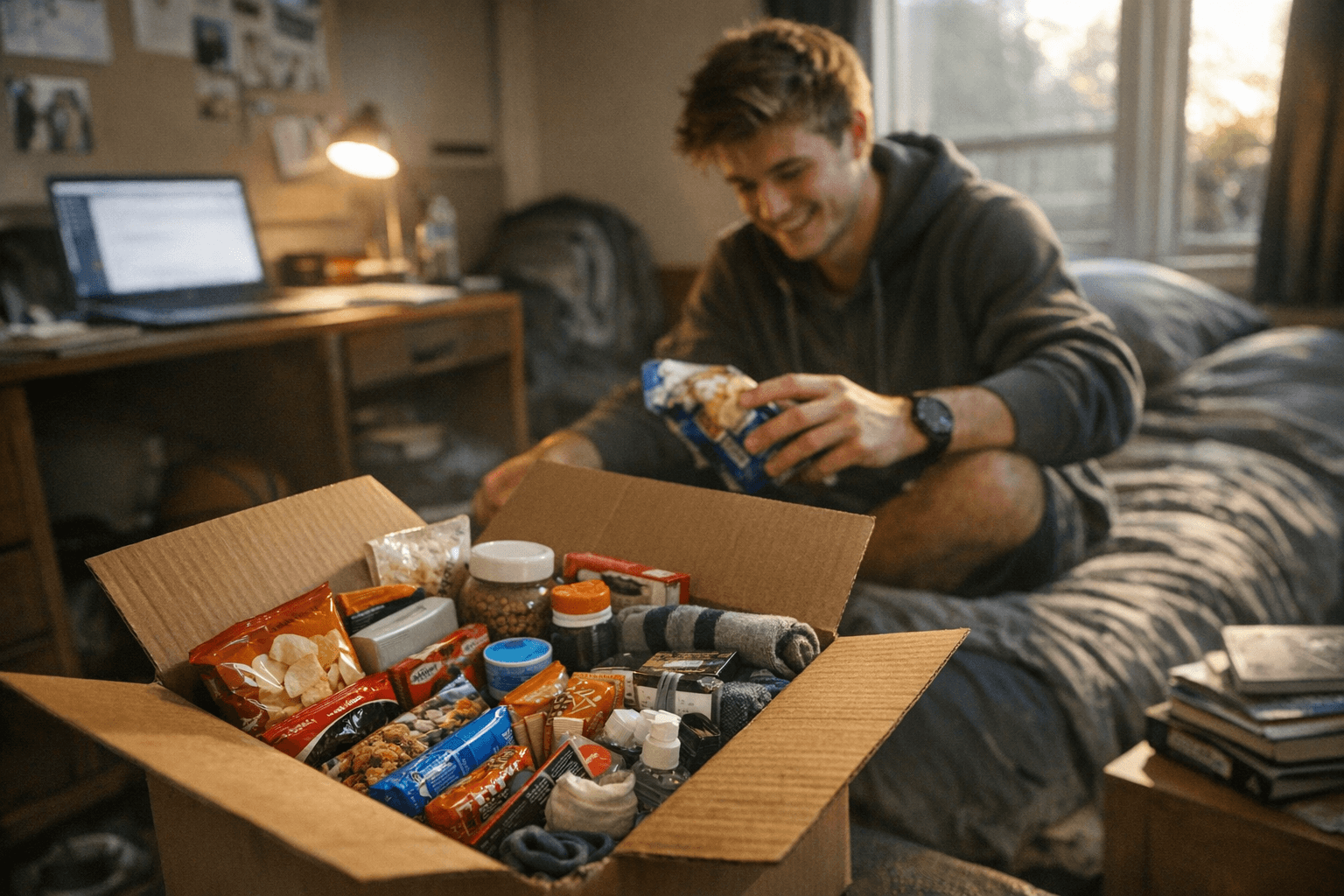
1. Snack variety assortment. A curated mix of trail mix, nuts, granola bars, and dried fruit does real work on move-in day, when dining halls are chaotic and no one has time to sit down for a meal.
Aim for a mix that skews shareable; the fastest way to break the ice with a new roommate is to have food on the desk.
2. Instant coffee packets. Blue Bottle's specialty coffee sachets, which use a cold-brew-style chicory blend, have become a standout option for dorm-friendly brewing since they require nothing but water, ice, and a preferred milk.
For students without space for a full coffee setup, these deliver a café-quality result with zero equipment.
3. Laundry detergent pods and dryer sheets. A pack of razors or a box of dryer sheets is simply one less thing a student has to spend money on, and for a broke first-year, that is a quiet relief.
Pre-portioned pods are compact for shipping and eliminate measuring errors in shared laundry rooms.
4. Over-the-counter medicine kit. First-aid basics, including band-aids, a pain reliever, cold medicine, and antacids, belong in the very first package, before anyone has figured out where the nearest pharmacy is.
Build it in a small zippered pouch so it lives in one place in the room.
5. Multi-port charging hub or cord organizer. Dorm desks are small and power strips fill up fast.
A cord organizer or a compact multi-port USB hub arrives before the tangle starts, which is exactly when it is most useful.
Phase 2: Ship After the First Weekend (Weeks 2 to 3)
By the end of the first weekend, your student has a clearer picture of what the room actually needs, what the schedule feels like, and who their hall neighbors are. This package leans cozy and social.
6. Foam earplugs. Whether a student is trying to study or sleep in their dorm, a pack of quality earplugs helps block commotion from thin walls, loud hallways, and roommates on different schedules.
The Howard Leight Max-1 foam plugs consistently hold the number-one bestseller rank in earplugs on Amazon.
7. Oil-free flat-storage popcorn maker. This is the item that quietly becomes the most-used appliance in the room.
The best dorm-compatible models require no oil and collapse flat for storage, making them genuinely practical in a 150-square-foot space.
8. Portable Bluetooth speaker. A waterproof, compact Bluetooth speaker with at least seven hours of playback works equally well for studying, pregames, and shower playlists.
Anker's Soundcore line consistently leads the number-one bestseller position in portable Bluetooth speakers on Amazon at a sub-$40 price point.
9. Door stopper. A door stopper is a small social cue: it signals to the hall that the room is open.
This is particularly useful during the first few weeks when social dynamics on the floor are still forming.
10. Air freshener or essential oil diffuser. Nearly all U.S. college dorms ban candles outright, including unlit ones, as well as incense and open-flame wax warmers such as Scentsy.
A USB-powered essential oil diffuser or a Glade plug-in handles the same job without violating housing policy.
11. Leave-in hair treatment mask. A quality leave-in treatment that repairs and strengthens hair from the inside out is one of the most-appreciated personal care items in a care package, particularly for students who suddenly have to manage their own routines.
The OGX Bonding Plex-307 range holds the number-one bestseller position in Hair Treatment Masks on Amazon.
12. Childhood photos and double-sided tape. Dorm walls are intentionally bland.
A printed set of five to ten photos from home, paired with a roll of double-sided tape or Command strips, costs under $15 and is one of the highest-impact items per dollar in any care package. A pocket photo printer loaded onto their phone extends this into an ongoing capability.
13. Fuzzy socks and a compact throw blanket. Dorm floors are cold and institutional.
A pair of thick fuzzy socks and a lightweight throw that fits over a twin XL bed provide the exact sensory comfort that makes a 12-foot-square room feel like home.
Phase 3: Save This for Midterms (Weeks 4 to 6)
Midterms hit roughly four to six weeks in. The homesickness has peaked, the workload has become real, and the student has a firm read on what they actually need. This is the highest-leverage shipping window.
14. Granola bars and chocolate-covered espresso beans. Granola bars are easy to grab and packed with energy-boosting ingredients for long study sessions, and chocolate-covered espresso beans serve as a caffeinated treat that pulls double duty as snack and stimulant.
Pack enough to share: a study group that discovers your student has a snack stash will remember it.
15. Blue light blocking glasses. Extended screen time during exam prep is a primary driver of the eye strain and sleep disruption that compounds stress during midterms.
A pair of amber-tinted blue light glasses is a $20 to $40 investment that addresses a real, recurring problem.
16. Portable charger (power bank). A student who runs out of charge during a library study session loses momentum.
A 10,000mAh power bank that fits in a jacket pocket is the most practical tech item in any midterms package, and it gets used every single week for four years.
17. Streaming service gift card. A streaming gift card, available for platforms including Netflix, Spotify, or HBO Max in amounts from $15 to $100, provides guilt-free entertainment decompression without touching a student's budget.
It doubles as a social tool when the room becomes a movie night destination.
18. Starbucks gift card. A Starbucks gift card is the single most universally understood "I know you're burning yourself out and I see you" gesture a parent can make.
Load it with $25 to $50 to cover a study week's worth of all-nighters without requiring a second thought.
19. Gratitude journal or stress-relief notebook. A physical journal for reflection and emotional processing supports the kind of slow decompression that a phone cannot replicate.
Look for a softcover format small enough to fit in a backpack, not a hardbound desk piece.
20. Compact wellness kit: resistance bands, herbal tea, and a vitamin pack. A small resistance band set, a sampler of calming teas (chamomile, ashwagandha blends), and a daily vitamin packet addresses physical, sleep, and nutritional needs without requiring gym access or extra time.
This is the package a student opens at 11 p.m. after a rough week and actually uses.
What NOT to Send (The Skip List)
Knowing what to leave out saves money and prevents mailroom drama. Avoid these categories entirely:
Open-coil appliances, including hot plates, toasters, toaster ovens, George Foreman grills, Instant Pots, and pressure cookers, are banned at virtually every U.S. college dorm on fire safety grounds. Sending one risks confiscation, a housing fine, and the awkward conversation that follows. Candles, including unlit candles, are equally prohibited at most schools, along with incense and open-flame wax warmers.
Skip anything the student already packed. Before Phase 2 ships, send a quick text asking what ran out and what they wish they had. Duplicate items waste money and crowd a small room. Avoid oversized boxes that won't fit in a standard mail cubby; packages requiring a special pickup slip add friction and sit uncollected for days. Perishables without commercial packaging, including homemade baked goods in warm weather, arrive as a science experiment rather than a treat.
5 Care Package Formulas (Copy and Share with Relatives)
These five formulas are designed so that multiple people can send packages without any overlap.
Formula 1: The Parent Anchor Package (Phase 1). Snack assortment + laundry pods and dryer sheets + OTC medicine kit. Under $40 shipped. Covers the practical survival layer before the student finds their footing.
Formula 2: The Caffeine and Focus Kit (Grandparent-Friendly). Instant coffee sachets + granola bars + Starbucks gift card ($25). All shelf-stable, easy to ship flat, and every item gets used immediately.
Formula 3: The Cozy Night In (Aunt or Uncle). Fuzzy socks + oil-free popcorn maker + streaming gift card. This is the "settle in and exhale" package, best sent after the first weekend when the student's schedule is set.
Formula 4: The Tech Survival Bundle (Sibling or Cousin). Cord organizer + portable charger + blue light glasses. Tech-forward, compact, ships in a small flat-rate box, and skews toward what a younger relative actually understands a student needs.
Formula 5: The Midterms Self-Care Drop (Family Friend or Godparent). Leave-in hair treatment + essential oil diffuser + gratitude journal + herbal tea sampler. The most personal formula in the set, best received around weeks four to six when the novelty of college has worn off and the grind has set in. It says, without using the words, that someone at home is paying attention.
The students who report feeling most supported during the first semester are rarely the ones with the most expensive packages waiting in the mailroom. They're the ones whose families understood that a $15 snack box on move-in day and a $30 care package timed to midterms does more than a $150 box sent once with no plan. Timing, intention, and a little coordination between family members is the actual gift.
Know something we missed? Have a correction or additional information?
Submit a Tip