Graduation Gift Spending Trends Reveal Eight Years of Retail Shifts
Graduation spending averaged $116.97 in 2024, rising steadily for eight years even as fewer adults are celebrating and gift counts per ceremony fall.
Graduation gift spending has climbed steadily for eight years even as fewer adults report celebrating the occasion, according to research from the Northwestern Medill Spiegel Research Center. The average planned spending reached $116.97 in 2024, growing at an average annual rate of $2.17, or 1.94%, across the 2017-to-2024 period. The counterintuitive pattern, more money per celebration but fewer celebrations overall, points to a market that is concentrating rather than expanding.
Only 33.6% of adults report celebrating graduation at all. Among those who do, the majority are marking a single graduate's milestone: 18.0% report one graduate, 8.2% report two, and 7.4% report three or more. Participation has shown a small decrease over the eight-year span, with an average annual growth rate of -0.72%, and the drop from 2023 to 2024 was somewhat sharper than the long-term trend.
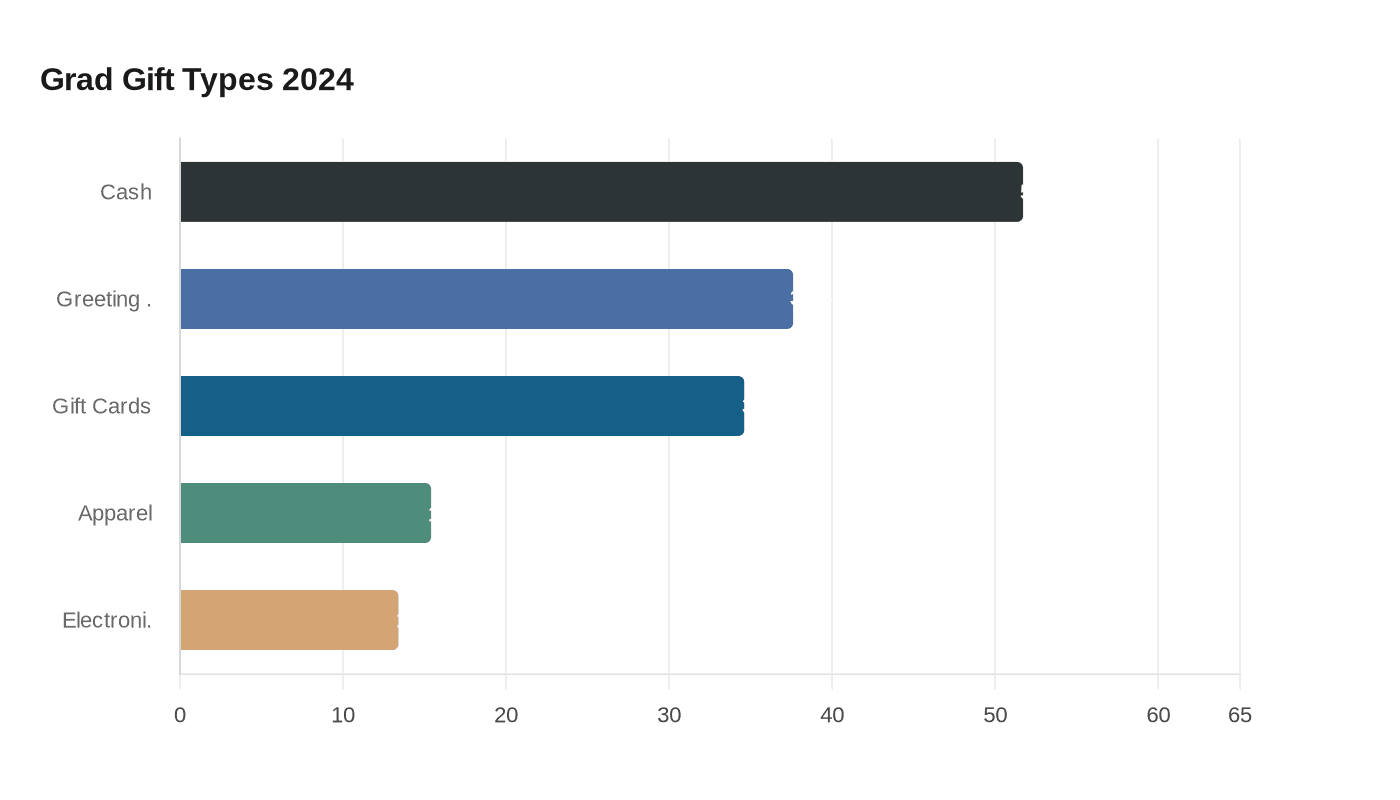
Cash remains the dominant gift choice by a wide margin, with 51.7% of graduation celebrants planning to give it in 2024. Greeting cards followed at 37.6% and gift cards at 34.6%, the only category to show meaningful year-over-year growth, up 4.08 points. Apparel and electronics, despite posting positive long-run growth rates over the eight years, both fell sharply from 2023 levels; apparel dropped 14.30 points to 15.4% and electronics fell 9.62 points to 13.4%.
Those contrasting trajectories for apparel and electronics are worth noting. Both categories gained ground across most of the 2017-2024 window before reversing hard in the most recent year. Whether that reversal reflects post-pandemic budget recalibration, shifting graduate preferences, or broader retail headwinds is a question the data alone cannot answer.
The research also identifies who is most likely to participate in graduation spending. Key predictors include the presence of children in the household, age, marital status, and income, a profile that suggests graduation gifting remains concentrated among parents and family members in specific demographic bands rather than distributed evenly across the adult population.
Memorial Day retail patterns run in a different direction: participation in Memorial Day sales has slightly increased over the same period, even as graduation celebrations edged lower. The divergence suggests that seasonal retail windows are not rising or falling in unison, and that graduation spending's steady dollar growth is being carried by a shrinking pool of more committed celebrants spending more per occasion.
This article was produced by Prism’s automated news system from verified source data, official records, and press releases, then run through automated quality and moderation checks before publishing. The system is built and supervised by the people who set the standards it runs under. Read our full AI policy.
Did this article answer your question?