Easter Gifts That Honor Indigenous Art, Culture, and Spring Renewal
Nearly 30% of Native American household income is lost to a national wage gap that authentic art purchases can help close — here's how to give Easter gifts that actually matter.
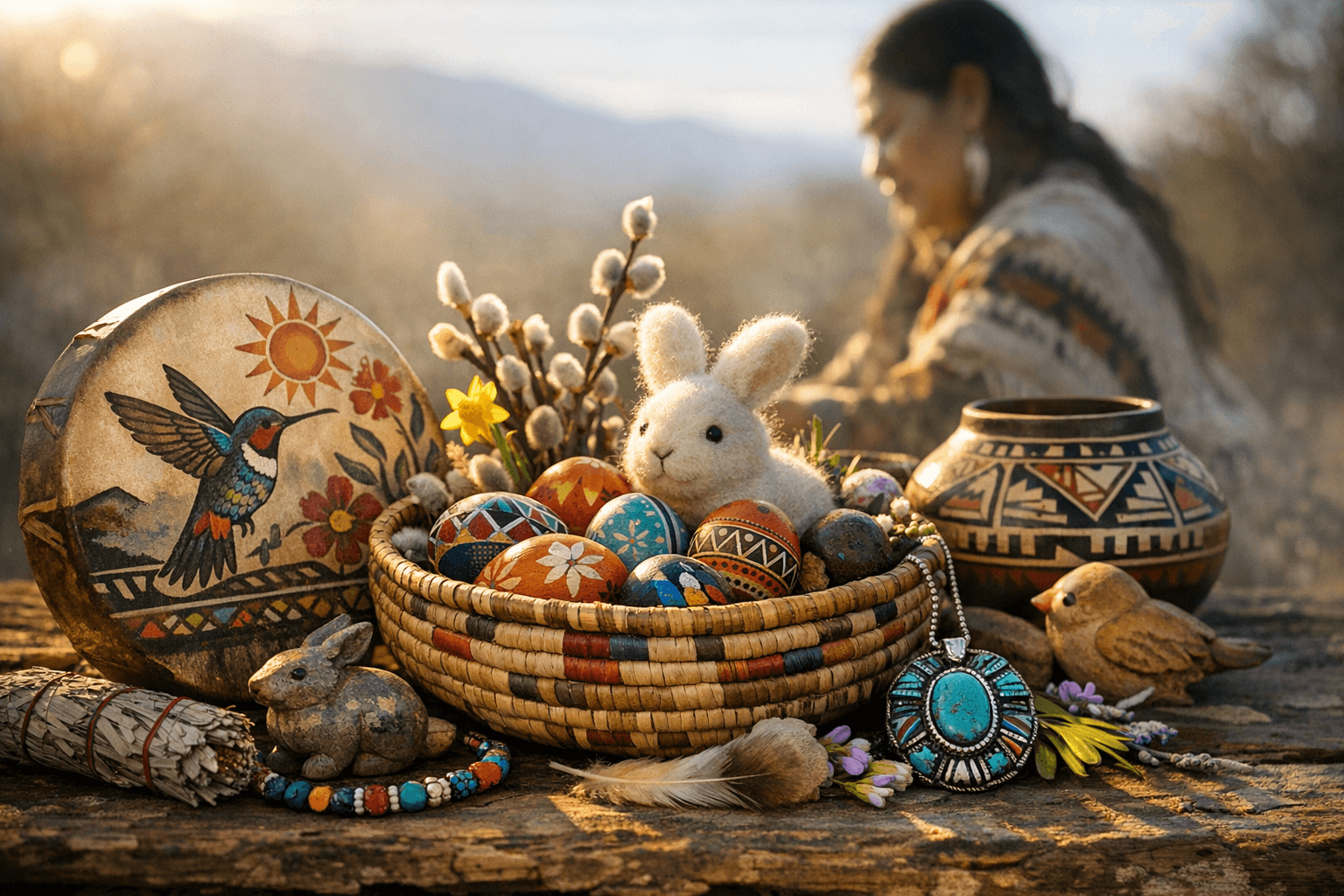
The tag says "Southwestern style." The packaging shows a stylized thunderbird. The price is suspiciously low. And somewhere, a Navajo silversmith — whose family has worked turquoise and sterling since the mid-nineteenth century — just lost a sale to an import that has no right to carry her tradition's name.
Spring gifting, for all its good intentions, is riddled with this problem. Easter baskets full of "Native-inspired" trinkets are easy to assemble and easy to get wrong. This guide is about getting it right: understanding the legal and moral weight behind the phrase "authentically made," learning what categories of Indigenous art connect most meaningfully to spring's themes of renewal, and knowing exactly how to verify what you are buying before money changes hands.
Why Spring and Indigenous Art Make Meaningful Partners
Easter's symbolism of renewal and rebirth is not unique to the Christian calendar. Across Native nations, spring is marked by ceremonial practices tied to the renewal of the earth, planting cycles, and community. The Hopi and other Pueblo peoples of the Southwest hold spring kachina ceremonies rooted in agricultural renewal, a tradition that has shaped the aesthetic vocabulary of the pottery, jewelry, and textile art produced in those communities for centuries. Gifting Indigenous art at this time of year is not an aesthetic coincidence; it is a seasonal alignment between two distinct but resonant traditions of honoring what spring means.
The Federal Law You Didn't Know Applied to Easter Shopping
Before you browse, know this: the Indian Arts and Crafts Act of 1990 (IACA, P.L. 101-644) is a federal truth-in-advertising law that makes it illegal to market art or craft products in a way that falsely suggests they were made by a Native American. Enforcement falls to the Indian Arts and Crafts Board (IACB), a division of the U.S. Department of the Interior. The penalties are not symbolic: a first-time individual violation can result in civil or criminal penalties of up to a $250,000 fine, a five-year prison term, or both. A business that violates the IACA can be fined up to $1,000,000.
The law also requires specificity. It is not enough to label something "Native American made" in a general sense; a product cannot legally carry a tribe's name unless it was made by an enrolled member or certified artisan of that tribe. Calling a piece "Navajo-style" to sidestep this is still a violation if the intent is to mislead. Yet according to legal analysis from the Center for Art Law, fake Native American artwork remains "a major problem, both on an economic basis and on a moral basis" as it erodes cultural protection for living Indigenous artists and their communities. The law is clear. Enforcement, however, depends significantly on informed shoppers.
The Economic Stakes Are Personal
Here is the share-worthy number: Native American households earned an average of approximately $37,000 in 2014, roughly 30% below the national average of $53,000 at that time. The Bureau of Indian Affairs identifies art sales as one of the most direct pathways to economic self-sufficiency for American Indian and Alaska Native communities. Every dollar spent on an authentic piece goes to a specific artist with a tribal affiliation, a family, and a tradition worth sustaining. Every dollar spent on a counterfeit goes somewhere else entirely.
The Santa Fe Indian Market, presented by the Southwestern Association for Indian Arts (SWAIA), is now in its 104th year and brings together over 1,000 Native artists representing more than 200 Tribal Nations from across the U.S. and Canada. Tailinh Agoyo, co-founder and former marketing director of the market, has long argued that shopper education is the essential lever for building real appreciation of Native American art. That education starts with knowing what to buy and from whom.
Silver and Turquoise Jewelry: The Navajo Cross and Beyond
Few gifts carry more layered meaning than a piece of Navajo silverwork. The Navajo learned silversmithing from the Spanish and Pueblo peoples in the mid-to-late nineteenth century, becoming the first Native nation to adopt European silversmithing methods. They then combined silver with turquoise, a stone mined by Southwestern Native peoples for hundreds of years, whose color spectrum of blue, green, black, and white represents elements of the natural world. The Navajo, Hopi, and Zuni nations each developed distinct silversmithing traditions that are still alive and producing today.
Navajo cross pendants are a particularly resonant Easter gift because they carry the literal overlay of Spanish colonial history onto Indigenous metalworking craft: the cross as a missionary-era import, reinterpreted and owned by Navajo hands. These pieces are story-bearing objects in the most precise sense. Authentic pendants from enrolled Navajo artists typically start in the $60-$150 range for simpler pieces; larger statement pendants and squash blossom necklaces by named artists can run considerably higher. Retailers like the Indian Pueblo Store in Albuquerque (certified by the 19 Pueblos of New Mexico) and Garland's in Sedona, Arizona, which works directly with Navajo and Hopi artists, are reliable starting points.
Seed Beadwork: Small Pieces, Deep Craft
Seed beadwork represents some of the most time-intensive and culturally specific art made by Indigenous artists today. Beverly Bear King Moran, a Hunkpapa Lakota beadwork artist enrolled at the Standing Rock Sioux Tribe, creates traditional buckskin dance outfits and beaded pieces in Lakota patterns and styling. She won Best of Show at the Autry Museum of the American West in 2016 and Best of Classification at the Heard Museum Indian Fair and Market in 2018. Her work, she has described, reflects, preserves, and enriches the cultural identity and spiritual heritage of the Lakota people. Earrings, small pouches, and beaded pendants by artists of this caliber make Easter gifts that will outlast any basket of chocolates. Beaded earrings by verified Native artists typically start around $45-$80; elaborate traditional pieces are priced accordingly for the labor involved.
Handcrafted Pottery: The Gift That Holds Something
Pueblo pottery is among the most immediately recognizable categories of Indigenous art, and among the most imitated. Acoma Pueblo in New Mexico is renowned for its fine-walled, intricate geometric painting; San Ildefonso for its black-on-black pottery tradition developed by potters like Maria Martinez; Santa Clara Pueblo for its carved blackware. Each tradition uses hand-coiling techniques and natural mineral paints, practices passed through generations that no factory process can replicate. Small decorative vessels from living Pueblo potters are available through certified outlets starting around $50-$80, with larger, signed works climbing significantly from there. Pottery carries a particular resonance for spring gifting: these are vessels, objects made to hold and protect, which is exactly what renewal requires.
Handwoven Baskets: The Oldest Art Form in the Room
Basketry predates pottery across most of North America, and it remains one of the most vital and technically demanding art forms in Indigenous communities today. Native American weavers use three primary techniques: coiling, plaiting, and twining. Because every basket is handmade, each weaver's work carries unique attributes in its construction and pattern. Baskets have served both practical purposes, gathering, storing, and carrying food, and ceremonial ones: as symbols of identity, status, and spiritual connection. One caution worth passing on to buyers: beginning in the late nineteenth century, outside commercial tastes began influencing basket design as weavers adapted for tourist markets. When seeking traditionally rooted pieces, provenance research and maker attribution matter as much as they do for jewelry or pottery.
Your Verification Checklist Before You Buy
The IACB maintains a directory of certified Indian artisans and tribal arts-and-crafts businesses through the U.S. Department of the Interior. Use it. Beyond that, apply these checks before purchasing any piece marketed as Native American-made:
- Ask whether the artist is an enrolled member or certified artisan of a federally or state-recognized tribe; this is the legal standard under the IACA.
- Prefer direct-from-artist purchasing at vetted markets like the Santa Fe Indian Market (August 15-16, 2026), or through verified artist websites with clear tribal attribution.
- Treat labels reading "Native-inspired," "Southwestern style," or "Indian-style" as red flags; these phrases are not legally equivalent to work made by a Native artist.
- Be skeptical of mass-produced silver and turquoise jewelry at low price points; overseas imports mimicking Navajo styles are not authentic Native American work, and their sale may violate the IACA if misrepresented.
- Ask the seller or artist to share the story behind the piece; in many Native traditions, objects carry embedded meaning in their symbols and patterns, and a knowledgeable seller will be able to speak to it. A seller who cannot is a useful signal.
The best Easter gift is one that carries weight: cultural weight, historical weight, and the weight of a specific person's hands and tradition. That is not a sentiment — it is a purchasing standard, and federal law agrees with it.
This article was produced by Prism’s automated news system from verified source data, official records, and press releases, then run through automated quality and moderation checks before publishing. The system is built and supervised by the people who set the standards it runs under. Read our full AI policy.
Did this article answer your question?


