Fresh Flowers and Potted Plants Make Meaningful Easter and Passover Gifts
Spring's most meaningful gifts grow roots: potted Easter lilies and Passover blooms that can be planted in your garden long after the holiday has passed.
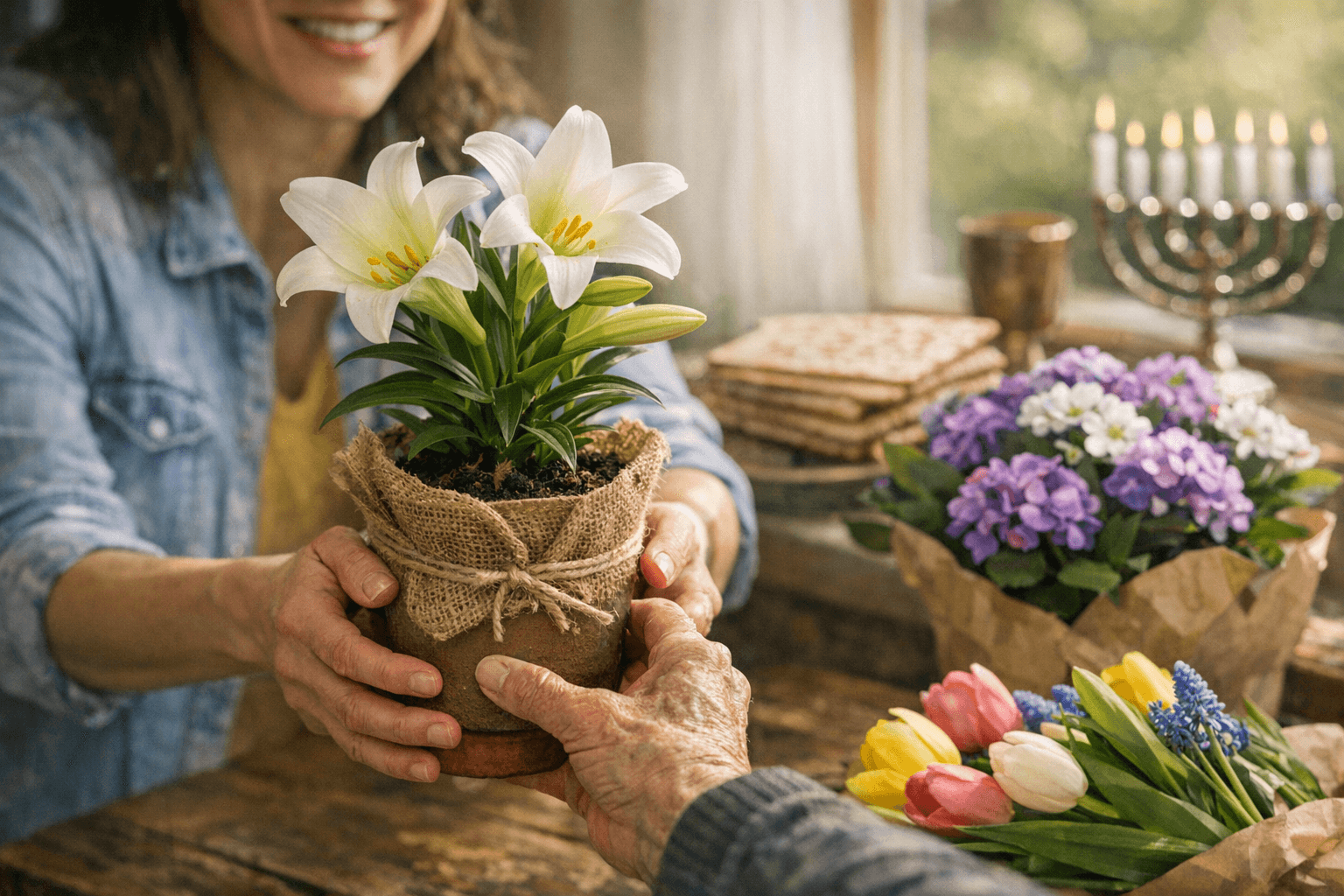
There is something quietly radical about giving a living plant as a gift. Cut flowers last a week; a potted Easter lily, tended properly and moved to the garden after it blooms, can return to greet you every spring for years. That is the logic behind the oldest and most reliable spring holiday gifting tradition: flowers and potted plants for Easter and Passover, two holidays whose themes of renewal, liberation, and new life map almost perfectly onto the season itself.
The Easter Lily's Unlikely American Story
The flower most synonymous with Easter, *Lilium longiflorum*, is not originally American at all. The species is native to Taiwan and Japan's Ryukyu Islands, and the story of how it became the dominant Easter flower in the United States begins with a World War I soldier named Louis Houghton. In 1919, Houghton returned from Bermuda to the southern Oregon coast carrying a suitcase full of hybrid lily bulbs, which he freely distributed to neighbors and friends. The flowers found ideal conditions along the border of northwestern California and southwestern Oregon, in a climate of mild temperatures, deep alluvial soils, and abundant rainfall that produces consistently high-quality bulbs.
The Harbor-Brookings bench of Southwest Curry County, Oregon and the Smith River area of Northwest Del Norte County, California, is now known as the Easter Lily Capital of the World. It is credited with arriving on American soil in the suitcase of a World War I soldier named Louis Houghton upon his return to Oregon from Bermuda in 1919. The Easter lily's dominance in the American market was cemented by a darker chapter: following the events of Pearl Harbor, the Japanese Easter lily supply dried up, creating domestic demand that caused the crop's value to surge, and it became known as "white gold" on the West Coast. By the war's close in 1945, upward of 1,000 farmers had started cultivating the flower. Today, nearly all Easter lily bulbs used in North America are grown in that small stretch of coastal California and Oregon.
What the White Lily Actually Means
The Easter lily carries layered symbolism that makes it genuinely appropriate as a gift, not just a pretty gesture. The white lily symbolizes purity, rebirth, new beginnings, and hope and is most often associated with the resurrection of Jesus Christ as observed on Easter. The trumpet-shaped white blooms have been referenced in Christian tradition for centuries, and their presence in churches during Easter services is so common that the flowers are essentially inseparable from the holiday in American culture.
In Pagan traditions, the Easter lily is associated with motherhood and is often gifted to mothers as a symbol of gratitude. That dual meaning, religious for some and maternal for others, makes it one of the more versatile spring gifts on the market. If you are shopping for a mom who gardens, a potted lily is a genuinely thoughtful choice with a longer payoff than almost any other option in this price range.
The Right Flowers for a Passover Table
Passover and flowers are a natural pairing that is often underappreciated outside Jewish communities. A well-designed Passover floral centerpiece serves not only as decoration but also as a symbol of spring and renewal, mirroring the themes of liberation and new beginnings inherent in Passover. Many families incorporate white lilies, roses, and spring greens to reflect the themes of purity, hope, and rebirth.
The best Passover flowers include tulips, lilies, roses, daisies, and other spring flowers, chosen for their beauty and floral symbolism. Many prefer white flowers for their elegance or blue flowers, which represent Jewish heritage. If you are heading to a Seder as a guest, flowers are a welcome and appropriate hostess gift. A pre-arranged bouquet is the better choice, so your host does not need to find a vase or arrange blooms during the holiday. Delivery is a great option, especially if you would like the flowers to arrive before sunset, in keeping with traditional observances, particularly in Orthodox or Conservative homes.
Potted Plants That Keep Giving
The strongest argument for a potted lily over a cut arrangement is longevity. Easter lilies bloom for two to three weeks indoors, and after flowering, they can be transplanted outdoors so you can enjoy them again. Easter lilies are perennial bulbs in USDA Zones 5-8. When planted outside in the right conditions, they can return and bloom again each year. For the gardening-inclined recipient, that is a remarkable value proposition: one holiday gift becomes a permanent addition to the garden.
Once all danger of frost has passed, transplant the lily outdoors in a sunny to partly shaded location. The bulb goes in pointed end up, and a layer of mulch added in late fall helps protect it through winter temperature swings. Easter lily bulbs also produce small bulblets underground that can be divided and replanted in the fall, though new bulbs typically take two to three years to grow large enough to bloom.
One Caution Worth Mentioning
Before giving an Easter lily to any household with cats, reconsider. All parts of Easter lilies are extremely toxic to cats. Even small amounts of pollen or leaves can cause severe kidney failure, and cats that may have ingested lilies should receive immediate veterinary care. For pet-owning friends, a bouquet of tulips or roses makes a safer alternative that still carries the spirit of the season.
The real gift, whether it is an Easter lily from Smith River or a vase of white roses for a Passover Seder, is the thought behind the gesture: spring is here, and you are worth celebrating.
This article was produced by Prism’s automated news system from verified source data, official records, and press releases, then run through automated quality and moderation checks before publishing. The system is built and supervised by the people who set the standards it runs under. Read our full AI policy.
Did this article answer your question?


