Spring Equinox Gifts and Traditions to Celebrate the Season's Renewal
Roughly 300 million people will mark the spring equinox as a new year — here's how to honor the season with gifts and traditions rooted in 3,000 years of human celebration.
Every civilization in recorded history has found a reason to celebrate the moment when day and night stand in perfect balance. On March 20, 2026, that balance arrived, marking the official start of spring in the Northern Hemisphere — a cosmic turning point that has shaped human civilization, inspired ancient monuments, sparked cultural festivals, and renewed a sense of hope for thousands of years. The gifts and traditions tied to this day echo that meaning: growth, renewal, and the deliberate act of beginning again.
The Astronomy Behind the Feeling
The word "equinox" comes from the Latin *aequinoctium*, meaning "equality between day and night." The spring equinox moment on March 20, 2026, occurred at 10:46 AM EDT. What makes this day feel different from any other isn't mysticism; it's biology. Many plants are controlled by photoperiodism, with growth and flowering responses triggered by day length. After March 20, the Northern Hemisphere experiences progressively longer days, and for long-day plants, this post-equinox period triggers floral development. The world is literally switching on. Because Earth's orbit is elliptical rather than perfectly circular, the four seasons are not the same length: spring lasts approximately 92.75 days, while winter is the shortest season at about 88.99 days. That feeling of spring arriving faster than winter ended is astronomically accurate.
Nowruz: The Persian New Year and the Oldest Celebration
In Iran and across Central Asia, the equinox marks Nowruz, the Persian New Year, a festival with Zoroastrian roots stretching back over 3,000 years, celebrated today by roughly 300 million people across dozens of countries. That figure alone makes it one of the most widely observed cultural events on the planet. Recognized by UNESCO as an Intangible Cultural Heritage of Humanity, Nowruz begins at the exact moment of the vernal equinox.
Preparations begin weeks in advance with spring cleaning called *khaneh tekani*, or "shaking the house," the sprouting of wheat or lentil seedlings called *sabzeh*, and the setting of the Haft-Seen table: a ceremonial display of seven items beginning with the Persian letter "seen," each symbolizing a different hope for the new year. Those seven items include apples for beauty, garlic for health, vinegar for patience, hyacinth for spring, sweet pudding for fertility, and sprouted wheat representing rebirth. On the day itself, families gather, exchange gifts, and visit elders. The celebrations continue for 13 days, culminating in Sizdah Bedar, a day spent outdoors in nature.
In 2026, the resonance of Nowruz ran even deeper. Nowruz coincided with the vernal equinox and the International Day of Happiness, designated March 20 by the United Nations in 2012 — a rare triple convergence that generated significant global interest.
Ostara: The Germanic Goddess of Dawn and Spring
Among Pagans, Witches, Heathens, and other polytheists, the spring equinox is celebrated under various names, including Ostara, Alban Eiler, and other regional or tradition-specific observances. The name has deep roots. Ostara comes from Eostre, an Anglo-Saxon goddess of spring and dawn whose association with fertility, renewal, rabbits, and eggs predates Christianity by centuries. The Venerable Bede, writing in the 8th century, noted that the month of April was named *Eosturmonath* in honor of the goddess, and that feasts were held in her name during the spring season.
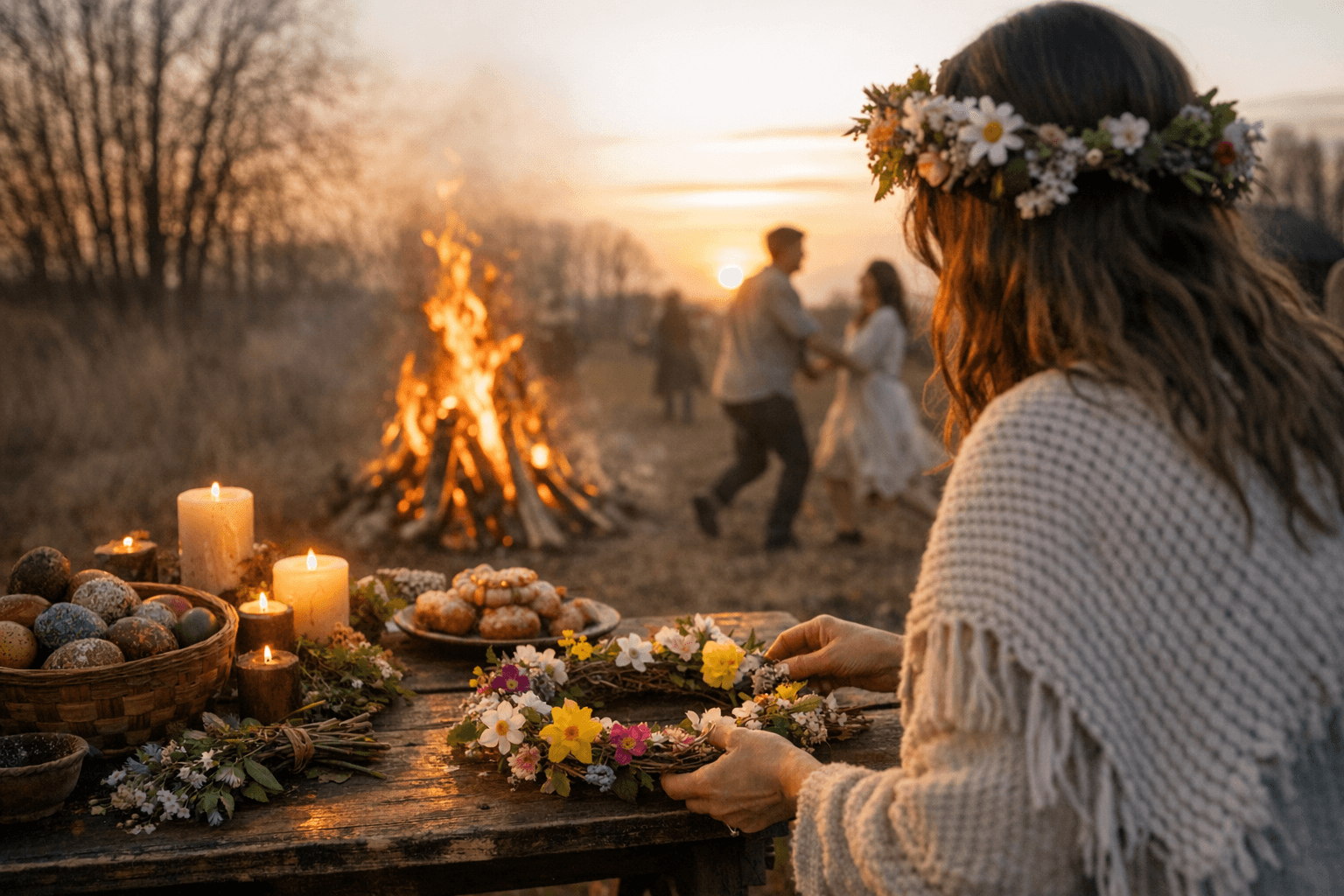
Ostara is notable as the etymological source for both the word "Easter" and, through the Old English *Eosturmonath*, the month of April in some linguistic traditions. In Pagan and Wiccan traditions, Ostara is one of the eight Sabbats on the Wheel of the Year, with celebrations including planting seeds both literally and metaphorically, decorating eggs, honoring the balance of light and dark, and setting intentions for the season ahead.
Eggs are a universal symbol of fertility and new life, and painting or decorating eggs is a traditional way to honor Ostara. The connection between rabbits, eggs, and spring fertility also appears in European folklore surrounding the Ostara rabbit. These symbols weren't invented for Instagram aesthetics; they're among the oldest recurring motifs in human seasonal expression.
Mesoamerican Monuments: Architecture as Equinox Calendar
No discussion of equinox traditions is complete without the stone engineering of ancient Mesoamerica. The most famous equinox phenomenon takes place at the Temple of Kukulcán (El Castillo) within the Chichén Itzá archaeological complex in Yucatán. Maya architects designed the pyramid with such geometric precision that a deliberate manipulation of sunlight occurs during the sunset of the equinox: the shadows cast by the structure's corners onto the northern staircase create a visual illusion of a feathered serpent (Kukulcán) slithering down to the massive stone head at the base.
El Castillo supports a two-story temple standing 79 feet tall with a total of 365 steps, reflecting the Maya's deep astronomical knowledge. The ancient Maya were sophisticated astronomers who built the equinox illusion directly into the architecture. The serpent effect isn't accidental decoration; it is the building's entire purpose, and Chichén Itzá is a UNESCO World Heritage site consistently ranked as Mexico's most-visited archaeological site, drawing more than 2 million people annually.
Further north, the reconstructed Cahokia Woodhenge, a large timber circle located at the Mississippian culture Cahokia archaeological site near Collinsville, Illinois, is the site of annual equinox and solstice sunrise observances. Across cultures and continents, human beings built their calendars into stone and wood, encoding the equinox as a fixed point around which life would organize itself.
How Cultures Celebrate Around the World
The breadth of equinox tradition is extraordinary. In Japan, Vernal Equinox Day is an official national holiday, and is spent visiting family graves and holding family reunions. Higan is a Buddhist observance exclusively celebrated by Japanese sects during both the spring and autumnal equinox. It is a week-long observance dedicated to honoring ancestors, visiting graves, and reflecting on the balance between this world and the "other shore."
In India, Holi is the March equinox festival, celebrated in honor of various Hindu deities and legends. It signals the triumph of good over evil, the most notable being the legend of Krishna and Radha. Every culture that celebrates the spring equinox includes some form of ritual cleansing: the *khaneh tekani* of Nowruz, the Christian Lenten tradition of simplification, and the very Western secular tradition of spring cleaning. The urge to clear out what winter left behind is not cultural coincidence; it is a shared human reflex.
Equinox Celebration Ideas at Home
You don't need a 79-foot pyramid or a ceremonial table to mark the occasion meaningfully. Traditionally, spring vegetables such as asparagus, peas, and fiddleheads are served alongside fresh herbs and light meats like lamb, while breads and cakes made with eggs and honey are popular choices for a seasonal feast. In Iran, Nowruz feasts feature dishes like *sabzi polo mahi* (herbed rice with fish), each carrying symbolic meaning.
Rituals of intention-setting draw from multiple traditions simultaneously. Writing down three intentions to nurture over the coming months, whether related to personal growth, relationships, creativity, or emotional healing, and placing them beneath a small plant or candle, connects the act of planting to the season's deeper symbolism. As the season progresses, revisiting those intentions and watching how they begin to take root is itself a form of seasonal practice.
Terracotta pot painting is a grounding, tactile activity: set up a table with ceramic or terracotta pots, acrylic paints, and brushes, then fill the finished pots with soil and herb starters. Basil, mint, or small flowers work especially well.
The Equinox Gift Guide
Gifts tied to the spring equinox should echo what the season is actually about: growth, nourishment, and potential waiting to emerge. Zazzle notes that spring-themed, low-effort gifts are among the most resonant ways to mark renewal, with potted herbs ranking as a standout option. The reasoning is sound. A living herb plant, unlike a candle or a card, requires tending. It keeps asking to be noticed. Basil, rosemary, and mint are practical enough to earn kitchen counter real estate while carrying genuine symbolic weight for the season.
Seed packets are meaningful, budget-friendly gifts that keep on growing. Whether giving sunflowers for joy, herbs for practicality, or forget-me-nots for remembrance, there is a seed for every occasion, and pairing seeds with a beautiful planter adds an extra layer of intention. The practice of planting seeds on the spring equinox as a symbolic act appears in Ostara tradition, in Nowruz where *sabzeh* (sprouted wheat) is grown weeks before the equinox for the Haft-Seen table, and in modern wellness culture alike.
For something more curated, consider these spring equinox gift ideas rooted in seasonal tradition:
- A potted herb kit with basil, mint, and thyme: practical, fragrant, and directly tied to Nowruz's tradition of living greenery on the Haft-Seen table
- Heirloom seed packets paired with a terracotta pot: an invitation to grow something from scratch, carrying the same symbolic weight as planting ceremonies across Indigenous, Persian, and Pagan traditions
- A seasonal feast basket with honey, dried herbs, olive oil, and spring teas: food as ritual, echoing equinox celebrations from Iran to Japan
- A gardening journal: designed to track planting dates, weather conditions, and harvest results, with sections for sketching garden layouts or recording new ideas, it is a creative and thoughtful gift for anyone who wants to plan and reflect on what they are growing
- Spring flowers such as daffodils, tulips, or hyacinths: spring flowers like these represent the return of vibrant colors and life, and hyacinth in particular appears directly on the Nowruz Haft-Seen table as a symbol of spring itself
The best equinox gift doesn't arrive wrapped in a seasonal trend; it carries something of the season inside it. Three thousand years of Nowruz celebrations, Ostara rites, Mayan architectural genius, and Japanese ancestral respect all converge on the same basic truth: the equinox is a threshold, and what you bring to it matters.
This article was produced by Prism’s automated news system from verified source data, official records, and press releases, then run through automated quality and moderation checks before publishing. The system is built and supervised by the people who set the standards it runs under. Read our full AI policy.
Did this article answer your question?


