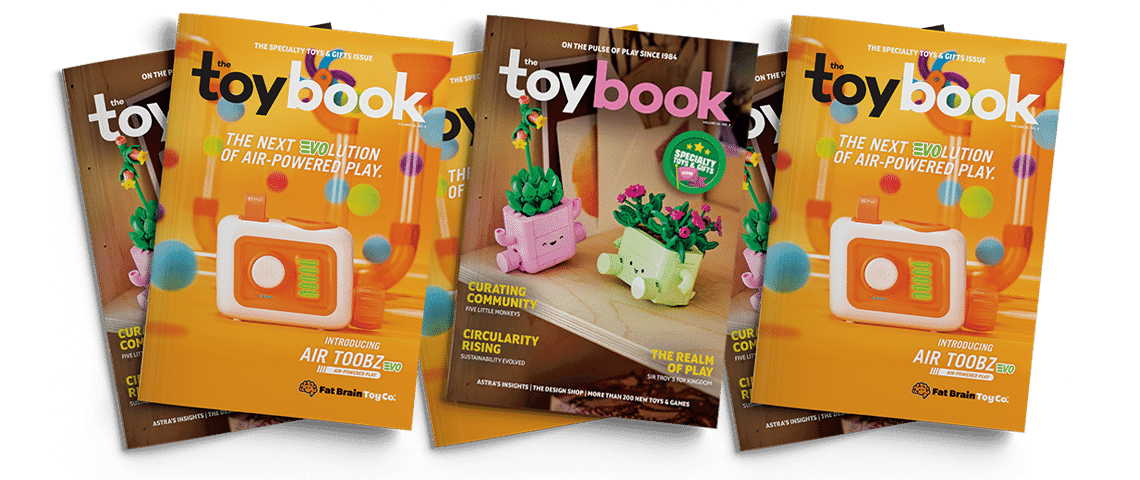
The Toy Book spotlights 200+ new toys and gifts for specialty retailers
The Toy Book’s specialty issue is a roadmap for smart holiday buying, with 200-plus new toys, hands-on play, and indie-retail bets that feel fresh.
1. Building and construction toys.
This is the kind of hands-on category that gives specialty retailers something customers can test, tinker with, and remember.
2. Adult-focused play.
The issue treats grown-up buyers as real toy customers, which is exactly where specialty stores can look sharper than mass-market guides.
3. Dolls.
Dolls stay giftable because they are easy to understand at a glance and still feel personal on the shelf.
4. Plush.
Plush remains the easy yes of specialty retail, soft, display-friendly, and hard to walk past.
5. Games.
Games matter here because they sell through demonstration and story, not just packaging.
6. Independent toy stores.
The issue is built for the buyers who need curation more than volume.
7. Hobby shops.
These stores need products with enough depth to reward repeat browsing, not just one-and-done novelty.
8. Card shops.
The line between collectible culture and giftable play keeps narrowing, and this issue leans into that overlap.
9. Comic shops.
Pop-culture retail still thrives on items that feel niche, not generic.
10. Game stores.
These buyers want products that can be explained fast and demoed even faster.
11. More than 200 new toys and games.
That scale is the point: specialty retailers get a wide enough field to spot what will actually sell.
12. The 42nd volume.
Longevity matters in trade publishing because it tells buyers the issue has earned its place in the calendar.
13. June 5 debut.
The timing gives retailers an early read on what belongs in mid-year and holiday planning.
14. Milwaukee, Wisconsin.
Astra’s host city gives the issue a concrete trade-show anchor instead of a generic summer launch window.
15. Astra Marketplace & Academy.
The Toy Book times the issue to one of the specialty toy industry’s most useful buying moments.
16. Independent specialty retail.
This is not a mass-market toy dump, it is a buyer map for stores that live on curation.
17. Open-ended play.
The best specialty gifts are the ones that invite imagination instead of dictating it.
18. Product discovery.
The issue is basically a shortcut to finding what is fresh before everyone else catches up.
19. Mid-year buying.
This is the moment when holiday assortments start to get real.
20. Holiday buying.
The products featured here are meant to help retailers move from summer show-floor interest to fourth-quarter sales.
21. More than 350 exhibitors.
Astra’s floor is big enough to make the issue feel like a true market snapshot.
22. Thousands of specialty toy professionals.
That scale matters because the issue is aimed at the people who actually place the orders.
23. Over 30 hours of education.
This is a trade show that wants to teach as much as it sells.
24. Hands-on product demonstrations.
Demo-friendly products have a better shot in specialty than they do in a locked-box catalog.
25. The Baird Center.
A modern venue helps the event feel built for scale, not just tradition.
26. Trade-only energy.
The conversation stays practical because everybody in the room is there to buy, sell, or support the category.
27. The keynote moment.
Retailers do not just need products, they need context for why those products matter now.
28. The Opening Party.
Specialty retail still runs on relationships, and this show makes room for them.
29. The Meet and Greet.
Buyers remember the booths where the conversation felt human.
30. The Astra Star Awards Gala.
Prestige still has a place in play, especially when retailers want a reason to stay engaged after hours.
31. The Game & Kit event.
That is the sort of format that lets product actually prove itself.
32. The new Demo Area.
If a toy is worth the shelf space, it should be worth watching in motion.
33. No-cost editorial submissions.
Brands are being given a rare low-friction way into a very valuable buyer conversation.
34. Key decision makers.
The issue is built to land in front of the people who decide what gets stocked.
35. Manufacturer visibility.
In specialty, getting noticed early is often the difference between a nice product and a reorderable one.
36. Summer show timing.
The calendar gives stores enough runway to turn interest into holiday inventory.
37. Classic play categories.
The Toy Book keeps betting that familiar play patterns still have legs when they are presented well.
38. New launches.
Fresh product matters most when it still has a story to tell.
39. Specialty store relevance.
This issue understands that indie buyers want surprise, but they also want sell-through.
40. Curated editorial features.
The mix of reporting and product discovery gives the issue more authority than a plain catalog.
41. Retailer-ready assortment building.
The real value is not just what is new, it is what is new and still easy to explain on the floor.
42. Play that photographs well.
Gift buyers share and save what looks good in a quick scroll.
43. Play that demos well.
Specialty stores win when the toy does half the selling itself.
44. Play that invites touch.
Hands-on products are a natural fit for in-store discovery.
45. Play that feels giftable.
The best holiday items are easy to wrap in a sentence and even easier to wrap in paper.
46. Full-conference access at $199.
That price point keeps the event positioned as a serious trade investment, not a casual outing.
47. Gala tickets at $50.
A separate ticket gives the awards night its own premium feel.
48. Early-bird pricing at $129.
Astra’s discounted entry makes it easier for smaller businesses to participate.
49. Thursday move-in.
The show is structured like a real working market, not just a display hall.
50. Friday education.
Buyers can learn before they browse, which is exactly how smart assortments get built.
51. Saturday trade show hours.
The weekend rhythm gives retailers time to compare, revisit, and confirm.
52. Sunday trade show time.
One more day on the floor means more room for discovery.
53. Monday wrap-up.
Strong shows respect the fact that buying decisions often need a final pass.
54. Show-floor lunch vouchers.
Astra is trying to keep attendees on site and in the conversation.
55. Light breakfast on the floor.
Trade shows run on coffee, conversation, and a lot of walking.
56. Conference networking.
Specialty toy retail still depends on who you know and who remembers you.
57. Retailer show-and-tell.
That format turns discovery into a story store teams can repeat to customers.
58. Full conference programming.
The event is built to give buyers both inspiration and actual tools.
59. Show floor only access.
Some buyers only need the products, and Astra gives them that path.
60. A no-frills path to the floor.
That keeps the event practical for stores watching every dollar.
61. Kidult momentum.
Whether or not the label is fashionable, adult toy buying is a real category now.
62. Giftable construction.
Toys that require a little assembly feel more intentional than passive entertainment.
63. Display-friendly dolls.
Dolls still work because they have a strong shelf presence and a clear emotional pitch.
64. Cuddle-first plush.
Plush is the easiest category for last-minute gifting and impulse additions.
65. Tabletop games.
Games remain one of the best specialty categories for repeat recommendations.
66. The indie buyer lens.
The issue is tuned to stores that want differentiation, not sameness.
67. The hobbyist lens.
Specialty retail works best when the product has a little depth to it.

68. The collector lens.
Card and comic shops thrive when a toy feels like part of a larger fandom.
69. The family gift lens.
Toys win holiday dollars when they can be enjoyed together.
70. The curiosity lens.
New products need a hook, not just shelf space.
71. The nostalgia lens.
Specialty shelves do well when something feels familiar but refreshed.
72. The hands-on lens.
Toys that reward handling are made for specialty retail.
73. The talking-point lens.
A buyer should be able to explain the item in one breath.
74. The cross-merchandising lens.
Specialty stores can place toys near adjacent gifts and build larger baskets.
75. The mid-year-to-holiday bridge.
This issue is really a bridge between show floor excitement and fourth-quarter reality.
76. The “what’s next” lens.
Retailers are not just shopping, they are forecasting.
77. The in-store theater lens.
The best specialty toys give staff something fun to demo.
78. The small-business lens.
Independent stores need products that justify floor space fast.
79. The resale lens.
A product has to earn its way back onto the order form.
80. The holiday-allocation lens.
Buyers are already thinking about which items can carry Q4.
81. The specialty-only mindset.
This is a guide for people who know a toy can still surprise when it is merchandised well.
82. The discovery stack.
Hundreds of products create enough volume for real comparison shopping.
83. The trend scan.
Building, dolls, plush, and games are not random picks, they are the dependable lanes retailers can still trust.
84. The buyer shortcut.
Specialty retailers are being handed a filtered version of the market.
85. The exhibitor advantage.
A good show presence turns into credibility long after the booth is packed up.
86. The media advantage.
Astra now pulls in content creators as well as buyers, which widens the reach of every good product.
87. The influencer factor.
That extra audience makes discovery feel more public and more immediate.
88. The education factor.
The industry is clearly trying to make product discovery smarter, not just bigger.
89. The show-floor proof point.
If a product cannot hold attention in person, it probably will not win at retail.
90. The order-form test.
Specialty buyers want the kind of item that feels obvious once they see it.
91. The story-first shelf.
Toys with a clear use case win over vague novelty.
92. The emotion-first shelf.
Dolls and plush still work because they promise comfort as much as play.
93. The activity-first shelf.
Games and kits turn the gift into something to do, not just something to own.
94. The community-first shelf.
Specialty retail remains personal, and the issue reflects that.
95. The neighborhood-store angle.
The best products help a small shop feel like a destination.
96. The seasonal planning angle.
June is early enough to influence fall buys without feeling too early.
97. The toy-store advantage.
Independent retailers can move faster on unusual ideas than big-box chains can.
98. The comic-shop advantage.
If a toy has fandom energy, it belongs somewhere with fans already walking in.
99. The game-shop advantage.
If a toy needs explanation, a specialist can do the selling better than a generic retailer can.
100. The hobby-shop advantage. The more niche the item, the more valuable the specialty floor becomes.
101. The trade-show rhythm. This is a show designed for walking, comparing, and returning with a sharper buying list.
102. The exhibitor booth count. More booths mean more chances to find something genuinely new.
103. The floor-plan logic. Big events need smart navigation, and Astra appears built for that.
104. The show-and-demonstrate logic. A good specialty product should hold up when the packaging comes off.
105. The buyer confidence logic. Seeing the product in motion reduces risk.
106. The retailer-education logic. Better sessions mean better floor decisions later.
107. The social calendar logic. Awards, parties, and receptions keep the industry talking after the show closes.
108. The face-to-face logic. Specialty retail still rewards the brands that show up in person.
109. The event-community logic. Astra describes the gathering as a way to connect with your play community, and that framing fits the category well.
110. The buyer-service logic. The show is built to make retailers feel supported, not just sold to.
111. The no-cost pitch logic. When access is free for submissions, the field gets broader and more interesting.
112. The wholesale logic. Specialty retailers want items that can still feel special after a few dozen facings.
113. The holiday-gift logic. The most useful products are the ones that can satisfy both kids and the adults buying for them.
114. The impulse-purchase logic. Plush and smaller games tend to keep baskets moving.
115. The “one more thing” logic. Specialty stores thrive on the add-on gift.
116. The open-ended shelf logic. The toys that do not over-explain themselves tend to age better in stores.
117. The adult-buyer logic. Grown-up enthusiasts spend differently, and retailers know it.
118. The display-table logic. Dolls and plush still dominate because they make a table look finished fast.
119. The shelf-story logic. A good specialty toy has a pitch that can survive a rushed afternoon.
120. The retailer-time logic. The issue saves buyers from having to sort through the whole market by themselves.
121. The “fresh but familiar” logic. The smartest holiday gifts often sit one step to the left of something people already know.
122. The “new without noise” logic. Specialty retailers are looking for launches that feel useful, not just loud.
123. The “more to do” logic. Toys that create an activity have a stronger gift case than static objects.
124. The “worth the price” logic. Trade buyers want something the customer can understand instantly.
125. The “worth the space” logic. Specialty stores cannot afford dead inventory, which is why this issue matters.
126. The “worth the reorder” logic. The ideal product is the one staff will ask for again after the first sell-through.
127. The “worth the demo” logic. A toy that comes alive in person earns a stronger place on the floor.
128. The “worth the conversation” logic. If a product gives sales staff something to say, it has a better shot.
129. The “worth the trip” logic. Shows like Astra remain important because they compress discovery into a few efficient days.
130. The “worth the hotel block” logic. The event is structured to keep the community together long enough for real business to happen.
131. The “worth the breakfast” logic. Early-morning sessions help retailers get the most out of the floor.
132. The “worth the calendar hold” logic. June 5 to 8 is a useful anchor for midsummer buying planning.
133. The “worth the return trip” logic. A four-day show gives buyers room to revisit products they liked the first time around.
134. The “worth the awards-night stay” logic. Events stick when they become part of the industry’s social fabric.
135. The “worth the education hours” logic. Over 30 hours of programming signals that the show is serious about retail outcomes.
136. The “worth the booth visit” logic. More than 350 exhibitors means buyers can still be surprised even after a full day on the floor.
137. The “worth the editorial pickup” logic. The Toy Book’s issue gives manufacturers a way to be seen in a trusted trade context.
138. The “worth the hype” logic. In specialty retail, hype matters less than fit, and that is a good thing.
139. The “worth the touch” logic. Physical interaction is still a huge advantage for toy sales.
140. The “worth the storytelling” logic. Strong specialty products do not need a long explanation to feel memorable.
141. The “giftable today, reorderable tomorrow” logic. That is the sweet spot retailers are chasing.
142. The “holiday-ready, not holiday-only” logic. The best picks should work beyond December.
143. The “seasonal but not disposable” logic. Specialty buyers want items with staying power.
144. The “freshness with function” logic. A new toy still has to do something useful for the store.
145. The “collector with play value” logic. The smartest gifts now live at the intersection of fandom and function.
146. The “kid-friendly, adult-approved” logic. That remains one of the strongest specialty-store lanes.
147. The “indie-friendly, shelf-friendly” logic. Retailers need products that are easy to stock and easy to explain.
148. The “buy it once, demo it often” logic. That is the kind of item that can pay for its floor space.
149. The “new now, strong later” logic. The issue is really about what still feels fresh by holiday season.
150. The “editor-approved but retailer-tested” logic. That combination is why the issue carries weight.
151. The “trade-show buzz with real utility” logic. Buzz alone is not enough; the products still need to sell.
152. The “a little cleverer than mainstream” logic. Specialty retail wins when the assortment feels chosen, not copied.
153. The “more tactile than digital” logic. Physical play still has a major advantage in gift retail.
154. The “store staff will actually love this” logic. Products that earn enthusiasm on the floor get recommended more often.
155. The “easy to sell in one sentence” logic. That is the hidden requirement for any holiday guide worth using.
156. The “not just for kids” logic. The issue acknowledges that play buying has widened beyond childhood.
157. The “not just for one store type” logic. Independent toy, hobby, card, comic, and game stores all have a lane here.
158. The “not just for one season” logic. Mid-year discovery can still shape holiday success.
159. The “not just for one buyer persona” logic. Astra’s floor is broad because specialty retail itself is broad.
160. The “not just for one kind of play” logic. Build, cuddle, collect, and compete all get room to breathe.
161. The issue’s biggest strength is clarity. It tells retailers where to look before the holiday rush gets noisy.
162. Its second strength is range. More than 200 products means more than one kind of shopper gets served.
163. Its third strength is timing. June is early enough to matter and late enough to be useful.
164. Its fourth strength is audience. The issue knows who buys specialty toys and writes for them directly.
165. Its fifth strength is trust. Volume 42 suggests the publication understands this lane better than most.
166. Its sixth strength is practicality. The issue is meant to help stores actually place orders.
167. Its seventh strength is momentum. Astra creates a live buying moment that keeps the issue from feeling abstract.
168. Its eighth strength is accessibility. No-cost submissions lower the barrier for emerging brands.
169. Its ninth strength is proof. The show floor lets products show their work.
170. Its tenth strength is community. Specialty toy retail is still a relationship business, and this issue understands that.
171. For shoppers, the takeaway is simple: the freshest holiday gifts usually start as smart specialty buys months earlier.
172. For retailers, the message is even simpler: the best assortments mix reliable categories with one or two surprises.
173. For manufacturers, visibility at Astra can still move the needle if the product is easy to demonstrate.
174. For indie stores, the issue is a reminder that curation is a competitive advantage, not a luxury.
175. For buyers, the smartest move is to treat the issue like a map, not a magazine.
176. For the holiday aisle, the cleanest win is still a product that feels like a gift and an activity at once.
177. For specialty retail, that mix of play value and presentation still beats pure novelty.
178. For crowded shelves, hands-on products remain the freshest way to stand out.
179. For tired gift guides, this is the antidote: fewer generic picks, more deliberate buying logic.
180. For the season ahead, the strongest specialty toys are the ones that make a shopper feel clever for choosing them.
181. The Toy Book is not just reporting on the market, it is helping define what deserves attention.
182. Astra is not just a venue, it is a filter for what specialty retail thinks is worth carrying.
183. The combination of editorial coverage and live product showing gives the issue unusual authority.
184. That authority matters because specialty stores need more than trend chatter, they need buying confidence.
185. The best holiday toys usually win twice, once on the shelf and again when they are opened.
186. This issue is built around that exact kind of winner.
187. The result is a smarter kind of holiday guide, one that starts with retail reality.
188. Retail reality means choosing products that can travel from trade-show floor to front counter without losing their appeal.
189. It also means respecting the stores that know their customers best.
190. That is why the issue’s specialty focus feels sharper than a broad toy roundup.
191. The freshest products are not always the loudest ones, just the ones that fit the right shop.
192. In specialty retail, fit is the whole game.
193. The issue respects that by giving space to categories that are easy to love and easy to sell.
194. It also respects the buyer’s time, which is rare and valuable in a crowded market.
195. The 200-plus products are less a list than a buying signal.
196. The signal says specialty retail is still where thoughtful play gets discovered first.
197. It says the holiday season rewards stores that are willing to be selective.
198. It says hands-on, giftable, and slightly surprising still beats generic.
199. It says the smartest shelves are built months before the rush, not during it.
200. And it says specialty retailers who pay attention now will look prescient when the holidays arrive.
This article was produced by Prism’s automated news system from verified source data, official records, and press releases, then run through automated quality and moderation checks before publishing. The system is built and supervised by the people who set the standards it runs under. Read our full AI policy.
Did this article answer your question?


