Move-In Ready Kits Bring Comfort and Dignity to People Leaving Homelessness
Move-In Ready Kits turn an empty apartment into a real home on day one, offering people leaving homelessness something most of us take for granted: a place that already has towels, dishes, and dignity waiting.
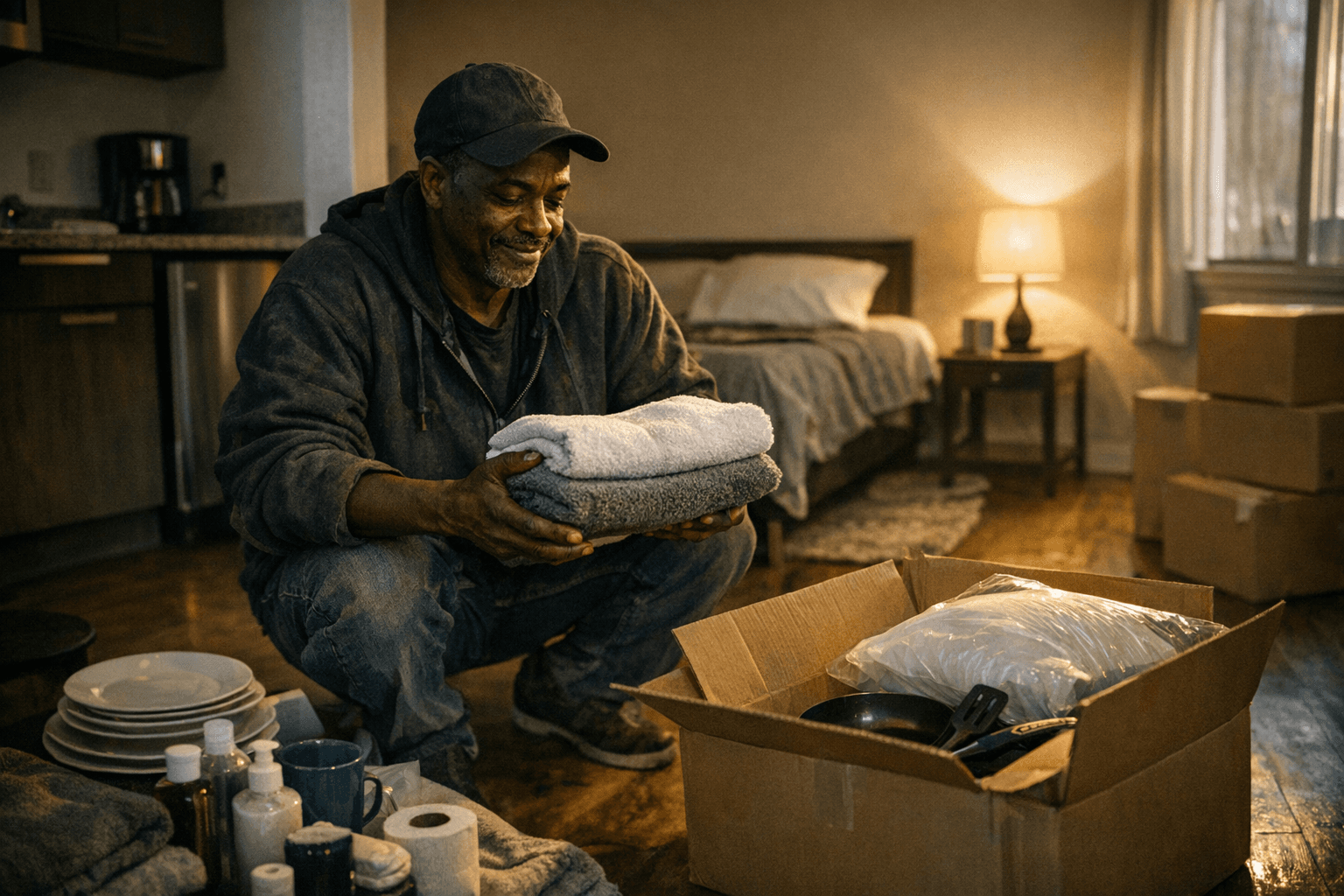
Getting a set of keys is not the same as coming home. For someone leaving homelessness, walking into an empty apartment can feel as disorienting as the shelter system they just left. There are no sheets on the bed, no pan to boil water in, no towel hanging in the bathroom. Most of us accumulated those things over years without thinking about it. People exiting homelessness rarely have that luxury, and the absence of those basics can make a new address feel less like a fresh start and more like another obstacle.
That gap is exactly what Move-In Ready Kits are designed to close.
What the Welcome Home Collaborative Does
The Welcome Home Collaborative provides transitional housing and one-on-one life coaching to individuals and families experiencing homelessness or hardship. Based in Cincinnati, Ohio, the organization operates on a model that goes well beyond placing people in a room. There are three segments of the Welcome Home Collaborative ministry: Transitional Housing, Remodeling and Renovating Vacant or Distressed Property, and providing Job and Life Skills. The philosophy is that housing alone is not enough; people need practical tools and human support to sustain it.
The organization's two-year program provides tools that allow program participants to build a solid foundation for life. All individuals and family heads are assigned a Life Coach who collaborates with them throughout their journey to create a life plan for independence and housing stability. Program participants meet with their Life Coach weekly in order to build a trusting relationship and to track their Life Plan progress.
The Move-In Ready Kit sits at the beginning of that journey, arriving on the same day as the keys.
Why the First Day Matters So Much
Housing alone does not create a sense of home. That transition, from a shelter or the street into a private space, needs to be made gentler. Moving into a new home is an exciting time for many, but for those who have recently overcome homelessness, the transition to permanent housing can be daunting. Despite ongoing support, affording basic necessities like bedding and cookware remains a challenge.
Research demonstrates that residents who move into housing with supports are 25% more likely to retain their housing. That statistic reframes what might look like a modest box of household goods into something with measurable, lasting impact. A kit is not charity in the conventional sense; it is a stability intervention.
The emotional dimension matters just as much as the practical one. One person receiving a housing welcome package put it plainly: "I am at a transition centre going into transitional housing from being homeless and someone brought me a housing welcome package. I just want to thank you guys because it's so amazing and this will for sure help me in my new apartment. I can't believe how much is in the package and that I got one."
What Goes Inside a Move-In Ready Kit
The contents vary slightly by organization, but the essentials are consistent across programs nationwide. Each kit is typically filled with items including plates, drinkware, silverware, utensils, toothbrushes, deodorant, bar soap, towels, laundry soap, cleaning supplies, and fleece blankets. Some programs break the kit into functional categories:
- A Cleaning Kit (approximately $30) includes a bucket, mop, broom, duster, dust pan, laundry soap, laundry basket, window cleaner, powder cleanser, sponges, cleaning rags, disinfecting wipes, and hand sanitizer.
- A Bathroom Kit (approximately $50) covers a shower curtain and rings, a garbage pail, bath mat, bath towels, shampoo, toothpaste, and a toothbrush.
- Kitchen and bedroom supplies round out the rest, typically bringing a full kit to around $300 to $540 in total value, depending on the program.
A basic transitional housing kit often includes a frying pan, cooking pot, utensils, dish soap, sponge, laundry detergent, plates, bowls, a towel, face cloth, razor, shampoo, conditioner, toothbrush, toothpaste, a bar of soap, and a mop.
The simplicity of that list is part of the point. The items are simple: towels, dishes, cookware, cleaning supplies, bedding. Most of us build these things over time. For someone walking into an empty apartment after experiencing homelessness, having these essentials ready can ease stress and restore dignity from day one.
The Broader Ecosystem of Move-In Support
Programs like this one exist in cities across the country, often structured differently but sharing the same core insight. The Welcome Home Kit supports community members moving from homelessness into housing by helping them furnish their space with new items that they choose themselves. Some organizations provide a curated box of goods assembled by volunteers; others issue gift cards that give recipients the autonomy to select their own items. Funding a Welcome Kit gives people the option to make their own decisions on sizes, colors, and designs, which is itself a form of dignity that the shelter system rarely affords.
High costs of rent and utilities can put home goods like pots and pans, bath towels, and cleaning supplies out of reach for people navigating housing and financial insecurity. A Move-In Ready Kit bridges that gap precisely at the moment when a person's financial resources are at their most stretched, right after paying a security deposit and first month's rent.
The community dimension of assembling and donating kits also matters. Volunteer Noel Fulcher shared: "It is joyful when you think about the recipients of these few items and how much it must help when moving into a new home."
The Housing First Connection
Move-In Ready Kits sit within a broader philosophy that treats housing itself as the starting point for everything else. The Housing First approach views housing as the foundation for life improvement and enables access to permanent housing without prerequisites or conditions beyond those of a typical renter. A kit reinforces that philosophy in a concrete way: it says that the person moving in deserves to start day one with the same baseline comforts as anyone else.
Providing access to housing generally results in cost savings for communities because housed people are less likely to use emergency services, including hospitals, jails, and emergency shelters, than those who are homeless. One study found an average cost savings on emergency services of $31,545 per person housed in a Housing First program over the course of two years. Against that backdrop, a $300 to $540 kit looks less like an expense and more like an exceptionally efficient investment.
How to Get Involved
For the Welcome Home Collaborative and organizations like it, community participation is what keeps these kits going. Groups can make an impact by hosting a drive for kit supplies, and volunteers can assemble kits onsite to learn more about the mission. Some programs accept financial donations tied directly to a single kit; at the Weingart Center in Los Angeles, every $540 raised covers the cost of one complete Welcome Home Kit. Others welcome gently used kitchen items, new household goods, or gift cards to large retailers.
The mission is to create change and cultivate a community of care so people can move with dignity from trauma and homelessness to healing and housing stability. Move-in kits are one practical way that community lives that mission; they help transform empty space into a place where someone can begin again.
The kits do not solve homelessness. What they do is ensure that the first night in a new home feels like a beginning rather than just the absence of something worse. For someone who has been without stable housing, that distinction is everything.
This article was produced by Prism’s automated news system from verified source data, official records, and press releases, then run through automated quality and moderation checks before publishing. The system is built and supervised by the people who set the standards it runs under. Read our full AI policy.
Did this article answer your question?