Amida's NASA Edition Digitrend Revives Space Age Design for Collectors
Amida's $4,420 NASA Tribute Digitrend is limited to 100 pieces, pairs a white ceramic shell with the iconic "worm" logo, and may be the most gifted collector's watch of 2026.
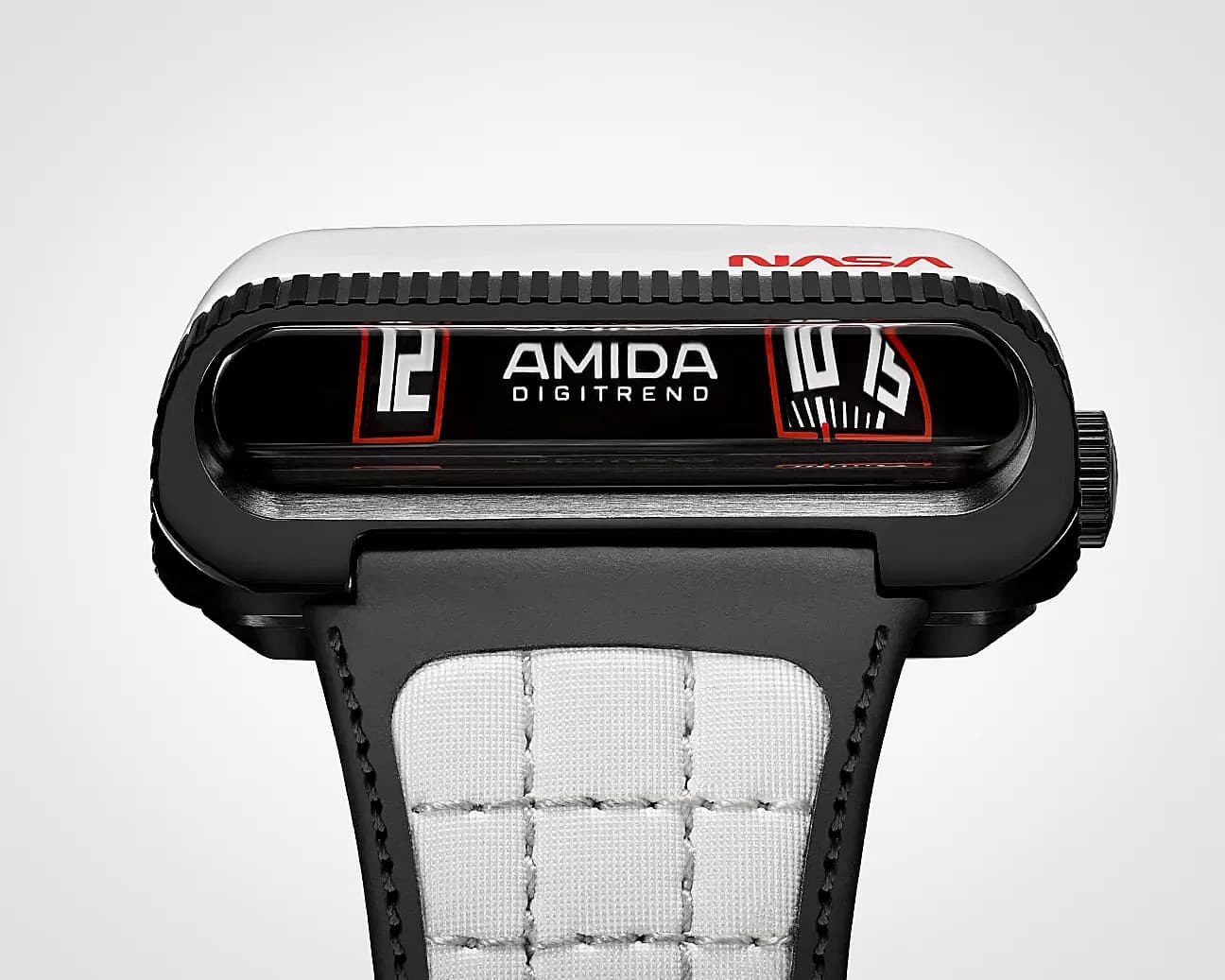
Boutique watchmaking has quietly become one of the most competitive gifting categories for serious collectors, and no release this year makes the case more forcefully than the Amida Digitrend NASA Tribute. One hundred pieces. White ceramic. A jumping-hour display viewed through a sapphire prism. And the NASA "worm" logo in red, officially licensed, sitting on the case like a mission patch. This is not a watch that needs explaining to the right person. It is the explanation.
Why 1976 Still Matters
In 1976, NASA unveiled the Space Shuttle Enterprise and Amida introduced the Digitrend, a mechanical jump-hour watch with a sapphire prism display that read time like a cockpit instrument. That parallel is the emotional spine of this release. The original Digitrend was a doomed novelty that tried to compete with cheaper quartz designs by using an automatic movement, a jump-hour complication, and a prism. It was not around for long, but decades later it became a fascination among collectors.
Amida was revived in 2024 by industry veterans Clément Meynier and Matthieu Allègre, specifically to bring back the Digitrend. This limited edition represents a structural re-engineering of Amida's iconic 1976 design, created in collaboration with NASA and built for collectors who value engineering heritage. The NASA Tribute is the most visually and conceptually ambitious version the revived brand has produced.
The Design: Ceramic, "Worm," and Spacecraft Logic
Every material choice on the NASA Tribute has a documented source. The watch features a monocoque DLC-coated steel case with a scratch-resistant white ceramic top shell, the same material used to shield spacecraft during atmospheric re-entry. The result is a 39.6mm case that is both lightweight and exceptionally durable, with a short 39mm lug-to-lug ensuring comfortable wear despite its bold 15.6mm profile. The contrast between the matte black DLC body and the glossy white ceramic reads immediately as something spacecraft-adjacent, not merely watch-adjacent.
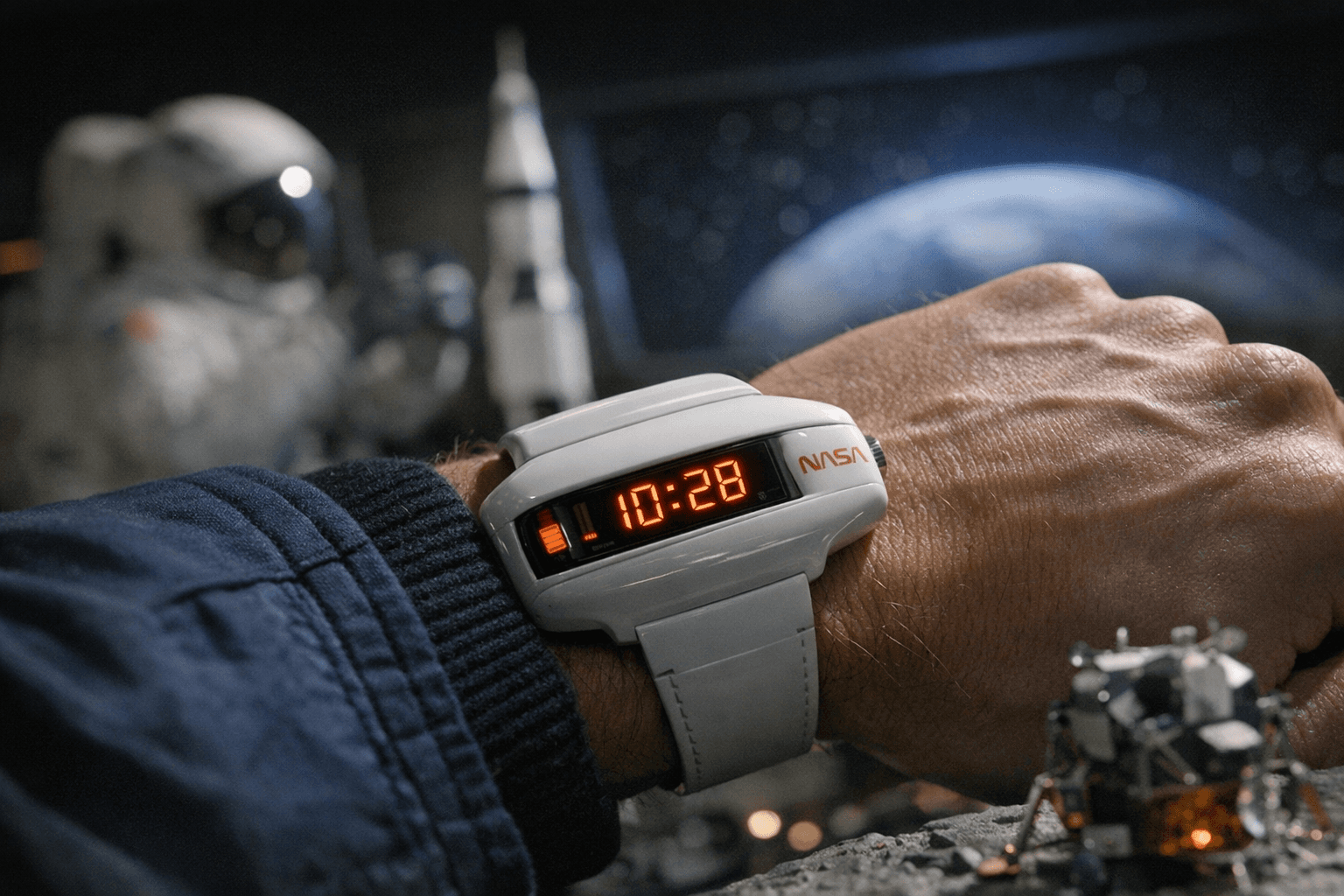
The monoblock body is black DLC-coated stainless steel with horizontal fluting, topped by a glossy white ceramic shell bearing the red NASA worm logo, the same logotype the agency used from 1975 to 1992. The watch's dial carries NASA's "worm" logo from the 70s and 80s, revived in 2020, rather than the older "meatball" insignia. That specific branding decision matters to anyone who grew up watching shuttle launches: the worm carries a precise cultural timestamp.
The Digitrend debuted in 1976 as a paradigm example of the casquette style born during that era. These watches wore their dials on the edge of the case so that you did not have to turn your wrist to tell the time when driving a car. The format is preserved entirely here. The jump-hour and dragging minutes apertures are viewed through a specially designed prism. It is the horological equivalent of a heads-up display: legible at a glance, deeply strange on closer inspection.
The Movement: A Nine-Component Module That Jumps
The jump-hour module is an in-house Amida invention and sits atop a Swiss Soprod Newton P092 automatic movement. It runs at 28,800 vibrations per hour, has 23 jewels, and offers a 44-hour power reserve. The base caliber is a credible, reliable Swiss movement; what sits on top of it is the differentiator.
Inside, the Swiss automatic Soprod Newton P092 movement drives an in-house nine-component jumping-hour module, displaying hours and scrolling minutes through a sapphire prism. You can look at the skeletonized rotor through the sapphire case back. On the movement, you will also find the motto "per aspera ad astra," which means "through hardships to the stars," associated with space exploration and honoring the astronauts who gave their lives in pursuit of it. Water resistance is rated to 165 feet (50 meters).
The Strap and the Packaging
The strap is made of black rubberized leather and Beta cloth, the same material that NASA used to manufacture space suits. It fastens to the wrist with a Velcro closure. A bi-material strap of leather and technical fabric is secured with a hook-and-loop fastening system, inspired by its critical application for securing equipment and astronauts in the zero-gravity environment of space.
The spherical transparent plastic packaging is an allusion to the space shuttles of the Apollo program. It photographs spectacularly, and for a gift, the unboxing is part of the story.
The Boutique Reality: Buy, Skip, or Wait
Limited to 100 watches, each individually numbered, the NASA Tribute is available with scheduled delivery in May 2026. Price is $4,420, with free international shipping and a two-year warranty. The checklist below is designed to help you decide quickly, because 100 pieces is not a margin for hesitation.
Buy if:
- You are gifting a collector who tracks independent watchmaking and knows the Digitrend's history. The dual-1976 narrative is the kind of provenance collectors genuinely prize.
- You value boutique novelty over horological orthodoxy. This is a jumping-hour prism watch in a ceramic NASA case, and it is not trying to be anything else.
- You can move before the run sells out. At 100 numbered pieces, this edition will not linger.
- The 15.6mm profile does not concern you or your recipient. The casquette format is inherently bold on the wrist.
Consider skipping if:
- Your recipient needs something that reads universally in a formal setting. The Digitrend is a conversation piece, not a chameleon.
- Immediate delivery is a hard requirement. May 2026 shipment means this is a gift with a runway, not a same-week surprise.
- You are thinking about resale. At 100 pieces from a boutique brand, secondary market pricing is unpredictable. Buy it for love, not as a hedge.
Three Alternatives If the Drop Is Gone
The 100-piece ceiling means this edition will sell out. These are the most defensible alternatives at three different price points.
Amida Digitrend Steel Edition (from $3,770): The Digitrend Steel Edition starts from $3,770 and shares the same movement architecture as the NASA Tribute. It is the foundational Digitrend without the NASA branding or ceramic shell, and it is the cleanest entry point into Amida's universe for a collector who wants the mechanical novelty without the themed edition premium. Availability is broader.
Omega Speedmaster Moonwatch Professional (around $6,300): The reference point for any space-heritage gifting conversation. Where the Digitrend leans on aesthetic tribute, the Moonwatch carries biographical credentials, certified by NASA for extravehicular activity in 1965 and continuously produced since. For a collector who wants documented history rather than design homage, this is the argument.
Louis Vuitton Tambour Convergence (from approximately $37,000): For the collector who wants jumping-hour novelty with luxury maison pedigree, the Tambour Convergence, developed with La Fabrique du Temps, is priced from USD $33,500. It is a different budget and a different brand philosophy, but the mechanical novelty driving the gifting decision is the same.
The Digitrend NASA Tribute is priced like a novelty aimed at hard-core collectors because that is exactly what it is. One hundred collectors worldwide will own a piece that aligns two parallel 1976 timelines: a defunct Swiss brand and a Space Shuttle program, reunited in 39.6mm of ceramic and steel. That specificity is precisely what makes it worth giving.
This article was produced by Prism’s automated news system from verified source data, official records, and press releases, then run through automated quality and moderation checks before publishing. The system is built and supervised by the people who set the standards it runs under. Read our full AI policy.
Did this article answer your question?