H. Moser & Cie. Debuts First Ceramic Streamliner Tourbillon as a Collector Statement Gift
H. Moser & Cie.'s first-ever ceramic watch pairs anthracite grey ceramic, a bracelet included, with a red Grand Feu enamel dial and flying tourbillon at CHF 89,000 ex-tax.
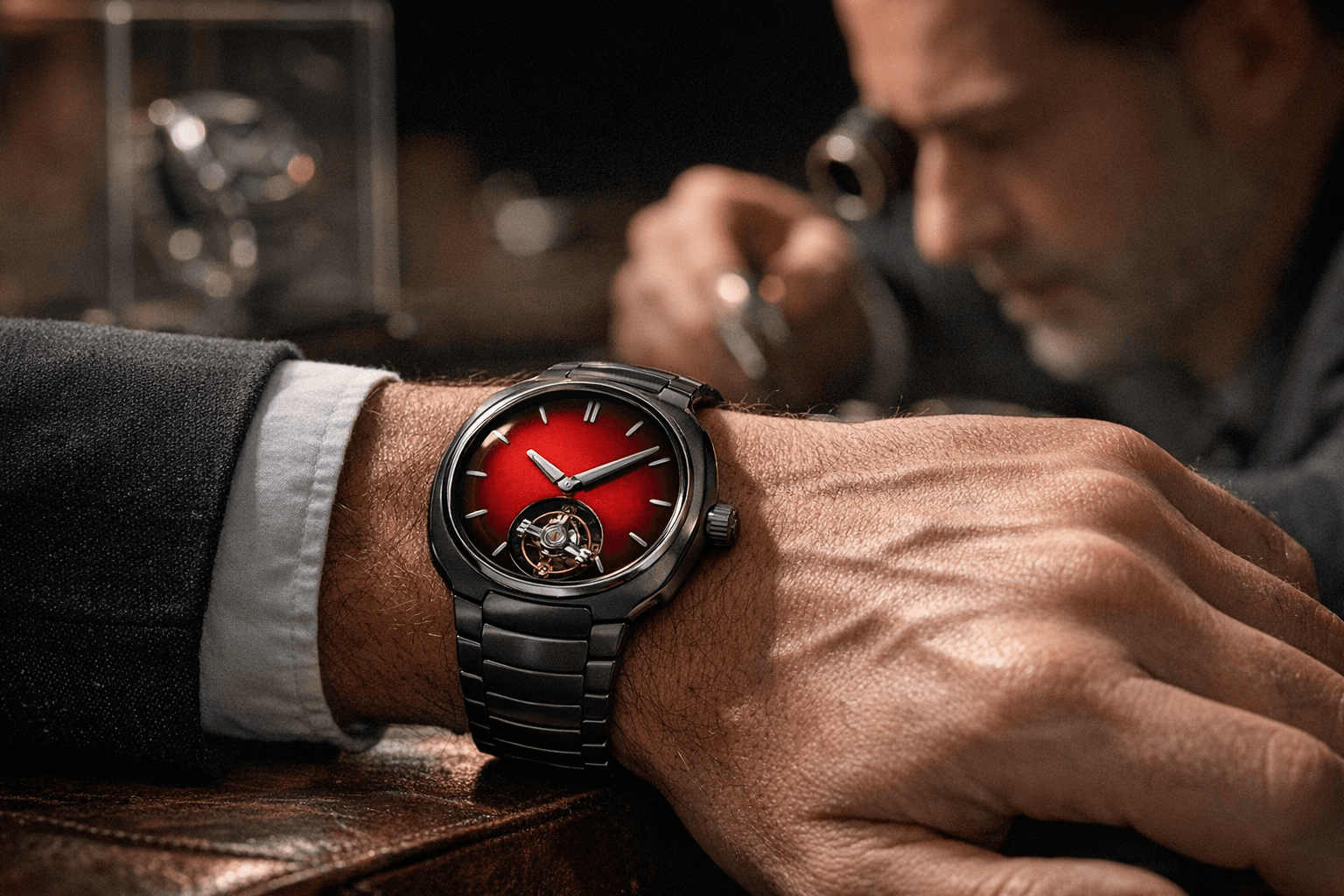
Ceramic has quietly become the defining material competition in serious sports watchmaking, and for the better part of a decade, H. Moser & Cie. watched from the sidelines while Chanel, Rado, and IWC established their ceramic credentials. The Schaffhausen manufacture has finally entered the category, and it did so at the deep end: the Streamliner Tourbillon Concept Ceramic marks the fast-rising independent brand's initial foray into one of the hottest trends in sports watches over the past decade.
The move that sets this watch apart from most ceramic debuts is not the case. Despite being a variation of a well-known model at its core, the new Streamliner is unexpectedly different and appealing, especially with a hand-finished ceramic bracelet, an unusual feature even in its segment. The bracelet carries a vertical satin finish with subtle polishing on the edges, while the case shows a contrasting circular satin finish. Both treatments are applied by hand to a material notoriously resistant to such refinement. The 40mm case measures 11mm thick, or 12.8mm including the domed sapphire crystal, and comes in anthracite grey ceramic with a screw-down crown engraved with an "M" and 120-metre water resistance.
What ceramic actually changes at the wrist is significant. Ceramic's appeal lies in its near-imperviousness to scratches, the fact that its color will never fade and, to a lesser extent, its lightweight and hypoallergenic attributes. For someone moving from a steel Streamliner, the hand-applied bracelet finishing survives desk edges, cuffs, and keyboards indefinitely; a polished steel bracelet would show contact within weeks. The weight difference is perceptible too: ceramic sits noticeably lighter. The fragility concern that follows every ceramic conversation is real but often overstated. Ceramics are very brittle in nature, so a well-placed impact might crack the case, which is why the inner case and caseback of this Streamliner are made from metal, with a steel caseback secured by four screws. The screwed sapphire caseback still exposes the movement fully, so nothing is hidden.
Inside, the in-house Calibre HMC 805 automatic features a bi-directional pawl winding system and a double hairspring, a rare setup that doubles down on the anti-gravity effect of the rotating escapement and improves precision, with a 72-hour power reserve. The one-minute flying tourbillon sits at 6 o'clock, flanked by partially skeletonized bridges and an oscillating weight in 18-carat red gold, all visible through the caseback.
Against that restrained anthracite shell sits the chromatic counterargument: the Red fumé Grand Feu enamel dial features a hammered texture created by engraving a textured pattern on a white gold base, then painstakingly applying two enamel pigments with a gradient effect before firing multiple times to achieve the precise intended tone of red. The dial omits indices and logos entirely, leaving time displayed solely via hour and minute hands fitted with Globolight inserts that contrast sharply against the red background. This is Moser's Concept philosophy in full: no text, no brand name, just the mechanics and the colour.
Compared to the all-black ceramic reads of an IWC Pilot or the graphic white of Chanel's J12, Moser's anthracite grey sits closer to gunmetal, which is the stealth-wealth case for owning this watch. It does not announce itself as ceramic. At $112,100, it is the second-priciest non-gold, non-gemset Streamliner in the current Moser catalog, after the highly limited Streamliner Minute Repeater. That positioning tells you this is a collector's purchase, not an entry point: the person who already owns a steel Streamliner Tourbillon and wants the same fluid architecture in a material that will hold its surface finish for the life of the watch. For a first tourbillon buyer at this level, the case for going ceramic over steel comes down to one thing: you will never have to worry about it again. The watch joins the permanent collection rather than a limited run, available through H. Moser & Cie. boutiques and select global retailers, which means this is a sourcing question, not an allocation one.
This article was produced by Prism’s automated news system from verified source data, official records, and press releases, then run through automated quality and moderation checks before publishing. The system is built and supervised by the people who set the standards it runs under. Read our full AI policy.
Did this article answer your question?