Pharrell's Joopiter Sells 66-Million-Year-Old Triceratops for $5.5 Million
Trey, a 66-million-year-old Triceratops, sold for $5.5 million on Pharrell Williams's Joopiter, setting a record for any dinosaur sold in an online-only sale.

Only one long-term museum-exhibited Triceratops skeleton has ever come to market. It just sold for $5.5 million on Pharrell Williams's Joopiter platform, setting a record for any dinosaur sold in an online-only format and announcing, definitively, that prehistoric fossils have crossed into the same collecting lane as blue-chip contemporary art.
The specimen, known as Trey, is a 17-foot sub-adult composed of more than 70 percent original material, excavated from the Lance Formation near Lusk, Wyoming, in 1993 during the fossil trade's so-called "Bone Rush." Lee Campbell and the late Allen Graffham of Geological Enterprises made the find the same year Jurassic Park was released in theaters. After restoration in Germany, Trey returned to anchor the 1995 grand opening of the Wyoming Dinosaur Center in Thermopolis and remained on public loan there until 2023. That institutional history is precisely what separates Trey from commercially excavated specimens with thinner records, and it is why the skeleton sold at the top of its $4.5 million to $5.5 million estimate.
For anyone considering a fossil at this level, the provenance file is the first line of due diligence. Trey was sold with the original fossil lease agreement with the landowner and photographs documenting the excavation by Campbell and Graffham. That documentation satisfies the baseline requirements for high-value insurance coverage, which for a specimen of this scale can run into six figures annually. Shipping and installation add further cost: a 17-foot skeleton requires climate-controlled crating, structural engineering for mounting, and, if crossing borders, export permits. The buyer's identity has not been disclosed; Trey was most recently on display at Co-Museum's facility at Le Freeport in Singapore.
Joopiter launched in 2022 after Williams determined that traditional auction houses were unequipped for archival fashion and cultural objects. The platform has expanded steadily into contemporary art and sports memorabilia, and the Trey sale was its most ambitious single lot yet. Caitlin Donovan, Joopiter's global head of sales, said the surging interest reflects a shift away from traditional categories like old master paintings and toward objects that carry "cultural resonance." Paleontologist Andre LuJan of Texas-based commercial firm PaleoTex, who consulted on the sale, put it more directly: Trey "has this cultural aspect that a lot of fossils that go to auction these days just simply don't have."
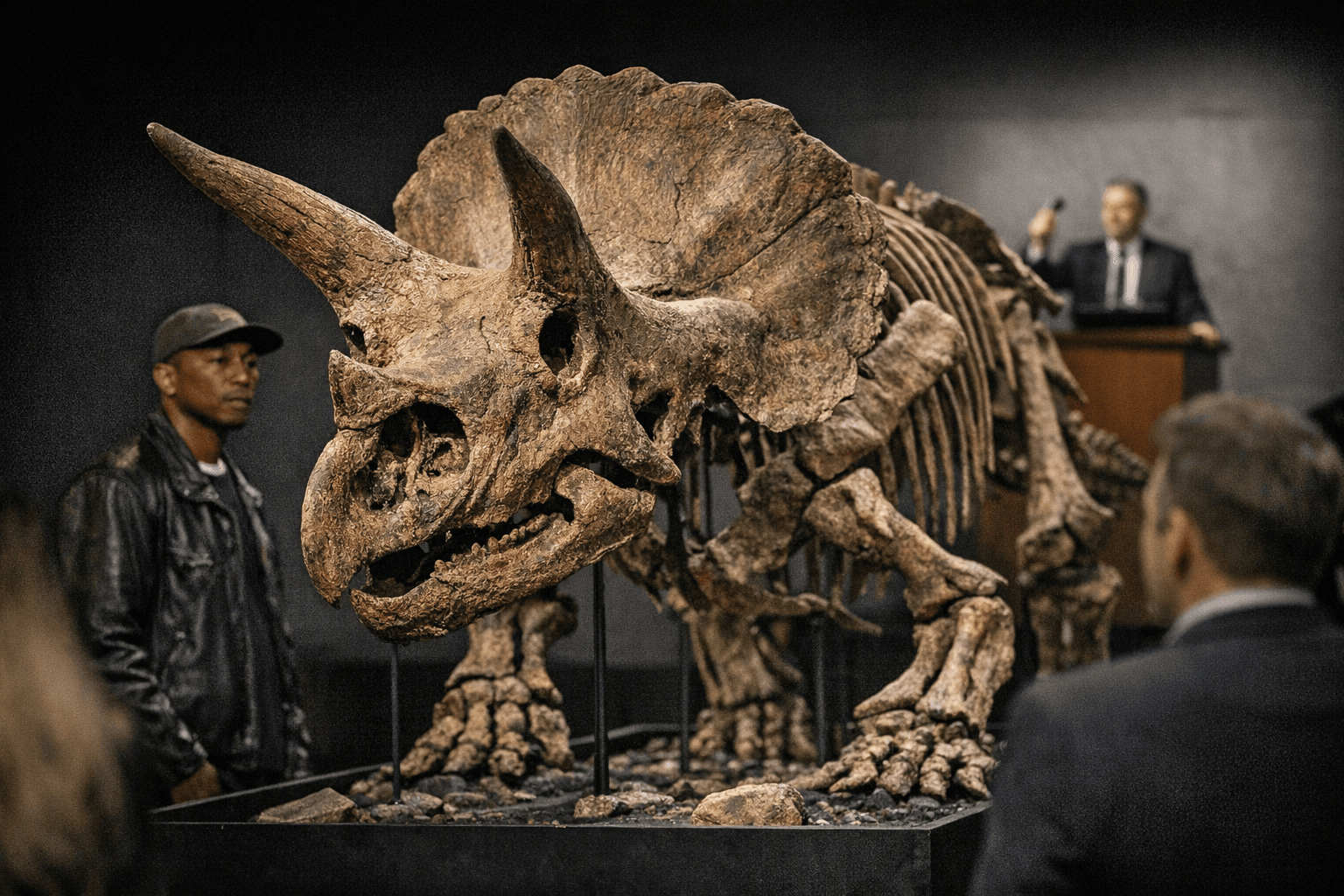
The $5.5 million result is notable but not unprecedented in the broader fossil market. Big John, the largest Triceratops ever discovered, sold for $7.7 million at the Drouot in Paris in 2021. The Stan T. rex fetched $31.8 million at Christie's in 2020. What distinguishes the Trey sale is the format and the accompanying capsule collection, both of which signal a deliberate effort to broaden the audience. Joopiter and Co-Museum produced the drop alongside the auction in partnership with Los Angeles streetwear label 424 and jeweler Hoorsenbuhs. The centerpiece is a 100-piece limited-edition fiberglass skull replica, each piece containing encased genuine Triceratops fossil fragments, priced at $695. The 424 items included a distressed trucker hat, a patched T-shirt, and a tote bag bearing abstract dinosaur motifs. Hoorsenbuhs contributed a sterling silver keychain cast in the shape of the skeleton.
The ethical debate around private fossil ownership remains live. Kristi Curry Rogers, a paleontologist at Macalester College, noted that museums are "getting totally priced out of an exploding market," and that fossils in private collections without guaranteed research access are "essentially lost to science." Trey's nearly three decades of institutional tenure complicates that critique more than most lots can. The capsule, meanwhile, turns a $5.5 million transaction into a collecting moment with genuine entry points. A sterling silver keychain and a skull containing actual Late Cretaceous material are not equivalent to owning Trey, but in a market where the benchmarks are now written in eight figures, they are something the traditional auction world never thought to offer.
Know something we missed? Have a correction or additional information?
Submit a Tip