Mother’s Day Marketing: Key trends retailers should use to shape gifting campaigns
Mother's Day spending is set to hit $34.1 billion in 2026, and the retailers winning the season are leaning on UGC, brand collabs, and hyper-local experience guides.

The $34.1 billion opportunity hiding in plain sight
Consumer spending on Mother's Day is expected to reach $34.1 billion this year, according to the annual survey by the National Retail Federation and Prosper Insights & Analytics. That makes it, as NRF Vice President of Industry and Consumer Insights Katherine Cullen noted, "an important holiday for many consumers, only surpassed by the winter holidays in terms of average spending," adding that "even in the face of economic uncertainty, consumers continue to celebrate the special women in their lives with gifts and outings."
On average, those celebrating plan to spend $259.04 on Mother's Day gifts and celebrations, about $5 more than they budgeted in 2024. Most of those celebrating (57%) are shopping specifically for a mother or stepmother, followed by a wife (23%) or daughter (12%). For retailers, that concentration of intent is a targeting gift: you know exactly who the buyer is and, in most cases, who they are buying for.
What shoppers are actually buying
The most popular gift categories remain flowers (74%), greeting cards (73%), and special outings such as dinner or brunch (61%). Consumers will spend a total of $6.8 billion on jewelry, making it the single largest dollar-value category even though it trails flowers and cards in participation rate. That gap between penetration and spend is the key creative brief: jewelry buyers are fewer but they spend far more per transaction, which means premium positioning, gifting bundles, and early-access offers are particularly well-suited to that segment.
The emotional driver behind these purchases is increasingly defined by meaning, not price. Almost half of celebrants (48%) believe finding a unique or different gift is most important, while 42% focus on making a special memory. Campaigns that speak directly to those motivations, rather than leading with discount mechanics, are already outperforming generic promotional creative.
Storytelling and UGC: the engagement multiplier
Authentic storytelling is not a soft metric anymore. 79% of consumers say that user-generated content has a high impact on their purchasing decisions, and 87% of brands now use UGC to connect with their audiences more deeply and authentically. For Mother's Day specifically, the emotional stakes of the occasion make UGC uniquely powerful: a real customer describing why she bought her mother a specific necklace will consistently outperform a studio shot of that necklace sitting in a box.
The CommerceNext briefing synthesized these dynamics into a clear recommendation: prioritize storytelling and authentic UGC across every surface, from paid social to email to product pages. The most effective executions tend to pair real customer voices with a specific product and price, giving browsing shoppers both the emotional permission and the practical information to convert.
One campaign that nailed this balance was Coach's Mother's Day push built around the theme "What We Carry Makes Us Stronger," anchored by Jennifer Lopez, a brand ambassador and mother, with pastel floral handbags at the center. The campaign extended across channels and included personalized customization options, which gave customers a reason to engage beyond a simple add-to-cart moment.
Brand collaborations: the price anchor is everything
Brand-by-brand collaborations remain among the most attention-grabbing plays in seasonal retail, but the CommerceNext analysis was pointed about what separates a successful partnership from a forgettable one: clear price anchors and accessible SKUs. A collaboration that is only legible at the high end leaves most shoppers without an entry point. The strongest collabs in recent seasons have structured their offerings with a visible range, typically one aspirational hero product and two or three accessible price points that give gifters of every budget a reason to engage.
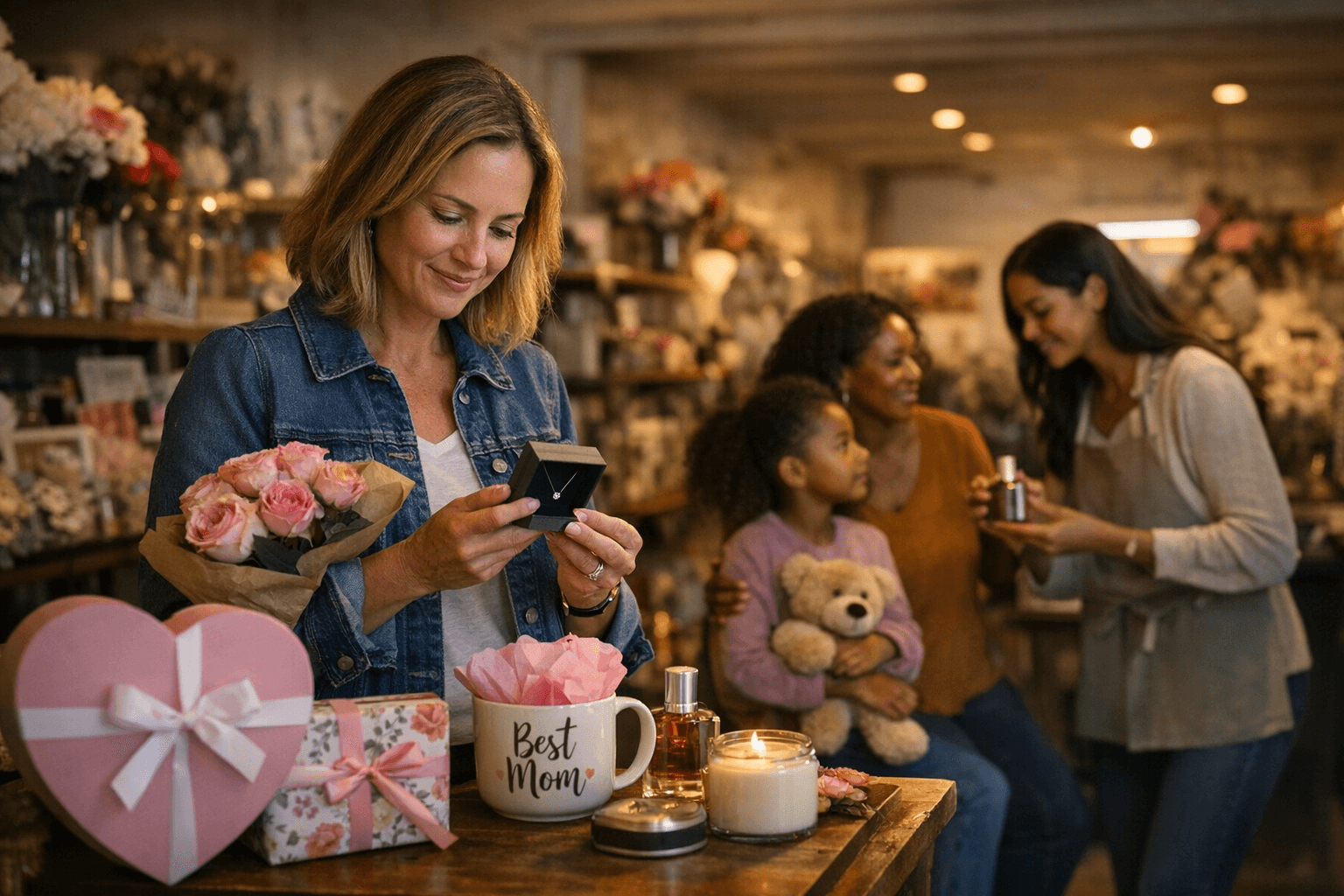
The unexpected-partnership angle, in particular, drives disproportionate earned attention. An Indiana handbag brand collaborating with a fragrance retailer generates more organic buzz than a predictable flower subscription teaming with a greeting card company. Retailers still planning their final weeks before Mother's Day should ask whether their partnership or bundling strategy has a genuine element of surprise, and whether that surprise comes with a clear, shopper-facing reason to act.
Omnichannel and the early-shopper conversion window
The window between now and Mother's Day is short, but it is not evenly distributed. Early shoppers, those browsing and buying three to four weeks out, represent a disproportionately high-value segment: they are deliberate, they have budget, and they respond to exclusive access mechanics. In-app exclusives and early access tiers have become particularly effective tools for converting this cohort, giving loyalty members and app users a reason to act before the last-minute rush rather than waiting for a sitewide sale.
Omnichannel execution is not just about having both an online and offline presence; it is about making each touchpoint add something the other cannot. A store can offer gift wrapping, engraving, and the tactile experience of choosing a scent or testing a texture. An app can offer early access, personalization previews, and exclusive SKUs. The retailers capturing the most Mother's Day spend right now are treating each channel as a reason to visit, not simply as a redundant route to the same catalog.
Experience-based guides beat generic roundups
One of the clearest tactical findings from the CommerceNext briefing: hyper-local, experience-based content, city-specific brunch guides, curated spa packages for a specific metro area, outperforms generic national roundups by a meaningful margin. The underlying logic is simple. A reader in Chicago searching for what to do with her mother on Sunday morning does not need 50 options from across the country; she needs three great ones that are actually available and actually local.
This has direct implications for content teams and local retail partners. A florist with three Chicago-area locations should be investing in a guide to the best Mother's Day brunch neighborhoods in the city, not just a generic "top flowers for Mom" post. A spa chain should be producing neighborhood-level content that targets specific zip codes, not a national campaign built around a stock photo of a woman in a robe.
The mechanics here are straightforward: local search intent is high in the final weeks before Mother's Day, competition for that intent is relatively low compared to national terms, and shoppers who find relevant local content convert faster because their logistical questions, where, how far, what's nearby, are already answered.
What to prioritize in the remaining window
The retailers best positioned to win Mother's Day 2026 are not necessarily the ones with the largest budgets. They are the ones who have resolved the four levers the CommerceNext briefing identified: authentic storytelling with real customer voices, brand collaborations with clear and accessible price architecture, omnichannel mechanics that reward early shoppers with something exclusive, and local experience content that answers the specific question a shopper in a specific city is actually asking.
With spending forecast to reach $34.1 billion and the average celebrant planning to spend $259, the demand is there. The creative and tactical decisions made in the next few weeks will determine who captures it.
This article was produced by Prism’s automated news system from verified source data, official records, and press releases, then run through automated quality and moderation checks before publishing. The system is built and supervised by the people who set the standards it runs under. Read our full AI policy.
Did this article answer your question?