Mother’s Day Spending Set to Hit Record $38 Billion This Year
Mother’s Day spending is set to hit $38 billion, with diners, florists and experience gifts claiming more of the budget than jewelers alone.

Mother’s Day spending is headed for a record $38 billion, and the clearest signal for shoppers is where the money is moving: toward flowers, dinner reservations, gift cards and experiences that feel personal without requiring a big luxury splurge. The National Retail Federation says 84% of U.S. adults plan to celebrate, with average spending per celebrator reaching a record $284.25.
That is a sharp jump from last year’s $34.1 billion and the previous record of $35.7 billion set in 2023. Mark Mathews, the NRF’s chief economist and executive director of research, said consumers are “gifting from the heart” despite “current economic uncertainty,” while Phil Rist, executive vice president of strategy at Prosper Insights & Analytics, said shoppers are budgeting more and spending across more categories. The survey, which the NRF and Prosper have conducted since 2003, shows how broad the holiday remains, even as buying habits keep shifting.

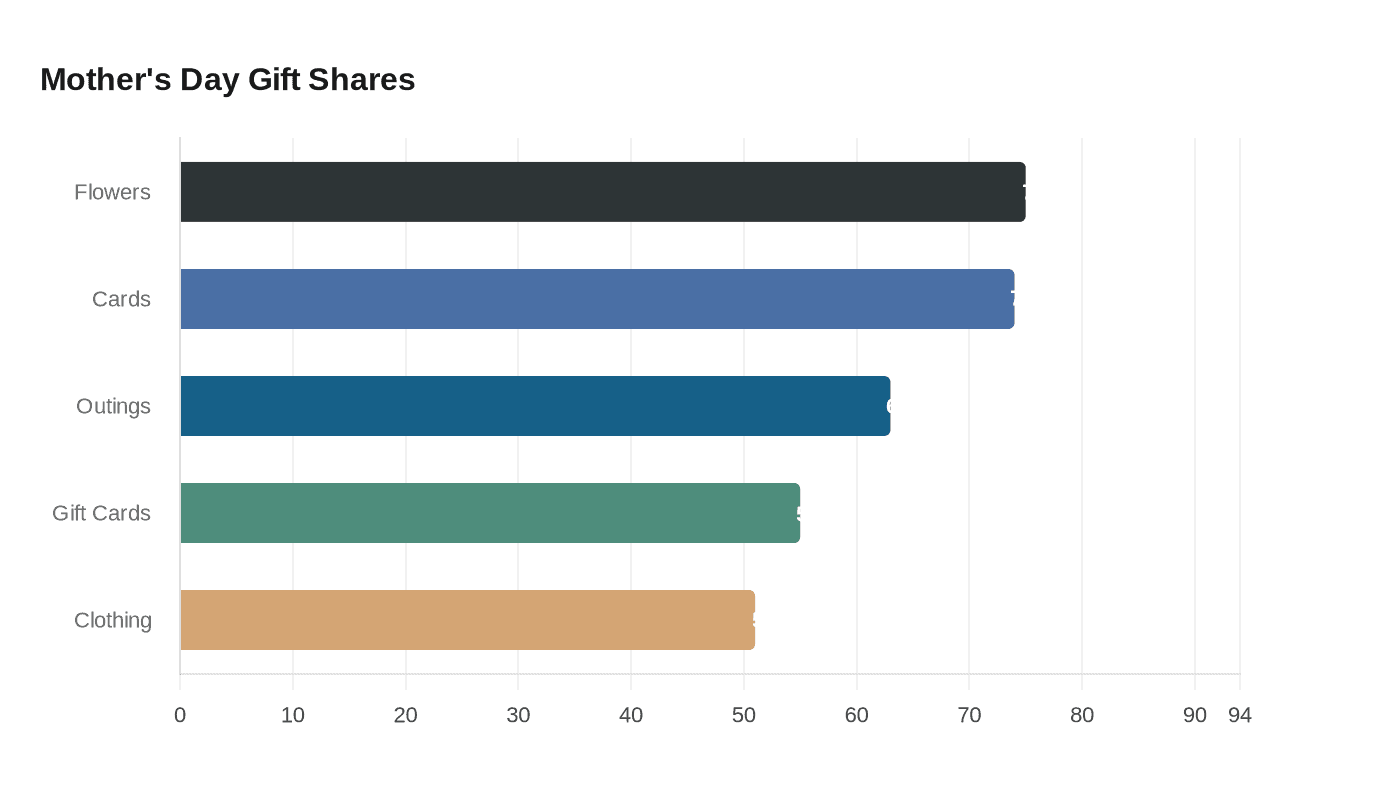
For most households, the practical roadmap starts with the categories people already love. Flowers remain the most popular gift, with 75% planning to buy them, followed by greeting cards at 74% and special outings like dinner or brunch at 63%. Gift cards are next at 55%, and clothing or accessories at 51%. The message is simple: a thoughtful reservation, a beautiful bouquet and a handwritten card still carry enormous weight, especially when the budget needs to stay disciplined. One-third of consumers also plan to give experiences such as concerts or sporting events, which makes Mother’s Day less about another object and more about a memory on the calendar.

The splurge end of the market is still growing, but it is concentrated in a few categories. Jewelry is the biggest spending category at $7.5 billion, while special outings are projected at $6.4 billion and electronics at $4.4 billion, the first time electronics spending has topped $4 billion in the survey’s history. That split is useful for shoppers: if the gift has to feel substantial, jewelry and electronics are where budgets expand; if the goal is elegance without excess, the winning move is a well-booked brunch, a florist with good taste, and a gift card that gives her one more reason to choose her own perfect day.
Shopping is also practical, not precious. Online and department stores are tied as the top destinations at 33% each, followed by specialty stores at 29% and discount stores at 26%. A Northwestern University Medill Spiegel Research Center analysis of April 2025 data ranked Mother’s Day as the third most popular U.S. holiday after Christmas and the Fourth of July, and the spending patterns show why: it remains one of the year’s biggest occasions for gifts that feel considered, useful and immediately enjoyed.
Know something we missed? Have a correction or additional information?
Submit a Tip