AI shopping assistants are reshaping personalized gift discovery
AI shopping assistants are turning vague gift ideas into tailored shortlists, but the real test is whether they can match taste, timing, and emotional nuance.
Accenture’s 19th Annual Holiday Shopping Survey found that 76% of consumers feel overwhelmed by too many product choices, a problem AI shopping assistants are starting to address by listening, narrowing, and translating a vague wish into something specific enough to feel considered. The pressure is highest when the purchase is personal, whether the target is a push present, an anniversary keepsake, or a milestone gift that has to land on the first try.
The gift search is becoming a conversation
The clearest change is the move from keyword search to guided dialogue. Conversational shopping assistants and hyper-personalized recommendations are making digital retail more intuitive, seamless, and individualized, the kind of shift that changes gift discovery. Instead of forcing shoppers to know the right brand, category, or filter before they begin, the interface is starting to behave more like a patient sales associate who can ask the next smart question.
The emotional burden of gift buying is often hidden inside the practical one. In Accenture’s 19th Annual Holiday Shopping Survey, 85% of consumers said they are likely to abandon carts because of frustration or indecision, and 66% said they have used generative AI in the last three months. In the same survey, 46% of U.S. shoppers said they plan to use conversational or gen AI tools before Black Friday, and 77% said they plan to use them for holiday shopping.
Why personalized gifting is the sharpest use case
Gift discovery is where AI’s promise becomes easiest to measure. Accenture found that 75% of heavy gen AI shoppers use it to explore new gift ideas. Gift buying is one of the few shopping moments where the product itself is only part of the job.

There is still a ceiling on trust. Accenture’s broader consumer research found that only 9% of consumers already rank gen AI as their single-most trusted source of what to buy. Shoppers are willing to let AI do the first pass, but they still want a human standard to decide whether the suggestion feels generous, thoughtful, and right for the occasion.
The traffic data shows the behavior is already real
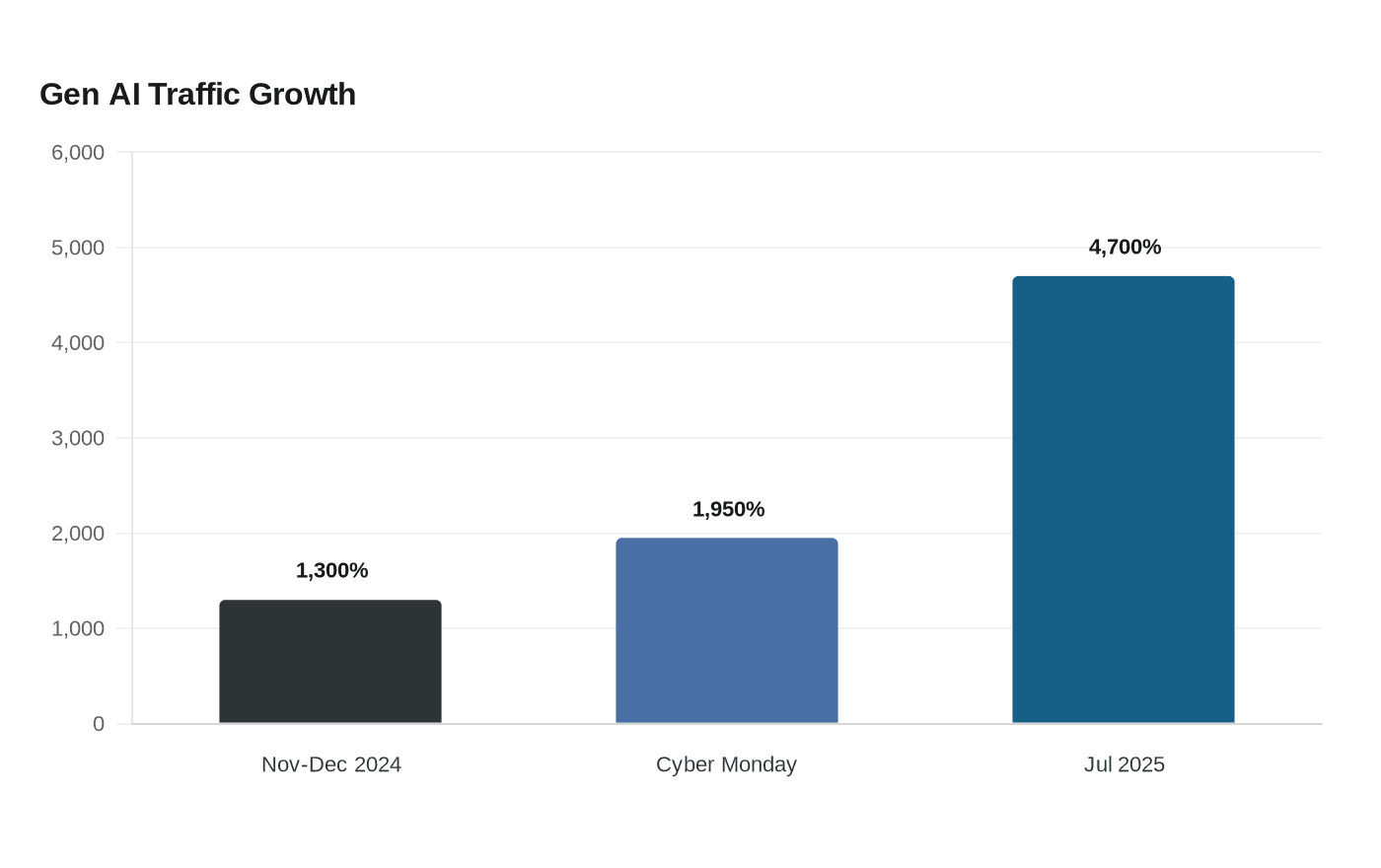
Adobe’s shopping data makes the adoption curve even harder to ignore. Generative AI traffic to U.S. retail sites rose 1,300% year over year during Nov. 1 to Dec. 31, 2024, rose 1,950% on Cyber Monday, and was up 4,700% year over year in July 2025. Those spikes show shoppers repeatedly returning to AI when the stakes are high and the search feels time-sensitive.
Adobe’s survey adds the consumer side of that story. Thirty-eight percent of U.S. consumers said they had used gen AI for online shopping, and 52% said they planned to do so, including for gift ideas, product recommendations, deals, and shopping lists. For buyers trying to find a premium personalized present, AI is increasingly part of the first draft of the buying process, not just the end-stage comparison step.
Retailers are building for assistants, not just browsers
The backend is changing as quickly as the front end. NVIDIA’s retail and CPG survey found that 89% of respondents were actively using AI or assessing AI projects, and digital shopping assistants or copilots were among the top generative AI use cases. The best assistant is only as good as the product data, inventory signals, and customer context underneath it.
Amazon has made that bet in the open. Its shopping assistant Rufus was renamed Alexa for Shopping on May 13, 2026, and Amazon says it uses generative and agentic AI to provide tailored answers and personalized product suggestions based on each customer’s shopping activity. Amazon says the assistant has helped customers billions of times.
Where AI adds real value for a premium gift
For personalized gifting, the strongest use case is not browsing. It is compression. A useful assistant can take a vague brief, a budget ceiling, and a recipient profile, then reduce a noisy marketplace into a smaller set of plausible options that match the occasion. That is especially helpful when the buyer knows the recipient well enough to recognize what feels wrong, but not enough to know exactly what will feel exceptional.
The limitation is taste, and taste is the point. AI can surface products with the right keywords, materials, and price band, but it still struggles with the softer judgments that make a gift feel luxurious in the right way: whether it is intimate enough, whether the presentation feels ceremonial, whether the idea reflects a shared memory, and whether the object itself has emotional weight.
That is why the best workflow now is collaborative rather than automatic. The smartest buyers will use AI to define the field, then apply their own judgment to choose the final piece. Give the assistant the relationship, the occasion, the budget, and one or two concrete style clues, and it can do the useful, time-saving work of narrowing.
This article was produced by Prism’s automated news system from verified source data, official records, and press releases, then run through automated quality and moderation checks before publishing. The system is built and supervised by the people who set the standards it runs under. Read our full AI policy.
Know something we missed? Have a correction or additional information?
Submit a Tip