Five Personalized Jewelry Categories Jewelers Need for Mother's Day Success
Mother's Day is the highest-stakes personalization window of the year; these five jewelry categories give jewelers a repeatable sell-through system, not just a seasonal spike.
Mother's Day is one of the most emotionally driven selling seasons in the jewelry calendar, and the customers walking through your door right now are not browsing. They are on a mission to find something that means something. The challenge for jewelers is translating that emotional urgency into a structured floor strategy. Stuller's industry guidance zeroes in on five personalization categories that consistently convert during the season and, critically, build the kind of customer relationships that bring people back in June, in September, in December. Here is what those five categories look like in practice, and how to merchandise them for maximum impact.
Birthstone Jewelry: The Family Portrait in Gemstone Form
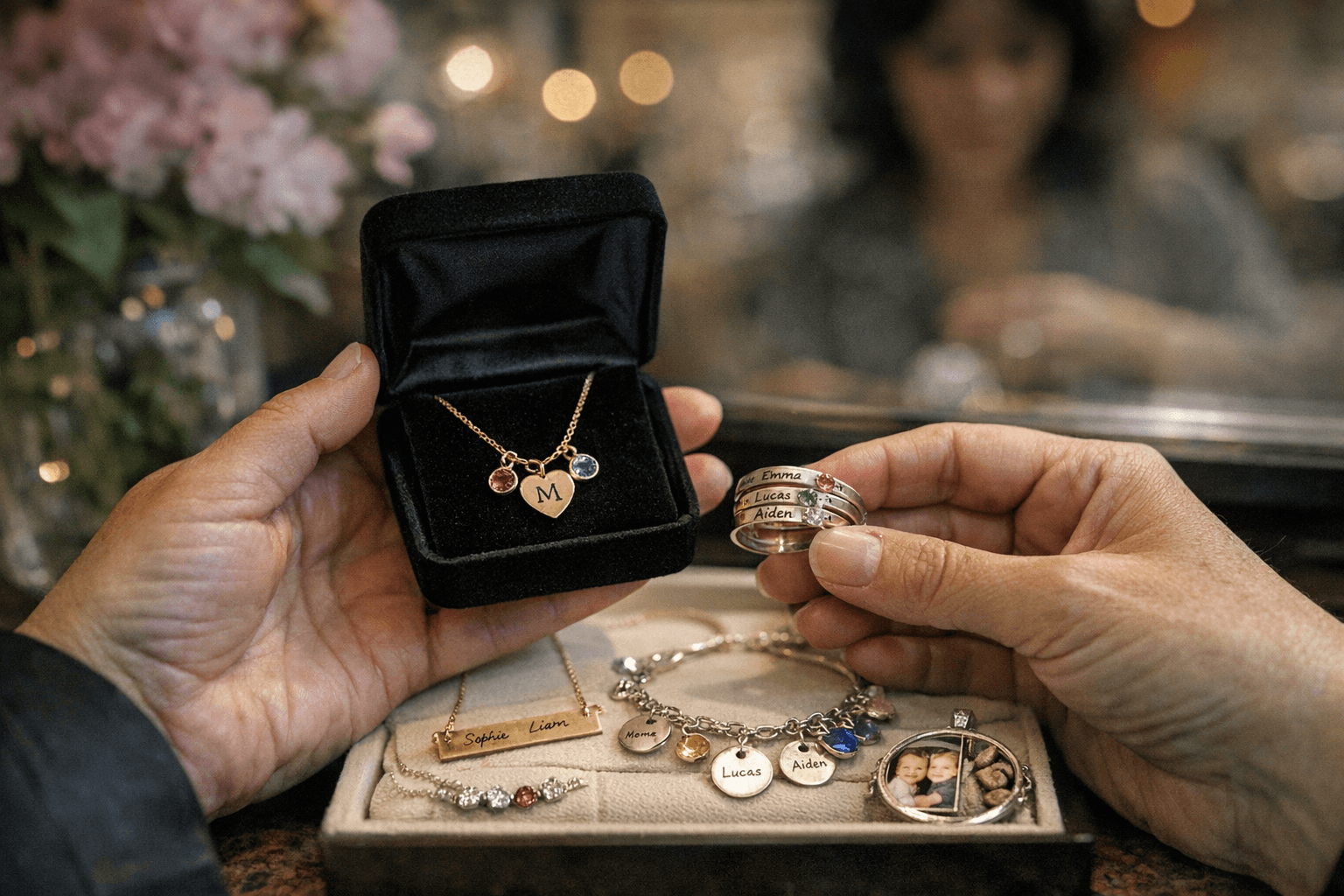
Birthstone pieces are perennially the most intuitive entry point for Mother's Day, and their staying power comes from a simple truth: every child in the family represents a stone that needs to be there. Stuller's approach encourages jewelers to frame multi-stone designs, whether a ring, pendant, or pair of earrings, as a symbolic family portrait rather than a decorative accessory. The framing matters. A pendant with three stones reads as a pretty gift; a pendant with each child's birth month stone reads as irreplaceable.
Stackable birthstone rings are among Stuller's best-selling Mother's Day formats precisely because the product logic builds itself: one ring per child, one ring per milestone. The sales conversation almost writes itself once you ask a single question: how many kids does she have? Tiered price points are essential here. Offering birthstone pieces across silver, gold vermeil, and solid gold ensures that the customer buying for a grandmother of six can find an entry point just as easily as the customer commissioning a single-stone gold piece.
Charm and Family Jewelry: The Gift That Keeps Getting Added To
Charm jewelry has become one of the strongest structural plays in Mother's Day merchandising because it solves the eternal problem of what to give after the first meaningful gift. Stuller identifies charm jewelry as a category that grows in popularity specifically because it invites wearers to build their story piece by piece, celebrating memories, milestones, and personal interests over time. For the jeweler, this is the AOV play hiding in plain sight.
The recommended approach: sell a starter chain or bracelet first, then position every charm as a future gift opportunity for birthdays, anniversaries, and subsequent Mother's Days. A customer who buys a chain and two charms in May is already a customer who needs to come back in August. Family tree and wildflower designs, branch motifs, and "family circle" silhouettes layer naturally into this category, giving customers recognizable symbolic vocabulary to work with when choosing additions.
Engraved Messages: When the Piece Carries the Words She Cannot Wear Otherwise
Engraving is the personalization category with the lowest barrier to entry and the highest emotional payoff. A plain signet ring becomes a keepsake the moment a child's name is cut into the back. A heart pendant becomes irreplaceable the moment a birthdate is added. Stuller's broader 2026 trend framework, which the company has named "Storyteller," specifically calls out engravings hidden inside bands or on the backs of pendants as a growing consumer preference: the intimacy of a private message that only the wearer knows is there.
For jewelers, the cross-sell logic is straightforward. Any engravable piece, whether a nameplate necklace, an accented signet ring, a number necklace, or a simple disc pendant, becomes a higher-ticket item the moment engraving is offered as a natural part of the conversation rather than an afterthought at the register. Train your floor staff to ask about dates, phrases, and names early in the consultation. The customer who came in for a $95 pendant may leave with a $140 pendant once she understands she can put her children's initials and a birth year on the back.
Initial and Letter Jewelry: Personal Shorthand at Every Price Point
Initial and letter jewelry occupies a unique position in the personalization spectrum because it reads as both fashion-forward and deeply personal at the same time. A block-letter initial pendant is on-trend right now in ways that favor gifting: it is visual, immediately legible as a statement, and unmistakably chosen for a specific person. Stuller has expanded its initial jewelry offering to include lab-grown diamond initials alongside traditional fine jewelry formats, which opens the category to customers who want the look of diamond personalization at a more accessible price.
The merchandising opportunity here is in multiples. A mother might wear her own initial alongside each child's initial as a layered necklace. Monogrammed designs, pendants with engraved dates, and letter charms that attach to existing bracelets all give the category depth. Andrea LeDay, Stuller's fine jewelry product manager, notes that customers in 2026 are "gravitating toward pieces that feel intentional, expressive, and lasting," and initial jewelry delivers precisely that combination of intention and wearability. Display layered initial looks on your floor to show customers what three or four pieces worn together actually look like; the visual does the selling.
Evolving Multi-Stone Designs: Engineering the Repeat Purchase
This fifth category is the one most jewelers underutilize, and it may be the most strategically important. Evolving multi-stone designs, structured so that new stones or settings can be added over time, transform a one-time Mother's Day sale into an ongoing customer relationship. Three-stone rings and pendants are the entry point: Stuller specifically recommends that jewelers encourage customers to personalize these with birthstones representing children or family members, framing the design as a growing, living piece rather than a finished product.
Stackable ring formats take this concept the furthest. When a mother starts with two rings representing two children and understands that a third can be added when the family grows, the jeweler has just created a multi-year purchase commitment without any high-pressure selling. The key merchandising tactic is explicit communication: show the customer what the stack looks like at two stones, at three, at four. Let her see the endpoint so she understands what she is investing in. Mother's Day 2026 is a real sales window, but the jeweler who positions these pieces correctly is also booking Mother's Day 2027 before May is over.
Across all five categories, the through-line in Stuller's guidance is the same: ask questions first. Understanding how many children, what milestones matter, and what the recipient already owns is what separates a transaction from a consultation. The jewelers who build seasonal personalization assortments around these five categories and train staff to have those early-conversation questions ready are the ones who see both higher average order values and customers who genuinely cannot imagine buying jewelry anywhere else.
This article was produced by Prism’s automated news system from verified source data, official records, and press releases, then run through automated quality and moderation checks before publishing. The system is built and supervised by the people who set the standards it runs under. Read our full AI policy.
Did this article answer your question?