How to Choose Personalized Gifts That Feel Thoughtful and Look Premium
Personalized gifts now beat price on emotional impact, but only when done right. Here's the buyer's playbook for choosing custom that genuinely lands, across budgets and timelines.
Fifty-three percent of people ignore gifts bearing company logos, according to a GiftAFeeling survey. That number is a useful lens for understanding what has gone wrong with so much "personalized" gifting: adding a name to something forgettable does not make it thoughtful. It makes it promotional. The difference between a custom gift that lives on someone's shelf for a decade and one that gets quietly donated comes down to a principle now validated by academic research: the personalization has to encode something specific and true about the recipient, and the product underneath it has to be worth keeping.
The U.S. personalized gifts market was valued at $9.69 billion in 2024 and is projected to reach $14.56 billion by 2030, growing at a compound annual rate of 7.02% according to Research and Markets. Globally, the market sits between $26 billion and $31 billion depending on the research firm, with SkyQuest placing it at $26.1 billion and Data Bridge Market Research at $30.84 billion in 2024. SkyQuest projects the global market will reach roughly $50 billion by 2033. Those figures reflect a genuine behavioral shift: a Deloitte survey found that about 36% of all buyers now prefer personalized gifts over standard alternatives, and among Gen Z and millennial consumers, the preference is intensifying. Around half of those younger buyers said in 2024 they were more likely to give a personalized gift than during the prior holiday season, compared to fewer than a quarter of Baby Boomers, per Statista data.
The market has matured enough that bad personalized gifts are now easy to find. The good news is they are equally easy to avoid.
Why personalization works, and why it sometimes doesn't
The academic case for personalized gifts has become remarkably strong. A December 2024 study from the University of Bath found that personalized gifts measurably raise recipients' self-esteem and emotional well-being, transforming an object into what researchers described as a meaningful experience. A 2024 study published in Psychology & Marketing, led by Pizzetti et al., found across four studies that recipients of customized gifts appreciate them more because of "vicarious pride," the emotional feeling a giver experiences when they successfully craft something unique. That pride transfers to the recipient. Separately, research published in the Journal of Consumer Psychology found that individuals who received personalized gifts experienced greater emotional resonance than those receiving generic equivalents.
The consistent finding: thoughtfulness and personal relevance outweigh price as the primary driver of how meaningful a gift feels. Shutterfly, which leads the U.S. personalized gifts market with 38% top-of-mind awareness, has built its positioning around exactly this insight, citing research that 70% of recipients value the thoughtfulness of a customized item. Millennials understand the effort required: Arizton data shows they spend an average of 42 minutes personalizing a gift and 27 minutes personalizing a card, significantly longer than older generations.
The rule that separates good custom gifts from bad ones
Quality first, personalization second. It sounds obvious, but most forgettable personalized gifts fail at the first step. Laser-engrave a $12 cutting board and you have a $12 cutting board with a name on it. Engrave a solid walnut board with a handsome grain and you have something worth displaying for years. The personalization is the finishing detail, not the justification for the product.
Before committing to customization, ask yourself honestly: would you buy this item without the engraving or monogram? If the answer is no, it will read as a promotional giveaway regardless of what text gets added. The people who tune out logo-branded gifts are not rejecting personalization as a concept. They are rejecting cheap products dressed up as thoughtful ones.
Beyond the monogram: what meaningful personalization looks like in 2026
The monogram has not disappeared, but it has been surpassed by what retailers and buyers now call "meaningful data" personalization: geographic coordinates of a first date, a wedding anniversary encoded in Morse code bracelet links, the precise latitude and longitude of a childhood home rendered as a custom map print, a birth date cast in custom typography. These formats feel genuinely personal because they encode a memory that only two people share. They require the giver to actually know something about the recipient.
Inside jokes work on the same principle. A custom book documenting a relationship's timeline, with photos, ticket stubs, and handwritten captions, is not something anyone could purchase off a shelf. It requires attentiveness. AI text generators and image tools have made this category more accessible, helping givers write narratives or poems around shared memories that can be printed and framed. Several Etsy sellers offer printed and framed custom narrative pieces starting around $30 to $50.
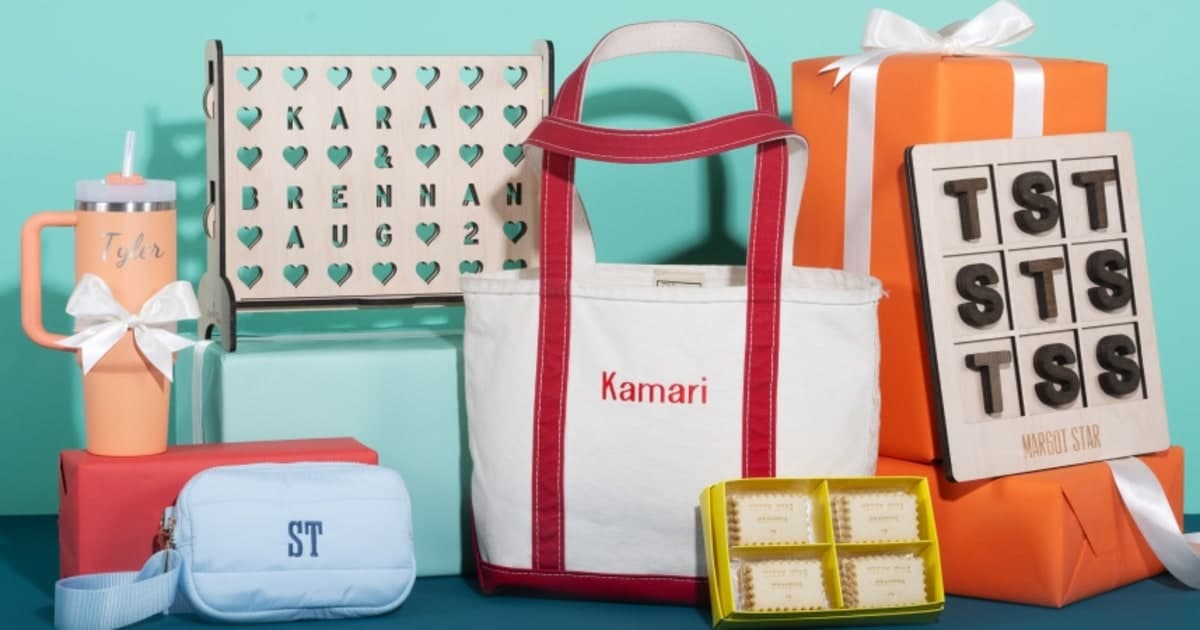
The contrast with a standard monogrammed tote bag is instructive. Both qualify as "personalized." Only one proves the giver was paying attention.
A buyer's playbook: matching gift type to recipient, budget, and timeline
The right personalized gift depends on three variables: your relationship to the recipient, your budget, and how much lead time you have.
Close friend or partner, $50-$150, one week or more
This is the sweet spot for coordinate or date engravings on quality goods. Mark & Graham offers leather goods, glassware, and home accessories with engraving and monogramming options, with a catalog structured around tasteful font choices and clean, considered placement. Uncommon Goods leans toward artisan-made pieces, including maps centered on meaningful locations and date-stamped items that feel genuinely distinctive. Both retailers provide digital mockups before you finalize an order, which matters: a well-conceived engraving killed by an unreadable font size is a preventable mistake.
Colleague or acquaintance, under $50
Etsy is the most versatile source at this price point, with hundreds of sellers offering digital-file personalization: custom portraits, map art, and typographic prints that can be delivered as downloads within 24 hours. Physical custom pieces from Etsy small-batch makers typically ship within three to seven business days. Etsy's Gift Mode, launched in January 2024 and powered by generative machine learning, helps narrow recommendations based on a recipient's individual profile and interests, a genuinely useful starting point when you don't know someone well.
Wedding, milestone birthday, or major life event, $150 and up, two or more weeks available
This is where premium personalization justifies its price. Custom-engraved jewelry, personalized leather travel accessories, and illustrated family portraits commissioned through Etsy or Uncommon Goods read as high-effort, considered gifts. Shutterfly's 24-Hour Designer Service reduces the friction of creating polished photo-based custom products, useful when a milestone arrives faster than expected. Personalization Mall, which holds 28% top-of-mind awareness in the U.S. market, and Zazzle, at 25%, both offer broad catalogs suited to life-event gifting with reliable production timelines.
Rush situations, same-week delivery
Look specifically for retailers advertising expedited engraving or embroidery. Several physical retail locations offer same-day or next-day personalization on select items. For truly last-minute needs, a digital custom illustration or personalized print from an Etsy seller with "instant download" labeling can arrive in minutes and be printed locally. The same-week custom window has compressed significantly in 2025 and 2026 as online retailers have invested in faster production capacity and better preview tooling.
The 3 questions that prevent a cringe custom gift
Before confirming any personalized order, run through these three:
- Would I buy this product without the personalization? If the answer is no, reconsider the base item. A good engraving cannot rescue weak construction or cheap materials.
- Does this detail require actual knowledge of the recipient? A name or initial requires no knowledge of the person. A coordinate, a meaningful date, a reference to a shared experience, or a private inside joke does. The second category is always the better gift.
- Have I checked the mockup? Every reputable retailer, from Mark & Graham to individual Etsy sellers, will generate a digital preview before you finalize. Study the font size, text placement, and legibility at actual scale. This step costs nothing and prevents the single most common mistake in custom gifting.
What has changed: fast-turn custom and AI-assisted previews
The most significant practical shift in personalized gifting over the last two years is the compression of turnaround times alongside a dramatic improvement in preview quality. Same-week physical personalization, once confined to mall kiosks and a handful of specialty jewelers, is now available from major online retailers. AI-generated mockups let buyers see a photo-realistic rendering of their engraved or embroidered item before committing, removing the uncertainty that historically made custom gifts feel risky for inexperienced buyers.
American Greetings demonstrated how mainstream the category has become when it launched its Pics & Wishes Digital Line in 2023 and followed in December 2024 with a Create-a-Card collection featuring recording artist Sia. Technavio's 2025 market analysis specifically identifies AI as a key transformation driver through 2029, projecting the global market will grow by $10.76 billion between 2025 and 2029. The tools are getting better; the barrier to giving a genuinely great custom gift is lower than it has ever been.
The eco-friendly angle
Home décor and accessories are the leading U.S. product category for personalized gifts, but within that segment, a sustainable sub-category is growing fast. Technavio cites eco-friendly personalized products as a key market driver, and Nielsen research finds 46% of global consumers are more likely to purchase eco-friendly items. One company specializing in customized eco-friendly gift baskets reported a 15% sales increase during the most recent holiday season. Natural wood, recycled textiles, and organic cotton pieces with embroidered personalization offer a base that aligns with both aesthetic quality and environmental considerations, and they tend to be the kind of products that pass the "would I buy this without the personalization?" test without hesitation.
The best personalized gift you will ever give is not the most expensive item on someone's shelf. It is the one they have to explain to visitors, because the detail on it is so specific to who they are that no one else would understand it. That specificity is not a feature of any particular retailer or price point. It is a function of paying attention, then choosing a product worthy of it.
This article was produced by Prism’s automated news system from verified source data, official records, and press releases, then run through automated quality and moderation checks before publishing. The system is built and supervised by the people who set the standards it runs under. Read our full AI policy.
Did this article answer your question?