Push Present Jewelry for New Mothers: Safe Styles and Smart Picks
Hailey Bieber debuted her diamond "MOM" ring two weeks postpartum, but most new mothers need jewelry that survives soapy hands, swollen fingers, and a baby who grabs everything.
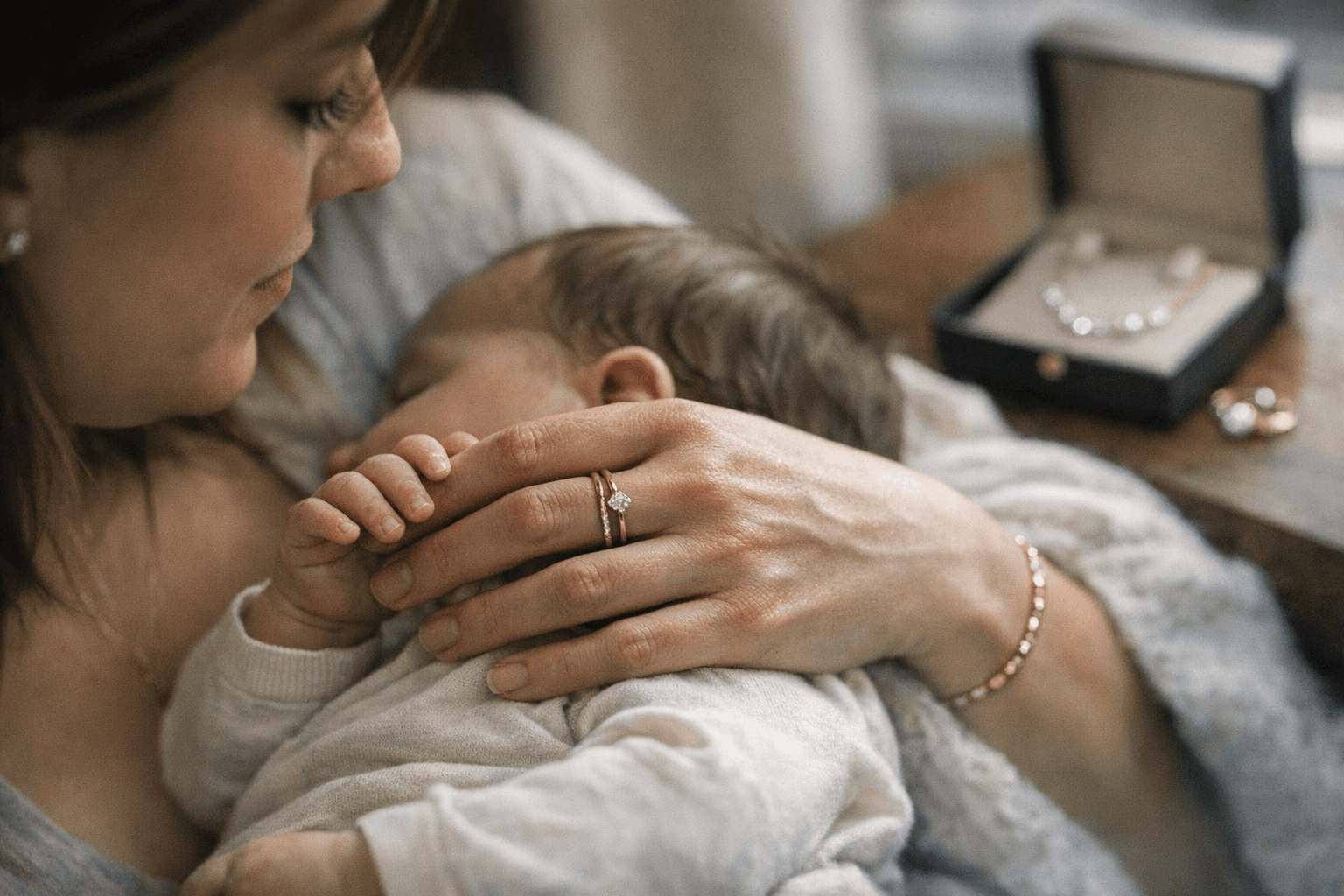
Two weeks after welcoming baby Jack Blues in August 2024, Hailey Bieber posted a close-up of a diamond-studded "MOM" ring to her Instagram Stories. The piece, crafted by Los Angeles jeweler Isa Grutman and retailing at $1,980, became the push-present moment of the season. What Bieber's post illustrated wasn't just the aesthetic appeal of birth jewelry; it was something more practical: the instinct to give a new mother something she will actually wear every day. That is a harder standard to meet than it sounds.
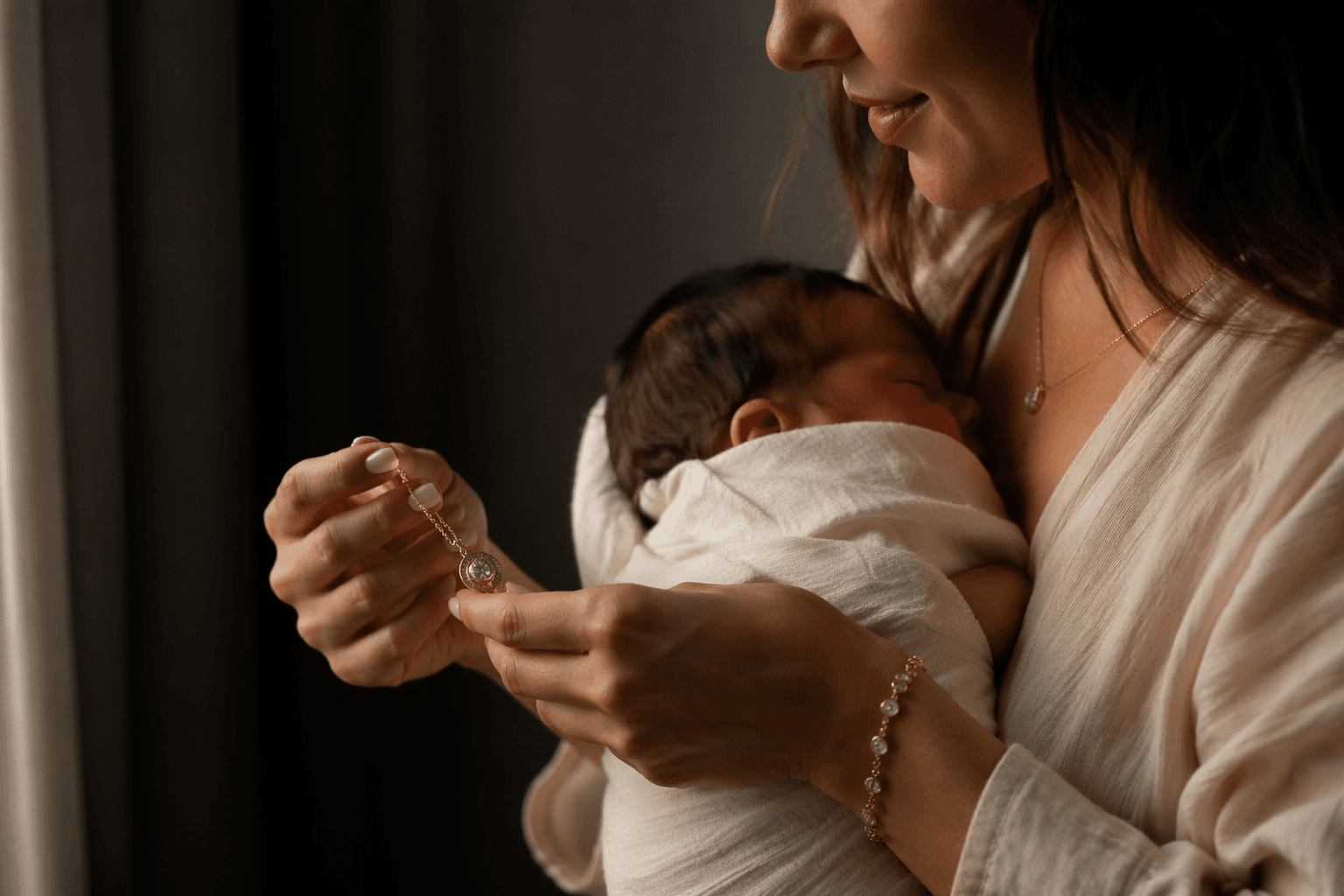
The first six to twelve months with a newborn involve relentless handwashing, unpredictable postpartum swelling, middle-of-the-night nursing sessions, and a baby who will grab and mouth anything that catches the light. The push present that photographs beautifully in the delivery room is not always the one that survives the fourth trimester. This guide is built to help partners choose once and choose well.
A tradition older than the term
Although "push present" sounds like early-2000s celebrity culture, the underlying tradition runs centuries deeper. Across India and the United Kingdom, families have long gifted jewelry and heirlooms after birth as symbols of love, gratitude, and continuity. In the United States, the tradition of giving diamond jewelry after childbirth may date to the mid-1930s, when brooches and engraved bracelets were favored gifts for new mothers, according to Fink's Jewelers. The specific phrase "push present" emerged in American media in the 1990s and entered mainstream vocabulary by the mid-2000s, a period that coincided with growing cultural attention to maternal health and a notable surge in media coverage.
Consumer opinion on the practice has always been divided. A 2004 BabyCenter survey of more than 30,000 respondents found that 38% of new mothers had already received a push present and 55% of pregnant mothers said they wanted one. A decade later, a 2015 Today show viewer survey found 45% opposed, 28% in support, and 26% who had never heard the term. The most consistent counterargument, voiced by roughly 40% of respondents in the BabyCenter data, was that the baby itself is already gift enough. Both camps agree on one thing: if jewelry is the choice, it should be something she can actually wear.
The constraints that most gift guides ignore
Here is what the first year of new motherhood looks like from a jewelry standpoint:
- Hands are washed constantly, often with hospital-grade soap, throughout every feeding and diaper change
- Fingers and wrists swell and contract unpredictably for weeks or months after delivery
- A curious infant will grab, pull, and mouth anything that dangles, swings, or catches the light
- Sleep deprivation means clasps, settings, and sizing details that require attention get quietly abandoned
Translating these realities into specifications is the most useful thing this guide can do. Think of every jewelry decision through one lens first: how likely is this piece to be grabbed, snagged, or cause injury during a feeding, a burp pat, or a 3 a.m. hold?
The baby-safe framework: settings, chains, and earrings
*Chains and necklaces:* A 16-to-18-inch chain rests at or above the collarbone, keeping it far enough from infant hands to reduce grab risk significantly while staying close enough to the body that it won't swing forward during nursing. Anything longer, including lariat styles and opera-length chains, moves directly into baby's reach. This is not a style judgment; it is physics.
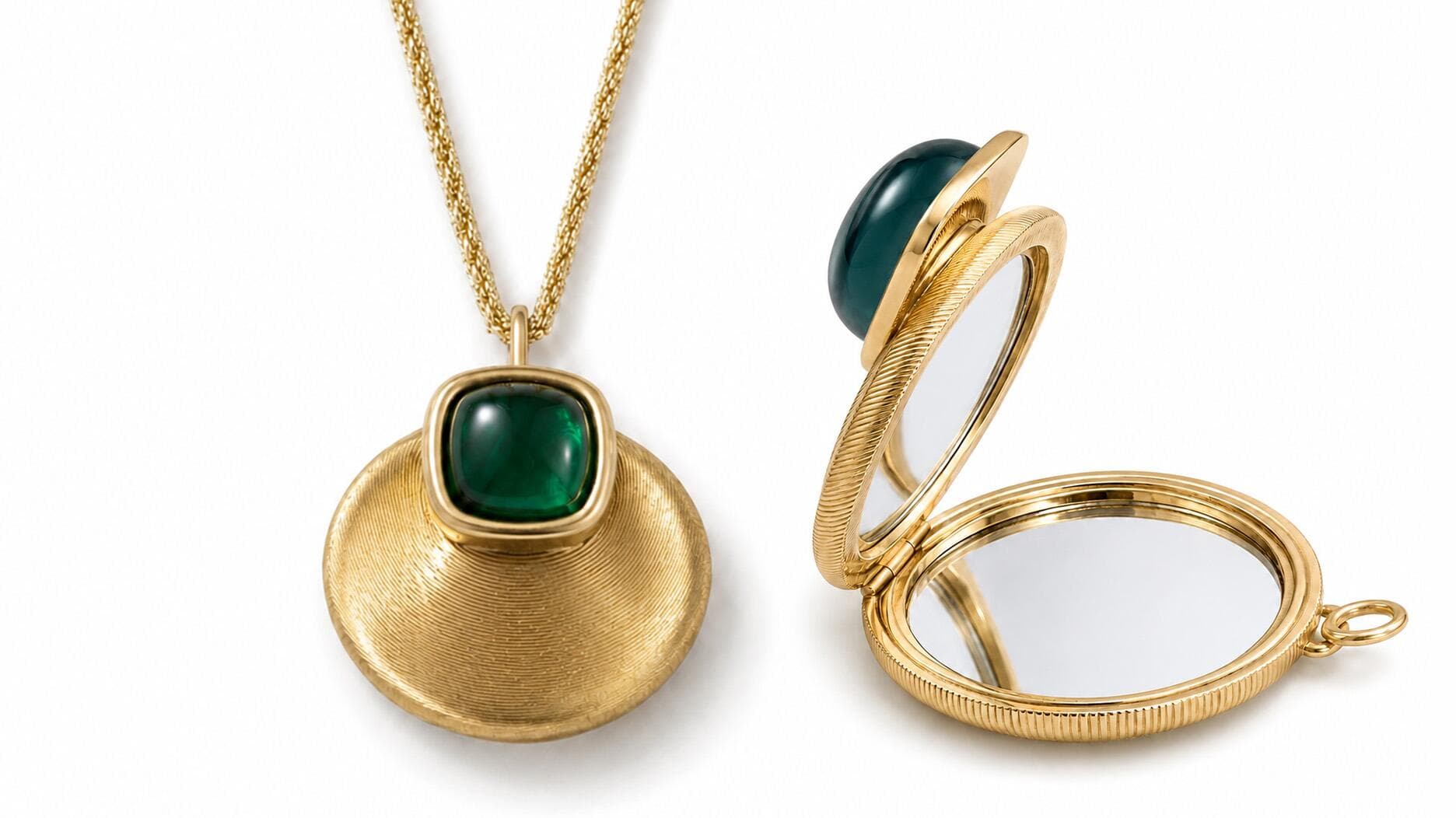
*Stone settings:* Bezel settings, which fully encase the stone in a rim of metal, have no exposed prongs for fabric or infant fingers to catch. A prong-set, high-profile solitaire pendant is the most common regret buy in this category: gorgeous at purchase, a daily snag risk in practice. For rings, a low-profile bezel or a flush-set band is the style that actually gets worn through year one.
*Earrings:* Studs are the unambiguous winner. No drops, no open-bottom hoops, no geometric chandeliers with moving parts. A pair of bezel-set diamond or birthstone studs in 14k gold offers zero grab points and unlimited wearability, morning to midnight.
The regret-buy checklist
- Long pendants that fall below the collarbone
- High-set prong solitaires on necklaces or rings
- Delicate chains under 1mm in width (they kink and break under daily stress)
- Gold-plated or gold-vermeil pieces (the outer layer wears off within months of repeated washing)
- Dangly or chandelier earrings with open hooks
- Bracelets with toggle or lobster clasps that require two hands to fasten
Metals that survive the handwashing reality
The recommendation of 14k gold or platinum is not arbitrary. At 58.3% pure gold, 14k gold balances purity with the hardness needed for daily wear. Platinum is hypoallergenic, extremely durable, and will not cause reactions during a postpartum period when the body is already in flux. Both metals hold up to repeated soap and water exposure without degrading. Gold-plated and gold-vermeil pieces, by contrast, rely on a thin outer layer that wears away quickly under frequent washing. A solid 14k gold stud will outlast a gold-plated chandelier every time, at any price point.
Lab-grown vs. natural stones: the honest numbers
The lab-grown diamond category has fundamentally changed the push-present math. As of 2025, a 1-carat lab-grown diamond averages $1,000 or less, compared to approximately $4,200 for a comparable natural stone. Lab-grown diamonds are chemically, physically, and optically identical to natural diamonds; the difference is origin, not quality. Prices have fallen approximately 74% from 2020 to 2025, driven by production outpacing demand. Lab-grown stones now represent roughly 20% of overall diamond sales and an estimated 45 to 52% of all U.S. engagement ring purchases, up from less than 1% of sales in 2015.
For partners who want the permanence and visual weight of diamond jewelry without the heirloom price tag, a lab-grown bezel-set stud or a low-profile lab diamond band represents genuine value at a moment when household finances are already under pressure. The case for natural diamonds remains real for families where provenance is part of the story. Luxury jeweler Kwiat reports that its push-present customers commonly spend $3,000 to $5,000 on a piece, a price point that reflects both the weight of natural stones and the symbolic weight of the occasion. Brilliant Earth, known for ethical sourcing standards across both lab and natural categories, consistently makes the point that emotional significance carries more weight than the number on the price tag.
Sizing and the postpartum window
Rings and bracelets require timing consideration that necklaces and studs do not. Postpartum swelling, driven by fluid retention that can persist for weeks or months after delivery, means a ring purchased before birth may not fit until well into the first year. Many jewelers and experienced mothers suggest waiting at least 12 months before resizing, as body composition continues to shift through breastfeeding. A solid gold or platinum band can always be resized by a professional jeweler; for simple bands, it is a straightforward procedure worth planning for at purchase.
If a ring is the intended gift, consider presenting it with an explicit invitation to schedule a proper sizing appointment together once the body has settled. That framing makes the gift feel considered rather than rushed. Necklaces and studs sidestep the issue entirely and are immediately wearable from the first day home.
Engraving: the detail that makes it specific
Engraving is what separates a beautiful piece from a personal one. Popular choices include the baby's name or initials, the delivery date, a brief love note, or the coordinates of the delivery location, whether that's a hospital, birthing center, or home. Coordinates have emerged as a modern, understated option: legible to the mother who knows, invisible to everyone else. A birthstone, either as the primary stone or alongside a diamond accent, adds another layer of meaning without requiring an inscription at all.
What to actually spend
Most couples spend between $50 and $300, with the overall range running from $10 to well above $10,000. American consumers spend an average of $240 per person per year on jewelry overall, a figure that helps contextualize why the $50 to $300 range feels accessible to most households. At any budget, the push-present pieces that earn daily wear share the same short list of properties: solid metal construction, a low-profile setting, a secure clasp or post, and a design simple enough to put on without thinking about it.
How to give it
The moment matters as much as the metal. The goal, as jewelers and parenting experts consistently frame it, is to signal: "I see you, I appreciate you, and I want to celebrate you." That tone is established by how the gift is given, not by its market value. A note that names something specific about what she went through, delivered privately and without spectacle, lands differently than a public gesture designed for an audience.
The push present that earns its place in her jewelry box is the one she reaches for on an ordinary Tuesday in month four, still nursing, still exhausted, wearing it anyway because it fits, feels comfortable, and means something. Choose for that woman.
This article was produced by Prism’s automated news system from verified source data, official records, and press releases, then run through automated quality and moderation checks before publishing. The system is built and supervised by the people who set the standards it runs under. Read our full AI policy.
Did this article answer your question?