Sweets Lead Valentine’s Shopping as Spending Reaches $29.1 Billion
Candy led Valentine’s purchases this year, with 56% of consumers planning to buy sweets as overall spending is forecast to hit a record $29.1 billion.
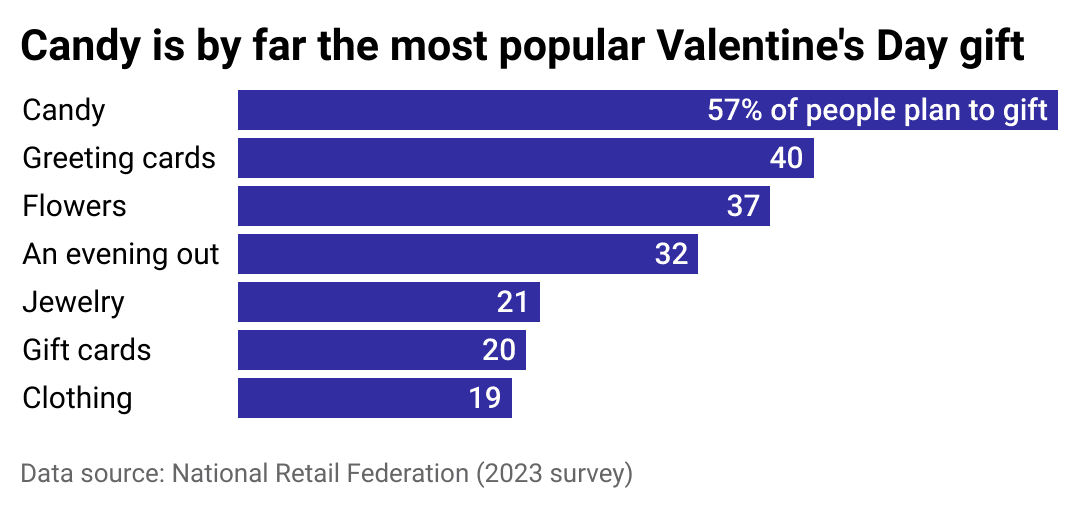
Candy dominated Valentine’s Day shopping this year, with 56% of consumers planning to purchase candy and “Sweets and candy remained the single most-purchased Valentine’s Day gift this year,” retail coverage shows. The preference for chocolate was bluntly summarized: “Nothing says I love you like chocolate,” an observation reflected across national retail data and lifestyle coverage.
Overall spending climbed to record levels. The annual survey released late January by the National Retail Federation and Prosper Insights & Analytics projects consumer spending will reach $29.1 billion this Valentine’s season, with the average shopper shelling out nearly $200 and the total expected to surpass the previous record of $27.5 billion set in 2025. Finviz summarized those headline figures and tied the average-spend estimate to broader market expectations heading into mid-February.
Pet-focused purchases stood out as a notable expansion of the holiday. A record 35% of Valentine’s Day shoppers are projected to buy gifts for their pets, totaling a “whopping $2.1 billion on their pets,” up from $1.7 billion in 2025. Multiple outlets highlighted that shift, and USA Inquirer preserved the year-over-year comparison as a clear sign that gift lists now routinely include animals alongside people.
Traditional categories held ground while experiential and unexpected gifts gained traction. “Cards and flowers also rank high, as does jewelry, according to the National Retail Federation,” coverage notes, and with Valentine’s Day falling on a Saturday this year, “experiential gifts are a big hit.” Retailers and restaurants saw the calendar placement as a practical driver of date-night bookings and experience purchases.
Reported shares of shoppers buying for romantic partners differ across summaries. One account states “83% of those celebrating will buy gifts for romantic partners,” while another synopsis of the NRF survey reports “55% plan to buy gifts for their significant others,” a figure Finviz connects to $14.5 billion in spending. Both figures are reported from NRF-related material; they stand side by side in coverage and merit review of the original NRF/Prosper release for precise question wording and sample framing.

Circana’s category analysis adds texture to the goods consumers selected. “More than 60% of consumers bought a present for their significant other for Valentine’s Day last year,” Circana finds, and it highlights growth beyond sweets: sales of fitness trackers rose across 2024 and 2025 with dollar sales “rising a whopping 187% last year,” driven in part by Oura rings as gift items. The juvenile books segment saw a 22% lift in units compared to the two weeks leading up to Valentine’s Day, and dollar sales of digital picture frames “surged 148% in the two weeks preceding Valentine’s Day last year.”
Product-level taste notes and market winners completed the picture. NewYorkMag and The Strategist recommend edible swaps such as Compartés Valentine’s Day Chocolates Heart Gift Box, Olivieri 1882’s two-sided heart, “one with candied apricots and the other in a deep, rich dark chocolate”, and less obvious gestures like “a box of pasta essentials to cook on date night and a decadent chocolate torte.” Strategist senior editor Hilary Reid called one nontraditional assortment “a ‘stylish alternative to the old Valentine’s Day box of chocolates.’”
Market-watch commentary pointed to beneficiaries of the surge: “Companies likely to benefit from the Valentine’s Day spending surge include florist 1-800-Flowers.com, Inc. (NASDAQ:FLWS), chocolate and candy makers, The Hershey Company (NYSE:HSY), and Mondelez International (NASDAQ:MDLZ), as well as specialty jewelry retailer Signet Jewelers (NYSE:SIG).” Katherine Cullen, NRF Vice President of Industry and Consumer Insights, framed the totals this way: “Valentine’s Day is a cherished holiday that resonates with many Americans, as seen with expected record-breaking spending this year.” Cullen added, “Much of that growth is driven by middle- and high-income shoppers who are expanding their gift lists to include friends, co-workers and even pets in addition to loved ones.”
The data sketch a holiday that remains centered on chocolate while stretching into wellness tech, children’s books, digital displays, and pet treats, a broader, higher-spending Valentine’s marketplace that retailers and gifters alike will watch closely as the season’s receipts are tallied.
This article was produced by Prism’s automated news system from verified source data, official records, and press releases, then run through automated quality and moderation checks before publishing. The system is built and supervised by the people who set the standards it runs under. Read our full AI policy.
Did this article answer your question?