Thoughtful Valentine's Day Gifts Signal Love More Than Price Ever Can
Research from Yale's School of Management confirms what great gift-givers already know: what you choose matters far more than what you spend.

There's a version of Valentine's Day that runs entirely on price anxiety. It looks like panic-buying the biggest bouquet at the grocery store checkout, or defaulting to a jewelry chain because the ad said she'd "love it." It costs more than it should, and it lands with less impact than you'd hope. Research from Yale School of Management cuts through exactly that kind of noise, and the findings are worth understanding before you spend a single dollar.
The core insight from Yale SOM's analysis of gift-giving psychology is deceptively simple: gifts are signals. They communicate something about the giver, the relationship, and how well one person actually knows another. Price is a blunt instrument. Thoughtfulness is precise. And the difference between a gift that genuinely moves someone and one that gets a polite "thank you" almost always comes down to signal clarity, not dollar amount.
What "signaling" actually means in practice
When researchers talk about gifts as signals, they mean that every gift choice broadcasts information. A generic gift, regardless of cost, signals low effort or low knowledge of the recipient. A specific, well-chosen gift signals that you've been paying attention. It says: I know what you love, I noticed that offhand thing you mentioned three months ago, I thought about you when I wasn't with you.
This is why a $30 book by an author your partner has been meaning to read will outperform a $150 box of chocolates almost every time. The book says something. The chocolates say "I needed to bring something." Neither is wrong, exactly, but only one of them lands as an act of care.
The implication for Valentine's gifting is that your research into who this person actually is right now matters more than your budget. What are they obsessed with this year? What's been hard for them lately? What small thing keeps coming up in conversation? The answers to those questions are your gift guide.
Gifts for the person who has been saying they need to slow down
If your partner, close friend, or family member has spent the last few months running ragged, the signal you want to send is: I see how depleted you are, and I want to give you permission to rest.
A beautiful candle from Flamingo Estate (around $48) made with garden-grown botanicals is specific enough to feel considered rather than generic. Pair it with a handwritten note that names exactly why you chose it, and you've just created a meaningful gift for under $60. If you want to spend more, a weighted blanket from Bearaby, which starts at around $199 for their organic cotton Napper, is genuinely luxurious and signals real investment in their comfort.
For something experiential, booking a single restorative treatment at a local spa and writing it into a proper card, complete with a date you've already cleared in their calendar, transforms a common gift into a specific act of planning on their behalf. That effort is the signal.
Gifts for the partner who is hard to shop for
The person who says "I don't need anything" is often the hardest to shop for and the most moved by a gift that proves you were listening anyway. The Yale SOM research reinforces what experienced gift-givers know intuitively: specificity is the antidote to the "I don't need anything" problem.
Go back through your mental catalog of the last six months. Did they mention a documentary they never got around to watching? A restaurant in a neighborhood they love that you haven't tried together? A kitchen tool they complained was missing from their setup? A $40 carbon steel pan from Matfer Bourgeat, a brand professional cooks swear by, will mean far more to someone who actually cooks than an expensive gift that has no relationship to their actual life.
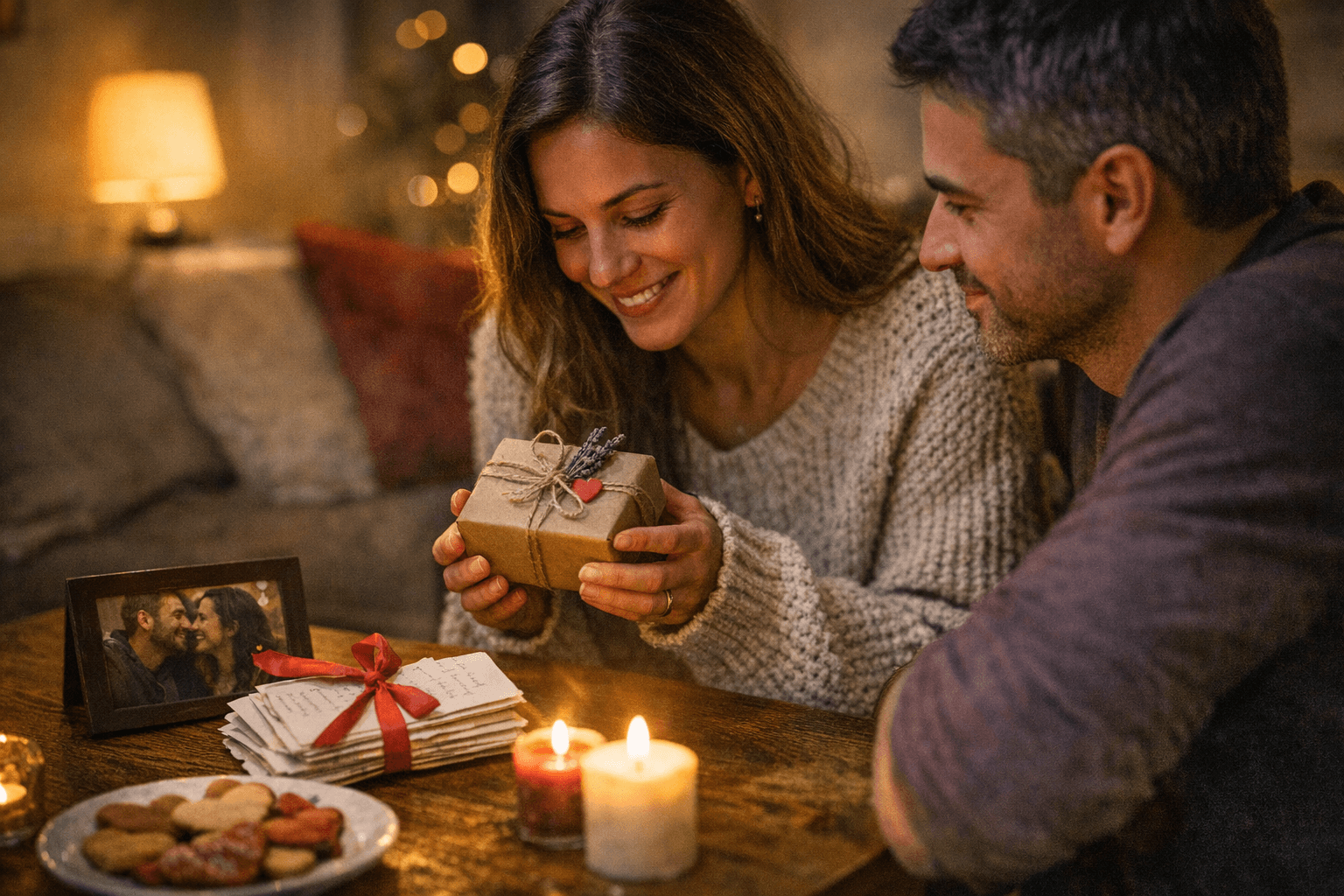
Custom or personalized gifts work particularly well here, not because personalization is inherently special, but because it requires you to make a decision. A custom star map from a site like Under Lucky Stars (around $50-$90) tied to a specific date that matters to your relationship is not interesting because it's personalized; it's interesting because choosing the date requires thought.
Gifts that create shared experience
Some of the most lasting Valentine's gifts are events, not objects. A cooking class, a ceramics workshop, a wine tasting, a concert you've already bought tickets for: all of these signal investment in the relationship itself rather than in the transaction of gift exchange.
The research-backed logic here is that shared experiences tend to increase relationship satisfaction in ways that objects don't. When you give an experience, you're also giving your time, which is genuinely the resource most people feel most starved for in adult relationships. A pasta-making class for two at a local culinary school typically runs $80 to $150 per couple and creates a memory that outlasts any box of chocolates.
If you want to spend less, design your own version: a handwritten "experience envelope" with a specific plan you've already thought through, a reservation you've already made, and a date you've already confirmed with their schedule in mind. The planning is the gift.
A word on flowers, chocolates, and the classics
None of the research suggests that traditional Valentine's gifts are bad choices. Flowers are genuinely beautiful. Good chocolate is one of life's pleasures. The issue is default-mode execution, choosing them because it's February 14th rather than because this specific person will love them.
If your person adores peonies, a hand-tied bouquet of peonies from a local florist says something completely different than a dozen red roses from a supermarket display. If they've mentioned a specific chocolatier, a box from that maker signals that you remembered. The category isn't the problem. Thoughtless execution within the category is.
Vosges Haut-Chocolat, for example, makes exotic chocolate bars starting around $12 each that feel genuinely special for someone who appreciates food. Recchiuti Confections in San Francisco produces some of the finest domestic truffles available, typically around $38 for a gift box, and they're specific enough to constitute a real recommendation rather than a placeholder.
The most important part of any gift
Yale SOM's framing of gifts as signals points toward one conclusion that holds across every price point and every category: the message matters as much as the object. Write the card. Be specific in it. Name why you chose what you chose. Tell them what it reminded you of, or what it made you think about them.
A $25 gift with a two-paragraph card that says something true will almost always beat a $200 gift with a store-supplied note. The signal is the love. The gift is just the vehicle.
This article was produced by Prism’s automated news system from verified source data, official records, and press releases, then run through automated quality and moderation checks before publishing. The system is built and supervised by the people who set the standards it runs under. Read our full AI policy.
Did this article answer your question?