Valentine's Day 2026 Shoppers Prioritize Personalization, Experiences Over Big Splurges
A record $29.1 billion in Valentine's Day spending, yet fewer than 55% of Americans celebrated — the growth came from shoppers buying for more people, not just partners.
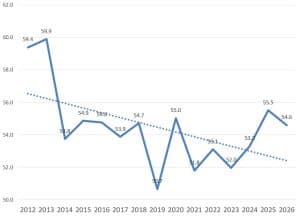
Valentine's Day 2026 produced a record $29.1 billion in consumer spending, according to the annual survey from the National Retail Federation and Prosper Insights & Analytics, but the number that tells the more interesting story is smaller: just 55% of U.S. adults participated. Spending hit an all-time high not because more people joined in, but because those who did celebrate opened their wallets wider and their gift lists longer.
The $29.1 billion total surpassed the previous record of $27.5 billion set in 2025, with shoppers budgeting an average of $199.78 per person, up from $188.81 the year prior and clearing the previous per-person record of $196.31 set in 2020. NRF Vice President of Industry and Consumer Insights Katherine Cullen pointed directly at who was driving that growth. "Much of that growth is driven by middle- and high-income shoppers who are expanding their gift lists to include friends, co-workers and even pets in addition to loved ones," Cullen said.
The numbers bear that out in ways that reframe Valentine's Day as something far bigger than a couples' holiday. While 83% of celebrators bought for romantic partners, sending total partner-gift spending to roughly $14.5 billion, 58% also purchased gifts for family members, with that segment expected to total $4.5 billion. About 32% of consumers planned to buy gifts for friends, and the same share, 32%, planned to buy for their pets. Even among those who said they were not celebrating at all, 29% still planned to mark the occasion in some way, whether by treating themselves or organizing a get-together with single friends and family members.
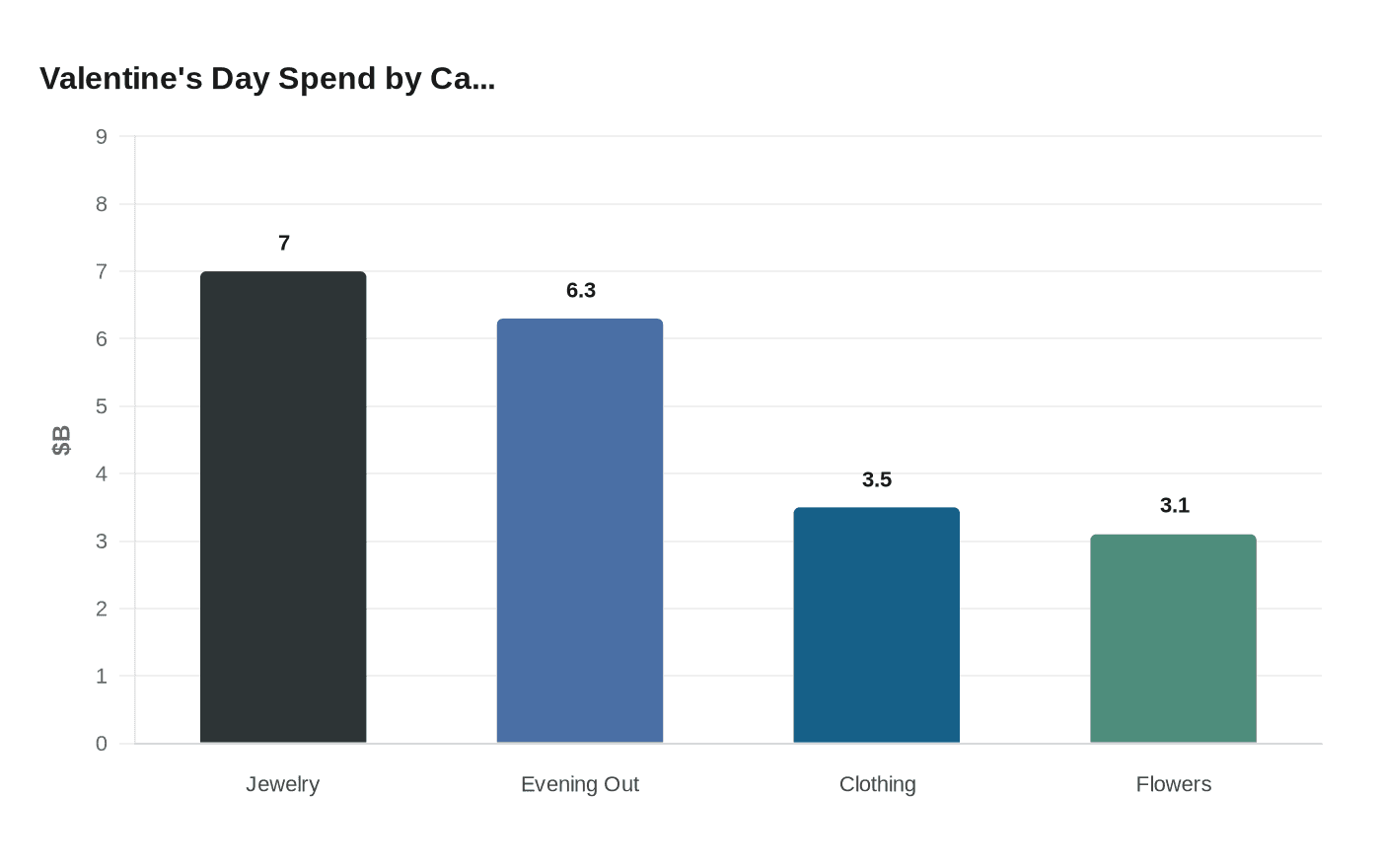
Jewelry topped the spending rankings for the tenth consecutive year, with shoppers projected to spend $7 billion on it, followed by $6.3 billion on an evening out, $3.5 billion on clothing, and $3.1 billion on flowers. That $6.3 billion for evenings out is the figure that most clearly reflects the experiential shift the survey identified. Reservations and shared moments competed seriously with physical gifts in the average household's Valentine's budget, and by total dollars, experiences ranked as the second-largest category in the holiday.
By popularity rather than dollars, the holiday's most traditional purchases still dominated: candy led at 56%, followed by flowers and greeting cards at 41% each, with an evening out at 39% and jewelry at 25%. The contrast between popularity rankings and dollar rankings captures the "affordable luxury" dynamic the research highlighted: many shoppers reached for candy and cards while a concentrated segment pushed jewelry spending to record levels.
Online shopping remained the leading purchase channel at 38%, followed by department stores at 34% and discount stores at 29%. Most shoppers planned in February, with a significant share making decisions in the week immediately before the holiday, a timeline that held consistent with prior years and continues to shape how retailers stock and promote in the final days before February 14.
The record aggregate figure combined with a participation rate just above half points to a structural shift in how Valentine's Day actually works as a retail event. Fewer people are celebrating, but those who are have expanded the definition of who deserves a gift, and that expansion, across friends, family, coworkers, and pets, is now the primary engine of growth.
Know something we missed? Have a correction or additional information?
Submit a Tip