Elegoo launches first filament dryer to fight moisture print failures
Elegoo's H1 HT dryer heats to 85°C to chase wet-filament failures, with a single-spool design aimed at popping, stringing and weak layers.
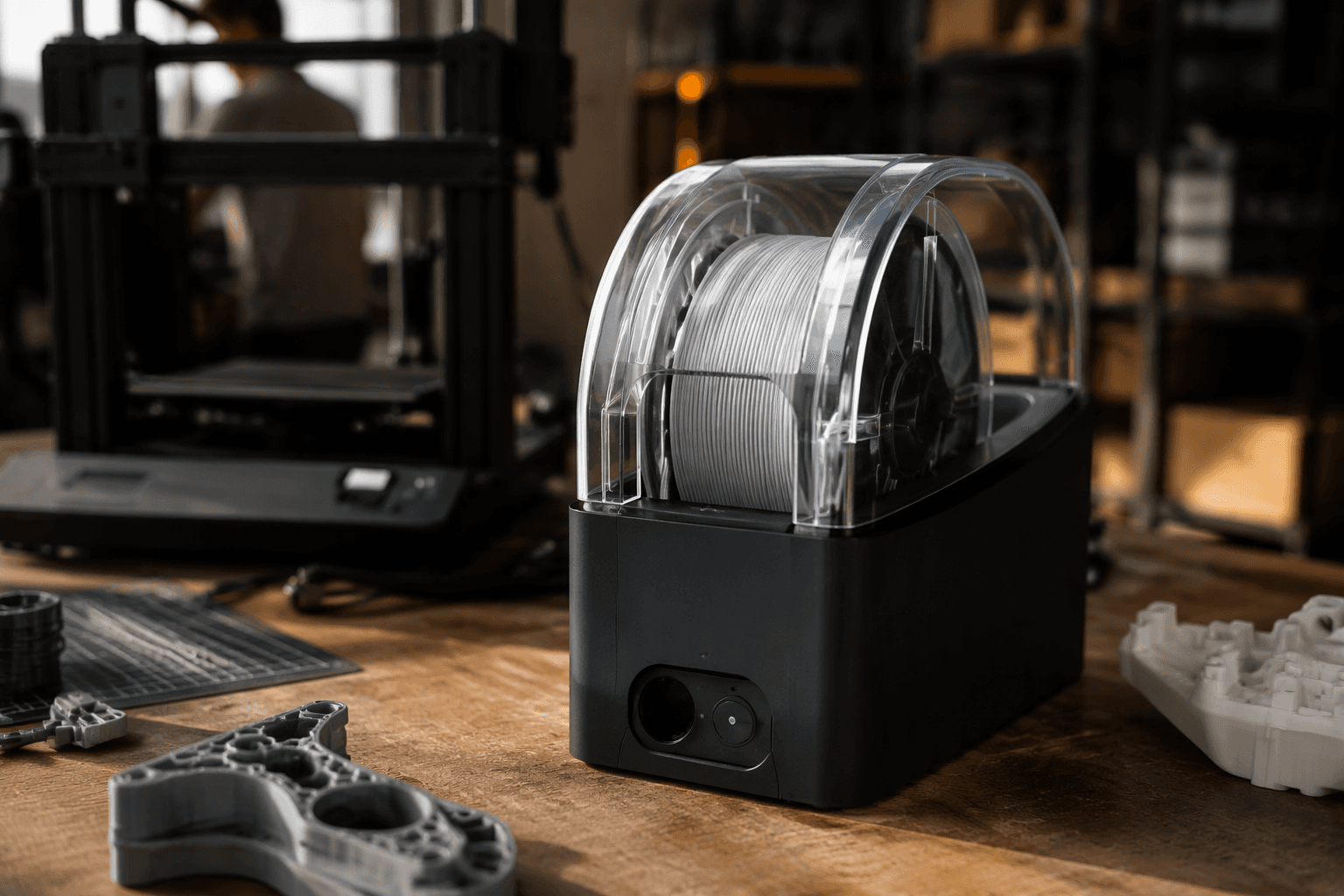
ELEGOO’s H1 HT Filament Dryer is the company’s first-ever dryer, and the 85°C ceiling is the number that will matter most to anyone battling wet-filament failures. In a July 24 release from Shenzhen, China, ELEGOO framed the single-spool unit as a direct answer to popping, stringing, weak layer bonding and surface blemishes caused by moisture. The promise is straightforward: dry the spool before it reaches the printer, and the run is far less likely to go sideways.
The H1 HT is being pitched as a broad accessory rather than a printer-specific add-on. VoxelMatters said it targets moisture-related print failures and works with virtually any filament extrusion 3D printer, while Engineering.com noted spool rotation, active vents and preset modes built to manage moisture before FDM printing. ELEGOO’s own blog pushed the same workflow message with the line “Deep Drying, Stable Printing.” Pricing landed in the $70 range, with The Crafty Catsman listing it at $70 and Dealroom summarizing it at $79.
That top-end temperature is what separates this dryer from a simple warming box. PLA is often dried around 55°C in community discussions on Bambu Lab and Prusa3D forums, PETG around 65°C and nylon around 75°C, which means the H1 HT’s 85°C ceiling gives real headroom for tougher hygroscopic materials and badly stored spools. If your bench lives on one material at a time and you keep filament sealed between prints, a dedicated dryer may feel like convenience. If you are fighting damp PETG, nylon or any spool that has started to hiss, string or extrude inconsistently, the higher heat makes more practical sense.
The interest around the H1 HT also fits a pattern that has been building for years. 3DPrintBeginner published a filament-drying guide in 2020, and the fact that Elegoo is now shipping its own unit shows how mainstream moisture control has become in everyday 3D printing. The hobby has moved well past treating drying as an advanced tweak, and the H1 HT is aimed squarely at the pain point makers know too well: a print that should have worked, but fails because the filament soaked up the room.
This article was produced by Prism’s automated news system from verified source data, official records, and press releases, then run through automated quality and moderation checks before publishing. The system is built and supervised by the people who set the standards it runs under. Read our full AI policy.
Did this article answer your question?