NC State composite self-heals delamination, could extend lifespans centuries
NC State’s self-healing composite has passed 1,000 repair cycles, a lab milestone that could one day make printed functional parts far less disposable.
A 3D-printed thermoplastic interlayer has now repaired delamination more than 1,000 times, pushing a long-running NC State composite project into territory that could reshape how aircraft, vehicles and other high-stress parts are built and maintained.
The material targets interlaminar delamination, the failure mode that shows up when layers separate from the matrix. Jason Patrick’s team at North Carolina State University says that problem has challenged fiber-reinforced polymer composites since the 1930s, even though FRP materials are prized in aircraft wings, turbine blades, automobiles, spacecraft, satellites and wind-turbine blades for their strength-to-weight ratio. NC State says conventional FRP composites are typically designed for 15 to 40 years, while the new self-healing approach could extend that lifetime by centuries.
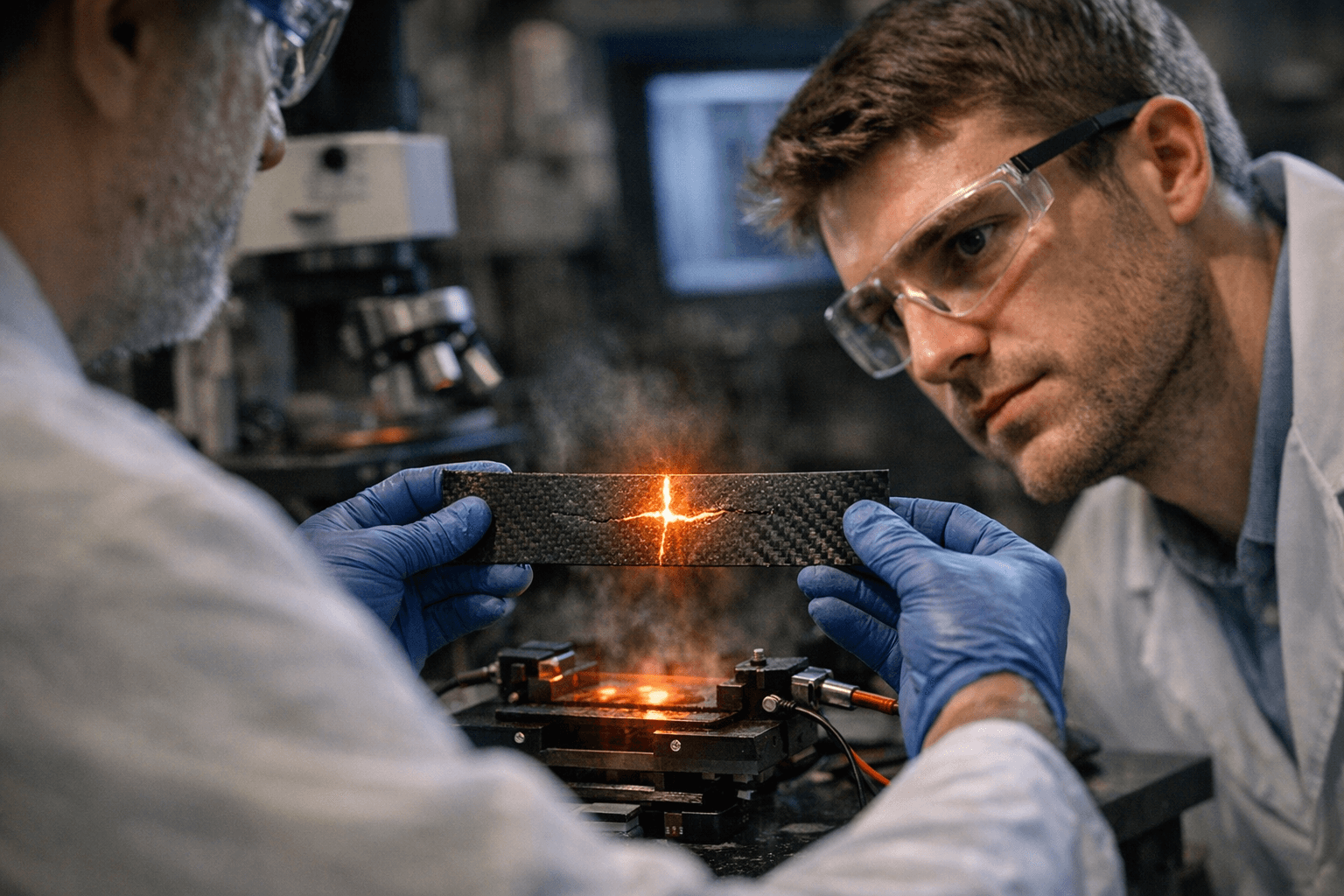
The trick is straightforward in concept and impressive in execution. Researchers 3D-print a thermoplastic healing agent into the composite structure and pair it with thin carbon-based heater layers. When current runs through the heaters, the composite warms, the thermoplastic melts, flows into cracks and microfractures, then re-bonds the damaged interfaces. That in-place repair matters because earlier self-healing composites often had to be removed from service to heal, or could only recover a limited number of times.
NC State first reported in 2022 that the concept had already healed at least 100 times without losing effectiveness. The university later said the printed thermoplastic interlayer made the laminate two to four times more resistant to delamination, and a 2024 paper drilled into EMAA thermoplastics, focusing on how chemistry and melt viscosity affect healing performance. The latest milestone, announced by NC State on January 14, 2026, shows the material repairing itself more than 1,000 times.
For hobbyists, the headline is not that a desktop filament swap is about to arrive next month. The practical takeaway is that the core idea behind repairable composite parts is getting much closer to real-world structural use, where repeated damage and maintenance cost real money. That could eventually matter for printed RC airframes, drone structures and other functional components if the same logic is translated into maker-friendly composite systems, repairable laminates or specialty filaments.
The commercial and government interest is already there. The University of Houston said in October 2025 that it received a $690,050 U.S. Army Research Office grant for self-healing composite work with NC State collaborator Kalyana B. Nakshatrala under the MEND-SCI project, with UH as the lead institution and NC State as a subcontracted partner. Patrick says the payoff would be lower replacement costs, less labor spent inspecting and repairing parts, lower energy use and less waste from discarded composite components.
That is the real shift here: not just a tougher composite, but a path toward parts that can be fixed in place instead of thrown away.
This article was produced by Prism’s automated news system from verified source data, official records, and press releases, then run through automated quality and moderation checks before publishing. The system is built and supervised by the people who set the standards it runs under. Read our full AI policy.
Did this article answer your question?