Protopasta’s carbon fiber PCTG proves smooth on a Prusa test print
A carbon-fiber PCTG spool just printed a useful broom holder cleanly on a Prusa CoreOne L, making the real question one of payoff, not novelty. The gains look practical, not decorative.

What this filament is trying to earn
Protopasta’s Carbon Fiber PCTG is built around a simple promise: make a functional co-polyester feel less like a compromise. The company says it starts with 100% new PCTG, is made in the USA, and is meant to give you the PETG-style workflow with better durability, UV resistance, and chemical resistance. In the high-impact version, Protopasta claims about 20% more strength and 115% more stiffness than unfilled PCTG, while also saying it stays more flexible than its High Strength Carbon Fiber PCTG.
That mix is what makes the material interesting to real printer owners. You are not buying it to chase a lab-number flex; you are buying it if you want a part that can take load, survive everyday use, and still print like something you would actually trust on a machine in your workshop.
Why the broom holder test matters
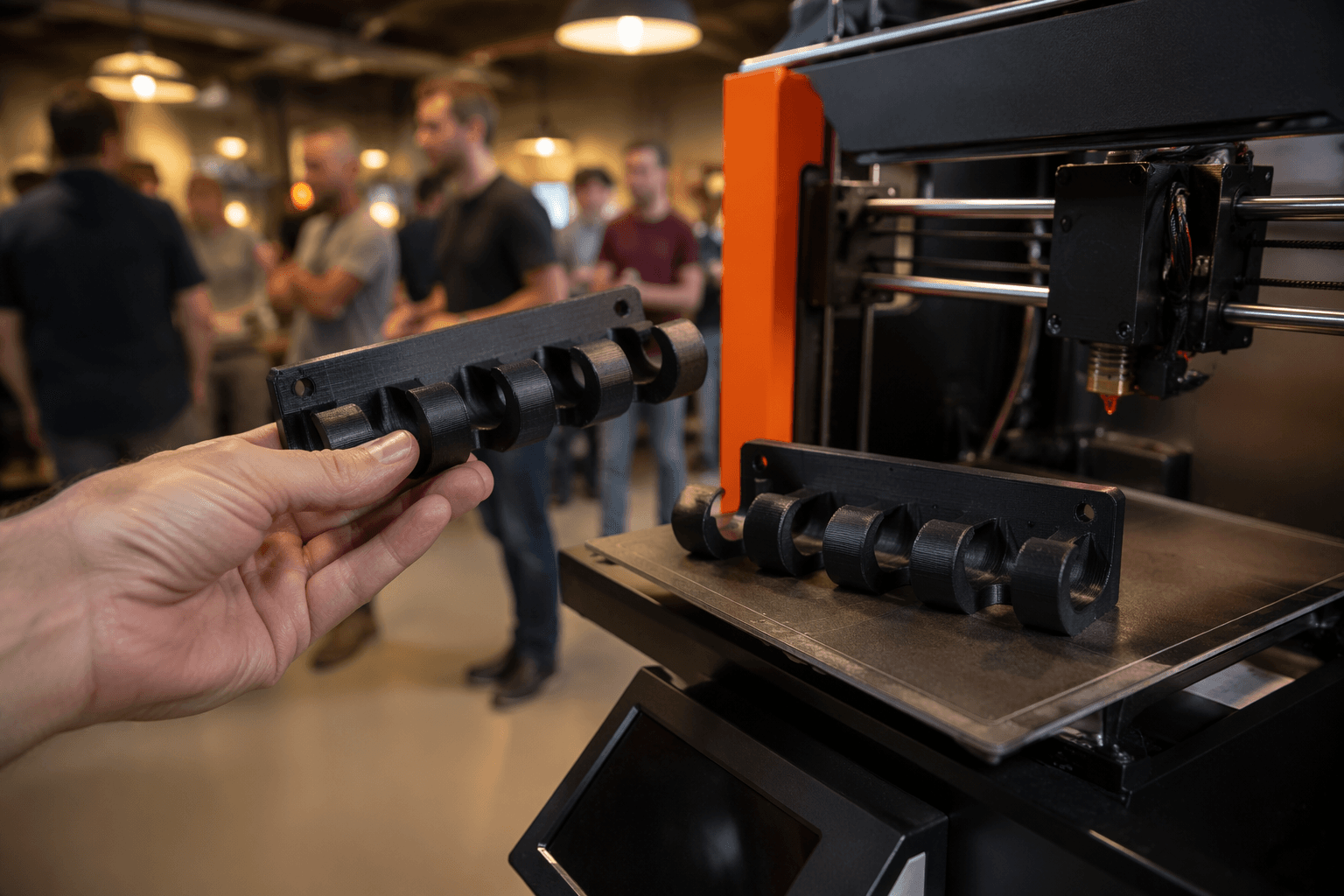
The print being used here is not a trophy model. It is a heavy-duty, snap-close broom wall holder 25mm remix by Simple£D on MakerWorld, a household storage part designed for 25 mm brooms or brushes. MakerWorld lists the model’s release date as April 26, 2025, which gives the test a practical anchor: this is a real utility part with a real fit requirement, not a stylized demo.
That matters because a filament can look great in a product page and still waste your time once the first layer starts. A broom holder has to snap, hold, and survive repeated use, so it is a much better judge of whether a carbon-fiber-filled spool is genuinely useful than a decorative print ever could be.
What the Prusa Core One L adds to the story
Prusa officially introduced the CORE One L on October 31, 2025 as the larger sibling to the CORE One. It offers a 300 x 300 x 330 mm build volume, or about 30 liters of print space, while keeping only about a 10% larger footprint than the standard CORE One. Prusa positions it as a machine aimed at uniform heating and workshop or business use, which is exactly the kind of environment where engineering filaments should show their best side.
That context makes the test feel credible. A large, functional part printed on a machine designed for consistent thermal behavior is a better stress test than a tiny sample on a finicky desktop setup. If a carbon-fiber PCTG spool prints smoothly there, it has a much stronger case for real-world jobs like brackets, tool holders, clips, and repair parts.
What you should expect before you buy
Protopasta recommends printing this filament at roughly 255°C to 275°C with an 80°C-plus bed, which puts it squarely in the “set up the machine properly” category. That temperature window is not exotic, but it is a reminder that this is not a throw-it-on-and-forget-it material. If your printer already behaves well with higher-temperature co-polyesters, you are in better shape than if you are still chasing first-layer consistency.
- Nozzle wear: carbon-fiber-filled filaments usually deserve attention here, especially if you print them often or for long runs. A clean print does not erase the fact that the filler is there to do work, and that means your hotend setup should be treated like an engineering toolchain, not a casual PLA profile.
- Drying: PCTG sits in the PETG family, so keeping the spool dry is still part of the normal routine. If you already dry and store engineering filaments carefully, this should feel familiar rather than burdensome.
- Enclosure and chamber expectations: this is not being pitched like a demanding high-temp exotic, but it does want a stable setup. The enclosed, uniformly heated character of the Core One L makes sense here, and that is one reason the test print feels like a better fit than a bare-bones machine with drafts and swingy ambient temps.
- Bed adhesion: the 80°C-plus bed recommendation suggests this is a material that wants a dependable build surface and a little thermal discipline. That is good news for people who care about repeatable utility parts, because the price of admission is mostly sensible setup, not ritual.
Does it beat standard PCTG or carbon PETG enough to matter?
This is the part that separates a buy from a curiosity. Protopasta’s own January 2026 testing notes say carbon-fiber-filled amorphous co-polyesters vary a lot by brand, and that some competing CF PCTG and PETG materials came out more brittle. That is the right warning label for this whole category: more fiber does not automatically mean a better part, and the wrong blend can feel impressive until you need it to bend, snap, or live through real use.
Compared with standard PCTG, the pitch here is straightforward: more stiffness, more strength, and a cleaner path to functional parts that feel serious without becoming brittle. Compared with carbon PETG, the appeal is that this looks like a more forgiving co-polyester recipe, not just a stiffer one. If you are printing fixtures, repair parts, clamps, or storage hardware on a Core One-class machine, that trade can make sense fast.
The real verdict
The broom holder test is telling because it strips away the marketing gloss. A carbon-fiber PCTG spool that can print a snap-close utility part smoothly on a Prusa Core One L is not promising magic, just fewer headaches and a more capable part. That is the whole point here: if your next print needs to hold, latch, and live on the wall, this is the kind of filament that earns its spot by getting out of the way.
Know something we missed? Have a correction or additional information?
Submit a Tip