Hatfield Rally House shows how hybrid pickleball and tennis clubs can thrive
Hatfield Rally House shows what the next pickleball phase looks like: a hybrid club built to keep both sports happy, separate, and busy under one roof.
A club built for the post-boom phase
Hatfield Rally House opened on January 10, 2026, and it arrives with a message that matters far beyond western Massachusetts: hybrid racquet clubs can work when they are designed on purpose, not patched together as a concession. Patrick Roche and his wife, Ashley Schaffer, first explored opening a tennis club nearly a decade ago, but the business case was weak then. By 2022, the pickleball surge had changed the math, and the idea came back as something bigger, a club where pickleball and tennis could live in the same building without feeling like rivals.
That shift is the real story. At 255 West St. in Hatfield, just off Exit 30 on Interstate 91, the club is not trying to choose sides. It is trying to make both sides stronger. Town records show Roche and Schaffer appeared before the Hatfield Select Board on January 13, 2026, to seek a wine and malt license, another sign that this was built as a full social venue, not just a place to rent court time and leave.
The layout solves the argument before it starts
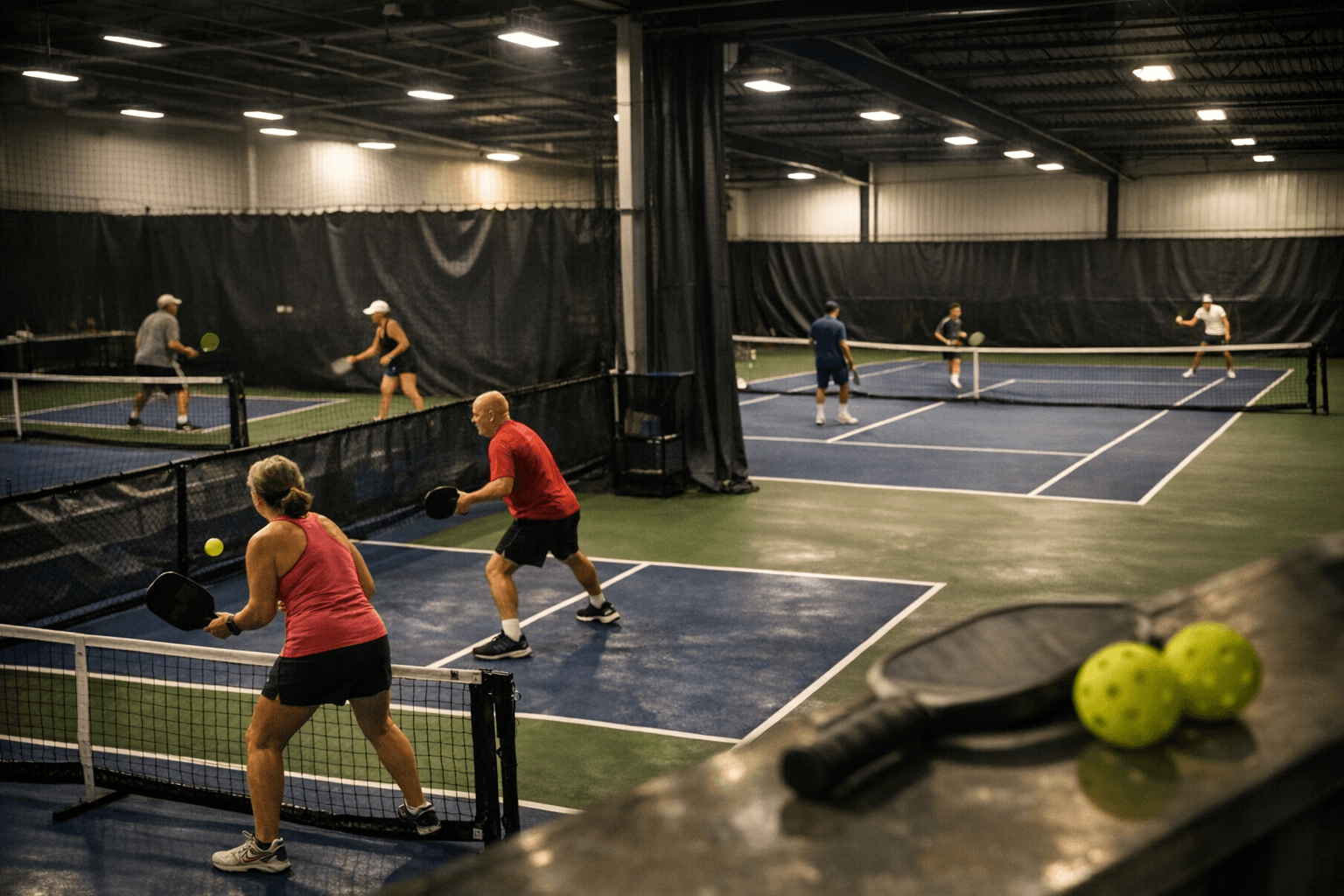
The club’s most useful idea is also its simplest: separate the sports physically, then connect them socially. Hatfield Rally House is a 60,000-square-foot facility with four tennis courts and eight pickleball courts, placed on opposite sides of the building. Between them sits a central lounge that works as both a buffer and a connector, which is exactly the kind of design choice shared-racquet facilities often miss.
That middle space matters because it changes the tone of the building. Instead of making one sport feel like it is intruding on the other, the lounge creates a place where players can see each other, meet between sessions, and cross over naturally. The same logic shows up in the rest of the footprint: a mezzanine, a grab-and-go café, a pro shop, a patio, and planned outdoor additions like bocce and beach courts. Website materials also emphasize Wi-Fi, food and drinks, showers, wheelchair accessibility, and a family-friendly environment. In other words, this is not just a court complex. It is a place built for lingering.
That is the practical lesson for local operators: shared facilities work better when the design acknowledges that noise, pace, and culture differ by sport. Hatfield does not pretend those differences are fake. It builds around them.
Pricing and programming make the mix feel fair
The other reason the hybrid model works here is that the club treats both sports as real products, not afterthoughts. The FAQ lists pickleball court time at $25 per hour and tennis court time at $35 per hour, with a $20 daily guest fee for non-members. That kind of transparent pricing helps the place feel balanced, especially in a market where players are used to comparing court access across clubs, parks, and private facilities.
Programming pushes that balance even further. Hatfield Rally House says it will offer beginner clinics, advanced sessions, intensity drills, racquet-sport triathlons, and spec tennis. The club’s website also says team leagues start in April 2026, and its events page lists a Spec Tennis Championship for April 18-19, 2026. That mix is smart because it gives players reasons to return at different stages of their development, whether they are brand new to one sport, already good at another, or looking for a crossover challenge.
The club’s own booking language makes the mission clear: it was born from a lifelong love of tennis and a desire to create a welcoming space where both pickleball and tennis players can play in harmony. That is not just branding. It is the operating logic.
Why this timing matters now
Hatfield Rally House lands at a moment when the broader court market is still expanding, but the easy early-boom assumptions are gone. USA Pickleball says its court-location database added more than 2,300 new locations in 2025, bringing the total to 18,258 locations nationwide, and that its database now includes 82,613 total known courts after 14,155 new courts were added in 2024. That kind of growth makes the sport impossible to ignore, but it also raises a harder question: what comes after the first rush of demand?
The answer is increasingly about design and coexistence. The United States Tennis Association says tennis had 23.8 million players in 2023 and that there are 252,000 tennis courts in the United States. Its 2022 Statement of Guidance supports sport-specific sites when possible, but also says shared-use approaches can make sense when dedicated sites are not feasible. That is the bridge Hatfield is walking across. It is not a tennis club reluctantly making room for pickleball, and it is not a pickleball barn trying to squeeze in a token court. It is a blended facility built around the idea that both sports can grow when the building respects each one.
Noise management is part of that, too. USA Pickleball’s Quiet Category and Noise-Reduced Category equipment designations show how seriously the sport is now taking acoustics. Hatfield’s physical separation and central buffer fit neatly into that shift. The lesson for operators is straightforward: if you want pickleball and tennis to coexist, you need more than a booking calendar. You need sound control, sightline planning, and a social spine that keeps the building from feeling divided.
Hatfield Rally House works because it treats hybrid as a design principle, a business plan, and a community promise at the same time. That is what the next stage of pickleball looks like when the boom gives way to something more durable.
Know something we missed? Have a correction or additional information?
Submit a Tip