Viral bath bomb videos are often too perfect to be real
The most polished bath bomb clips are often the least honest. Real bombs fizz fast, blur their colors, and leave traces, not perfect rainbow stacks or foam towers.
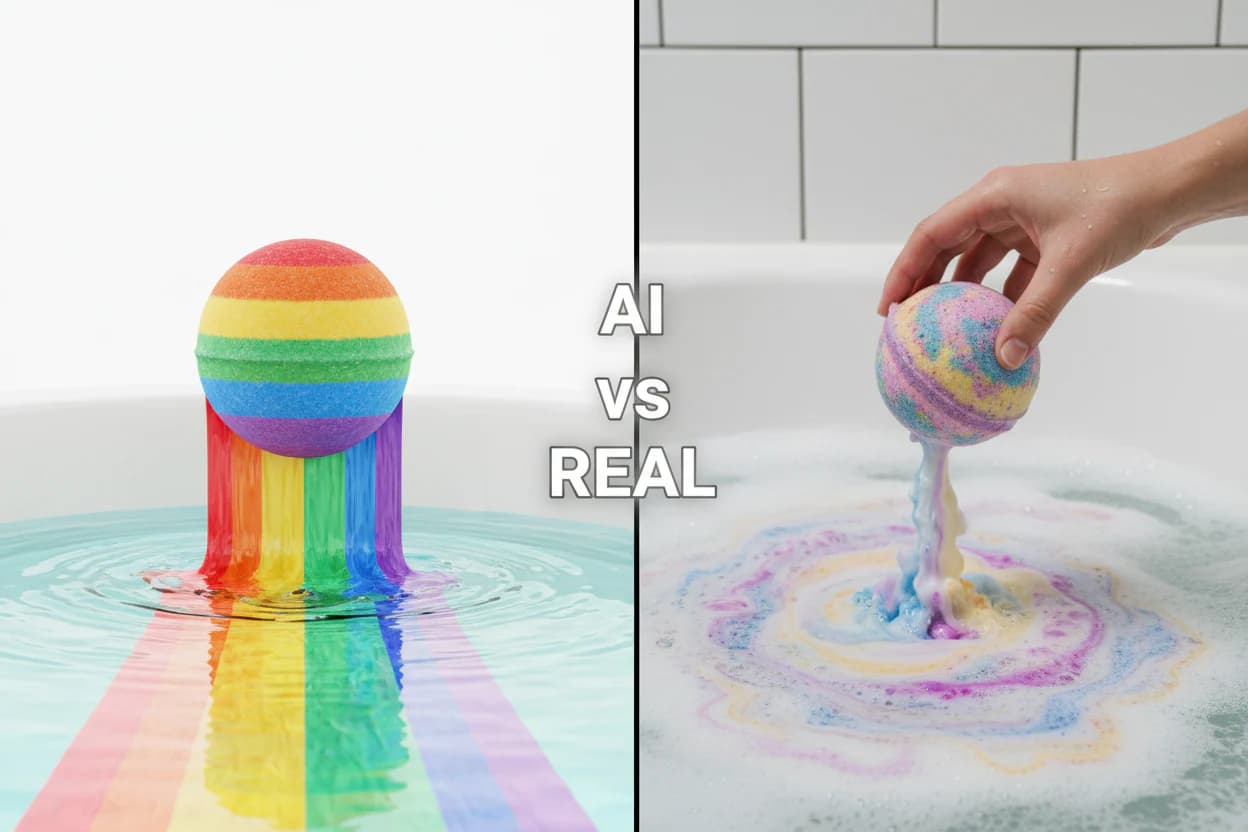
Drop a bath bomb into warm water and it starts fizzing almost immediately; the colors bloom and mix instead of holding the perfect stripes, sculpted foam, and color that seem to obey a director’s cue in viral TikTok and Instagram clips. In a real tub, the effect is more organic and a lot less symmetrical: the whole thing changes depending on water temperature, agitation, tub size, and the formula itself. That gap between the clip and the soak is where most of the confusion lives.
Myth: the clip is the product
The biggest bath bomb myth is that a bomb should look identical to the edited clip you saw online. That is not how these products behave in water, and the more “perfect” the reveal looks, the more likely it has been manipulated, staged, or generated to sell a fantasy instead of showing the actual drop. Bath bombs are highly visual, which is exactly why they are so easy to misrepresent.
The giveaway is usually physics. A real bath bomb breaks apart as it dissolves, so the color does not stay in neat rainbow bands for long, and the foam does not usually rise into a frozen tower that holds its shape for the camera.
Reality: the chemistry is the appeal
Bath bombs work through an acid-base reaction. When sodium bicarbonate meets an acid such as citric acid in water, the reaction releases carbon dioxide, and that gas is what creates the fizz and bubbles seen when the bomb hits the tub. The Smithsonian Science Education Center includes cornstarch and oils among common bath bomb ingredients: cornstarch slows the reaction so the fizz lasts longer, and oils can help bind the solid ingredients together.
That chemistry is part of why the category took off in the first place. The modern fizzing sphere is credited to Mo Constantine in 1989. Lush calls her the inventor and mother of the bath bomb, describes bath bombs as one of its best-selling inventions, and marks World Bath Bomb Day.

What a real tub actually does
Once it meets the water, the color will spread in marbling and swirls, sometimes quickly, sometimes more slowly, but it will not stay locked into perfect lanes for the full video.
Foam has limits too. Some formulas are designed to bubble more than others, but a real bath bomb should not need a skyscraper of suds to prove it is working. Water temperature, tub size, how much you move the water, and the exact ingredient mix all influence how far the fizz travels and how much foam you see.
Residue is another reality check. Because bath bombs are cosmetic products, they can leave traces from dyes, fragrance oils, essential oils, and other ingredients, especially if the formula is overloaded or poorly balanced. A little trace in the tub is not automatically a problem, but a heavy gritty ring or stubborn color stain can be a sign that the formula leans more on spectacle than on balance.
How to judge quality without getting fooled
If you want to read a bath bomb demo like an insider, look for the signs of a formula that behaves like one. The most useful clues are not the most dramatic ones.
- The ingredient list is visible and readable, because bath bombs are marketed as cosmetics, not novelty toys.
- The demo shows color spreading and breakup, not a color grid that never collapses.
- The foam rises naturally from the reaction, instead of appearing as an impossible set piece.
- The seller has a reputation for consistent formulas, not just one viral clip.
- The product looks like it would be comfortable in a real soak, not only photogenic on a phone screen.
That ingredient check matters for skin as much as for chemistry. The U.S. Food and Drug Administration has guidance for small businesses and homemade cosmetics that covers labeling and ingredient considerations, and Cleveland Clinic and WebMD warn that formulas can include fragrances, dyes, and essential oils that irritate sensitive skin.
Why the market is so easy to exaggerate
Bath bombs are not a tiny craft niche anymore. Grand View Research estimated the global bath bomb market at USD 1,859.7 million in 2023 and projected it to reach USD 2,837.8 million by 2030. Another market report put the category at USD 1.38 billion in 2024 and projected growth to USD 2.49 billion by 2034, which is a reminder that there is real money behind the shiny footage.
That scale helps explain the pressure to overperform online. When a product is this visual, a polished clip can travel farther than a truthful one, and a misleading demo can feel more persuasive than a careful explanation of how bath chemistry actually behaves. Honest creators have to work harder to show a bomb dissolving in real time.
This article was produced by Prism’s automated news system from verified source data, official records, and press releases, then run through automated quality and moderation checks before publishing. The system is built and supervised by the people who set the standards it runs under. Read our full AI policy.
Did this article answer your question?