Massimo Bandera’s larch showcases alpine resilience and refined deadwood
Massimo Bandera’s larch proves that deadwood only works when the tree still reads as a believable alpine survivor, not a stage prop.
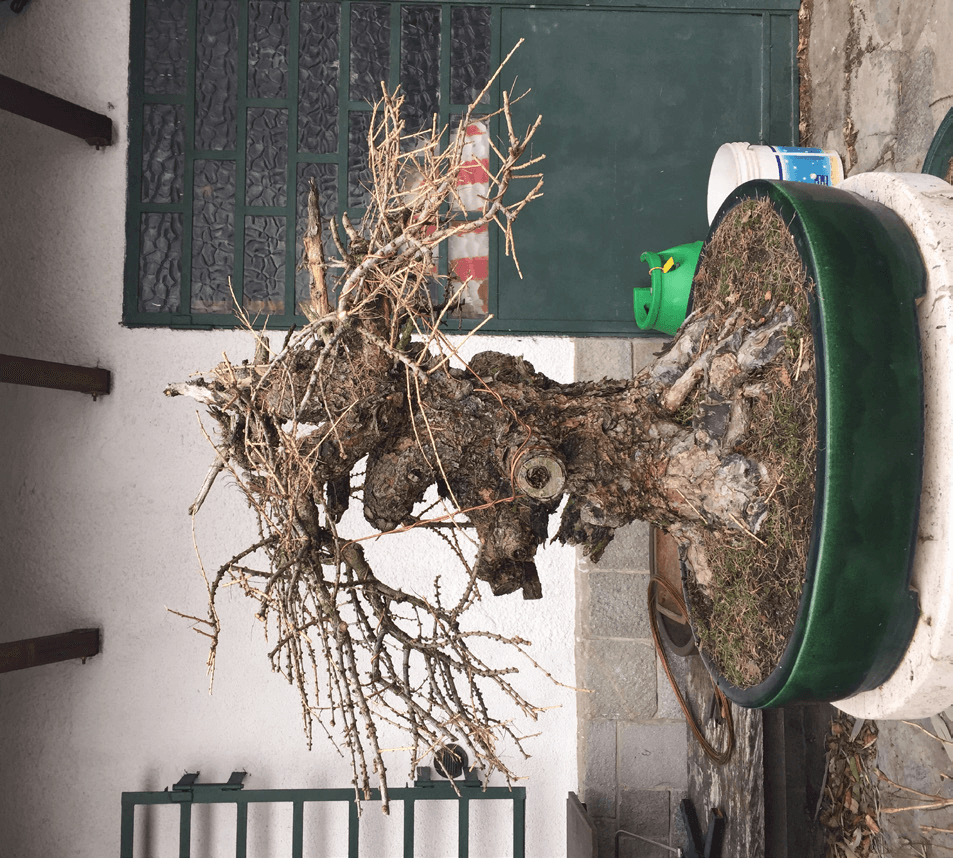
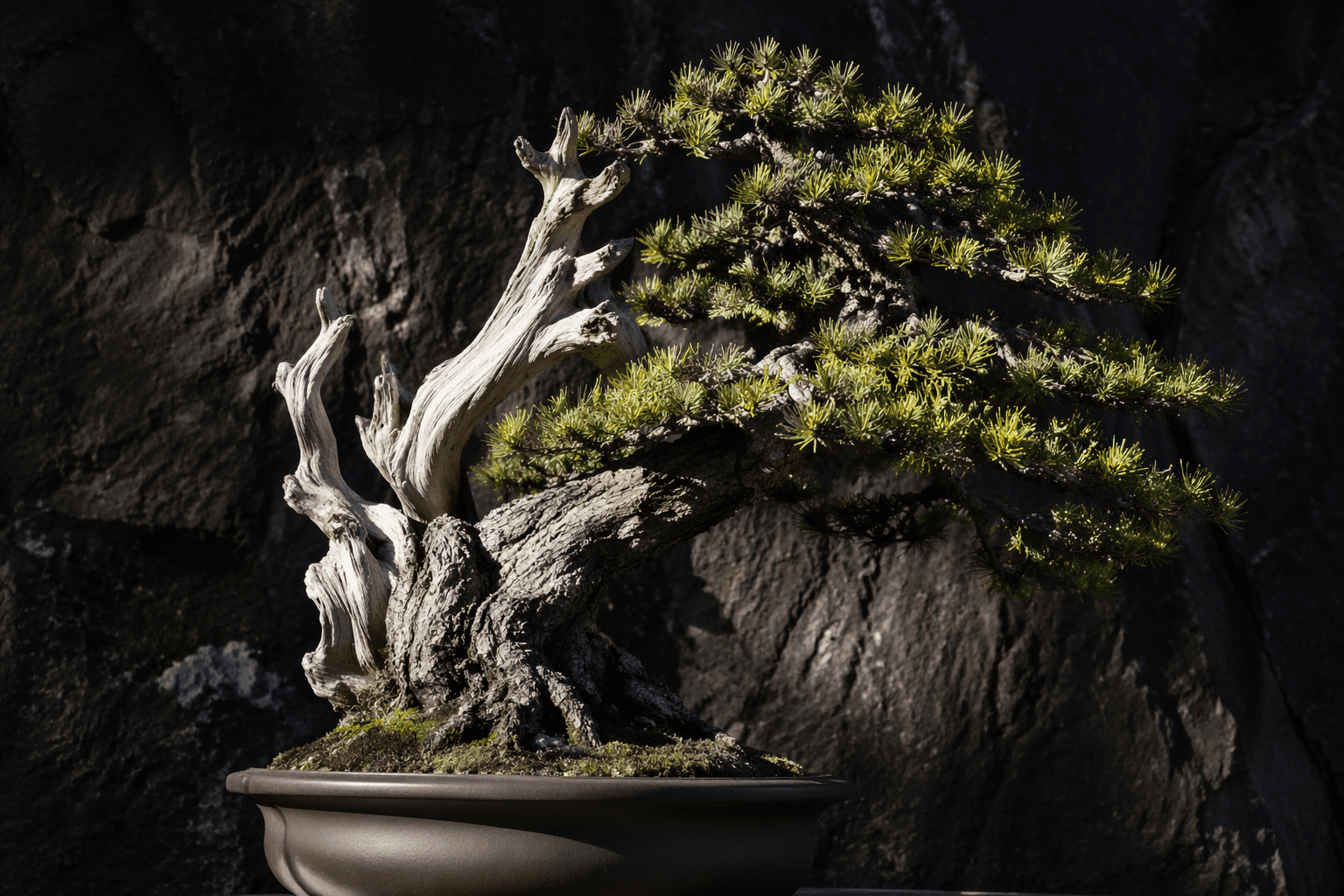
A convincing larch is never just about carving. In Massimo Bandera’s hands, the drama comes from making the deadwood serve the tree’s own story, so the trunk, nebari, and hollowed sections still read as one weathered alpine character. That balance is what gives this European larch its force: a tree with a nebari of about 40 cm and a height of roughly 80 cm, shaped to look ancient without losing the honesty of the material.
Reading the tree before reaching for the tool
Bandera’s larch works because the design begins with observation, not force. The upper jin becomes part of the image only because the trunk already carries the right history in its folds and hollows, and the carving simply clarifies what is there. In the finished reading, the deadwood does not shout over the living structure. It supports the illusion of age, weather, and survival.
That approach fits Bandera himself. Born in 1967, he says he has devoted himself to bonsai since 1978, and his own view of the art is divided into three branches: art, nature, and human experience. Those ideas are easy to say and hard to practice, but this larch makes them visible. The work is technical, yet the goal is emotional truth.
Why European larch is such a demanding subject
Larix decidua is one of the great alpine trees, native to the mountains of central Europe, especially the Alps and the Carpathians. It carries the seasonal rhythm that bonsai artists love: soft young growth, bright autumn color, and a conifer form that still behaves like a deciduous tree. That combination gives the species an unusual presence in a pot, but it also makes it unforgiving when conditions drift away from mountain reality.
The lowland climate around Milan is a hard place to keep a larch at its best. The humid Po Valley summers, the milder nights, and the reduced mountain swing in temperature all work against the species. Larch needs cool nights, moving air, and strong day-night contrasts that echo its native elevation. Without that, the tree loses the edge that makes it thrive.
The wider climate picture reinforces the same lesson. Research on European larch has shown that growth and wood formation are strongly tied to climate and elevation, and that warming has reduced growth and wood density at lower elevations in the French Alps. A 2024 study of plantations in northern Spain also used climate, drought, and tree-ring data from four sites to benchmark how the species tolerates stress. In other words, this is not a casual species in a warm basin. It is a tree that tells you immediately when the setting no longer feels alpine.
Deadwood that matches the species
Larch bonsai has its own visual grammar, and deadwood is part of it. Carving is often used to create or refine jins that fit the tree’s character, not to impose an unrelated fantasy on the trunk. The species already brings rugged bark, strong seasonal change, and a dramatic silhouette, so the deadwood has to feel like the next chapter of the same tree rather than a separate idea glued on top.
Bandera’s winter 2023 work centered on carving, trunk refinement, and bringing the hollowed areas forward so the tree would read as aged and exposed. The upper jin, once worked into the composition, began to suggest a dragon-like form, but the power of that image comes from restraint. The tree is still a larch first. The deadwood only deepens what the living structure was already saying.
That is the practical lesson in the piece: when the character is right, carving can sharpen expression. When it is not, it becomes decoration. On a species like larch, with its rugged trunk line and seasonal brilliance, the best carving is usually the kind you notice after you have already accepted the tree as believable.
Bandera’s place in the wider bonsai world
Bandera is not a marginal figure working in isolation. MAO Torino described him as one of Italy’s and the world’s leading bonsai artists, and his role there extended beyond this single tree. In October 2023, the museum’s terrace opened as an open-air bonsai museum with eight selected specimens chosen by Bandera, with the project scheduled to run through September 30, 2024. That context matters because it places his larch within a broader curatorial eye, one that understands both display and species character.
His teaching and exhibition record also stretches back for decades, including collaborations and demonstrations from the mid-1980s onward. More recent educational events at MAO in 2024 and 2025 show that his influence is still active, not just historical. The larch belongs to that ongoing practice: a living demonstration of how a senior artist reads material, refines it, and stops before the tree loses its voice.
What this larch teaches about technique and patience
The story is not only about the tree. It is also about the reality of workshop work, where a single cut can interrupt months of progress. During the project, the author cut a hand with a carving bit, and that injury delayed completion for months. The delay becomes part of the work’s emotional shape, because bonsai often advances through exactly that mix of concentration, setback, and return.
For larch, that patience is not optional. The species demands an environment that resembles the mountains, and it asks for a design that feels earned rather than staged. Bandera’s tree answers both demands at once: the mountain species is kept believable, and the deadwood is refined until it strengthens the image instead of overpowering it.
That is why the tree lands so well. The larch is resilient, but resilience alone is not the point. The point is that the craftsmanship never breaks the illusion of a real alpine survivor, and that is where the work becomes memorable.
This article was produced by Prism’s automated news system from verified source data, official records, and press releases, then run through automated quality and moderation checks before publishing. The system is built and supervised by the people who set the standards it runs under. Read our full AI policy.
Did this article answer your question?