Swindon bonsai club workshop turns Japanese black pines into teaching tools
Swindon & District Bonsai put Japanese black pines on the workbench, not the pedestal, giving members a live lesson in pruning, wiring, and long-term development.
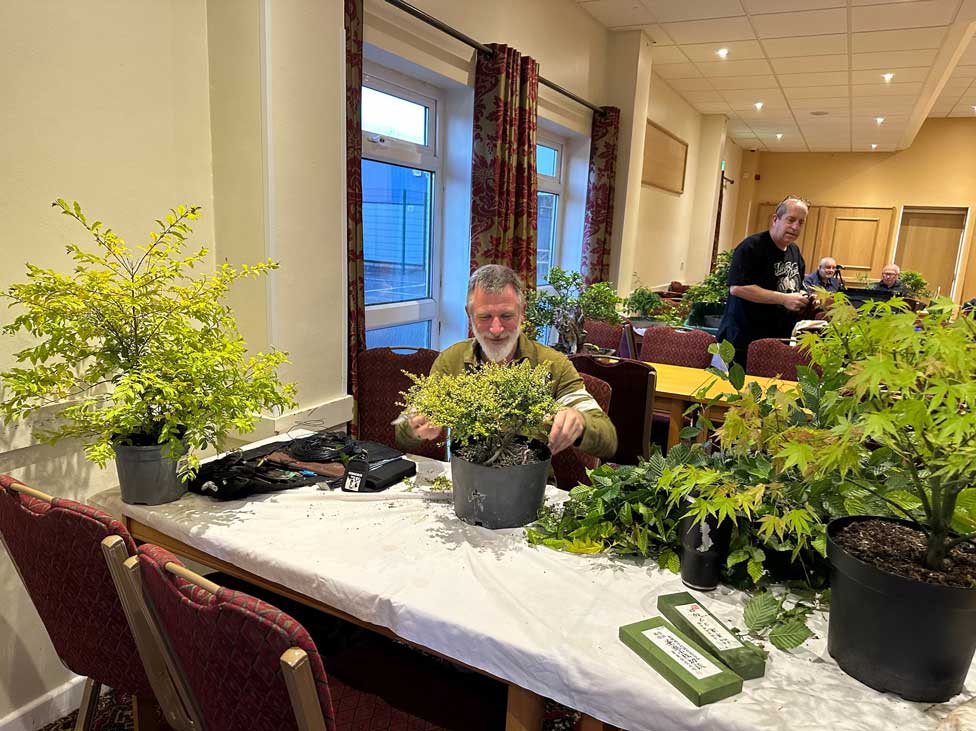
Swindon & District Bonsai used its June club meeting to show exactly why small societies still matter: they put living material in front of members and let everyone work through the decisions together. Andy brought Japanese black pines he has been growing with and for club members, turning the evening into a practical session built around observation, technique, and shared problem-solving rather than a passive talk.
Japanese black pines as teaching stock
The pines were not presented as finished show trees. They were there to demonstrate progress and to open up discussion about possible future techniques, which is often where the most useful club learning happens. Members were invited to have a go themselves, with pruning and wiring at the centre of the session, so the evening functioned as a workshop in the truest sense.
That matters because Japanese black pine work is rarely about one dramatic styling session. It is about reading the tree, choosing what to remove, deciding what to hold, and understanding how each action affects the next season’s development. By bringing in material that already had history, rather than starting with a blank demo tree, the club gave members a chance to think like growers instead of spectators.
Why the basket-grown trees stood out
One of the most useful details in the club’s post was the container choice. The pines have been kept in aquatic baskets, which the club says prevents overwatering. That directly ties a technical growing method to visible results, and it is exactly the kind of practical detail that makes a local club night worthwhile.
The club says the trees are showing strong year-on-year growth and development, which makes them especially effective as teaching material. Members were not just told that a technique works, they could see that the trees have responded over time. In bonsai, that kind of proof matters, because the best lessons usually come from trees that have already been pushed, recovered, and refined through several growing cycles.

For anyone following pine culture, the combination of basket growing, controlled moisture, and steady development offers a straightforward lesson: container choice can shape both vigor and refinement. Here, the growing system was not an abstract idea. It was part of the lesson itself.
A meeting built around participation
The social rhythm of the evening was just as important as the horticulture. Members were not simply watching Andy work. They were invited to compare notes, try pruning and wiring for themselves, and see how a branch changes when the tools come out. That kind of participatory format keeps a club alive, because the knowledge is moving between hands, not just from speaker to audience.
The June meeting also asked members to bring accent plants and display combinations from a recent shitakusa and kusamono workshop with Ritta Copper. That widens the picture beyond tree styling alone and shows a club culture that values presentation as well as structure. Accent plants and companion display work are part of the same visual conversation as the tree, and the request made it clear that Swindon members are being encouraged to think about complete compositions, not isolated specimens.
A club with a steady teaching rhythm
The June session fits into a broader pattern of hands-on meetings and workshops. The club’s April 2026 meeting drew an excellent turnout, with members enjoying an engaging evening of discussion, seasonal tree-care advice, and time spent sharing progress on their own trees. Pruning and repotting were part of that discussion, which suggests a programme designed to stay useful across the bonsai calendar rather than one that relies on occasional showpiece events.

The club has also been building a body of Japanese black pine knowledge over time. An earlier April 2023 club night featured a talk on Japanese black pine by Andy, who was identified in that post as the club’s new vice chairman. That continuity matters. When the same species returns to the agenda in different formats, a club can move from broad guidance to real refinement, with members seeing how advice from one year translates into work on living trees later on.
The result is a society that keeps technique current by repeating the right subjects in different ways. One month it is seasonal care, another it is pine development, and another it is the display side of the hobby. Together, those meetings create a learning cycle that members can actually use.
Where the society meets
Swindon & District Bonsai Society is listed as meeting at Coleview Community Centre, Towcester Road, Stratton St Margaret, Swindon SN3 4AS. A club listing gives the meeting time as 7.30 until 10.00pm, and another directory identifies the society as part of the Federation of British Bonsai Societies.
That setting helps explain the club’s approach. A regular venue, a fixed evening slot, and a place within a wider federation all support the kind of steady, practical work seen in the June meeting. The society’s public listings point to a group that is not just gathering to talk about bonsai, but using the club format to keep skills moving from one meeting to the next.
By putting Japanese black pines on the table and letting members work them in real time, Swindon & District Bonsai showed how local clubs keep the craft alive. The lesson was not that bonsai is something to watch from a distance. It was that the best club nights still happen when the trees, the tools, and the people all meet in the same room.
This article was produced by Prism’s automated news system from verified source data, official records, and press releases, then run through automated quality and moderation checks before publishing. The system is built and supervised by the people who set the standards it runs under. Read our full AI policy.
Did this article answer your question?