London sand mandala becomes a public lesson in impermanence
A London sand mandala turned a gallery into a public classroom on impermanence, as three Tibetan monks built and then dissolved the work before thousands.
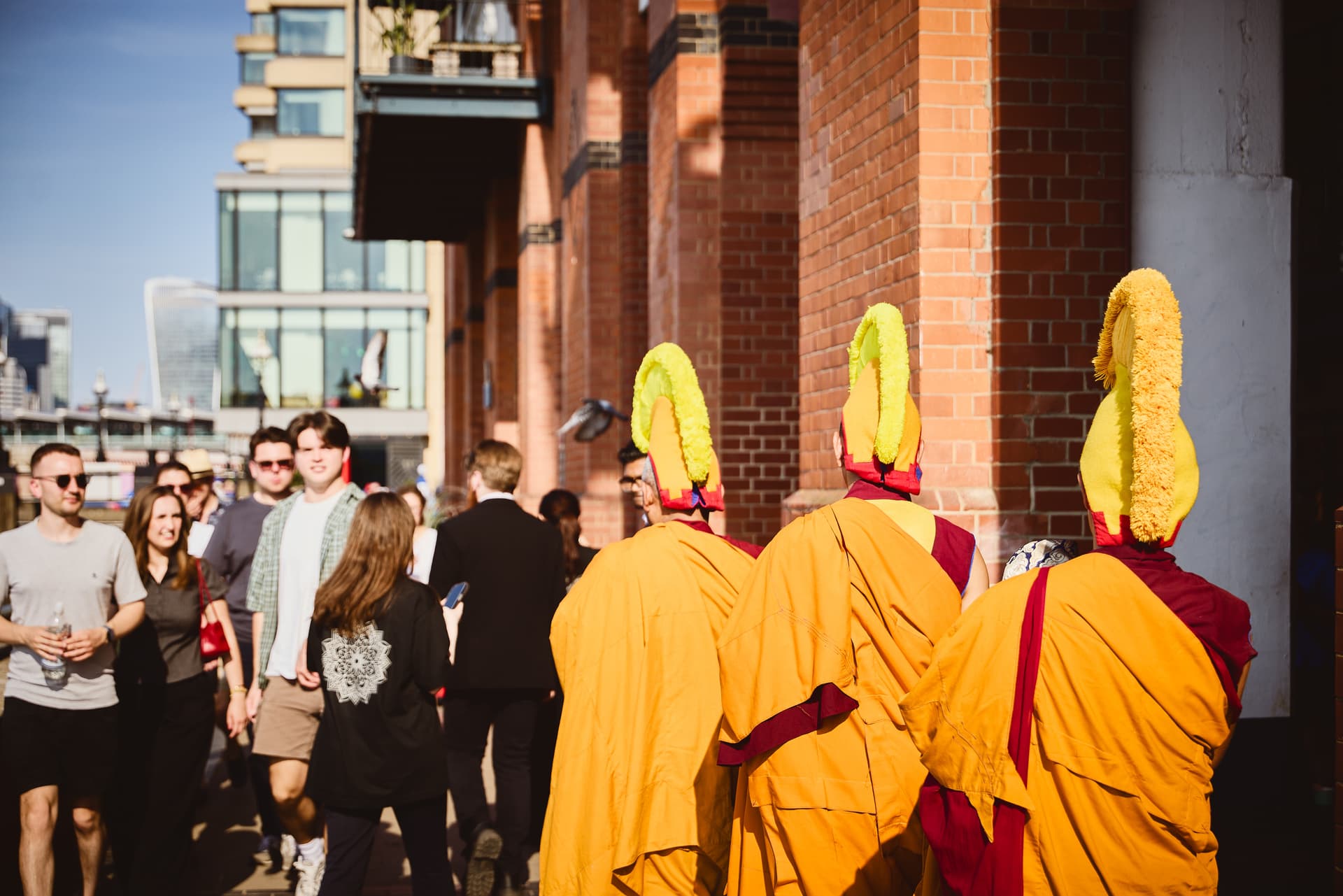
At Oxo Tower Wharf, three senior Tibetan monks built a sand mandala grain by grain, and the lesson was never meant to end with the image itself. From June 17 to 21, visitors at OXO Gallery watched a form come into being in public, free to enter and open daily from 11 a.m. to 7 p.m., as the Buddhist Film Festival used the installation to slow the tempo of the South Bank and make impermanence visible.
A public festival built around a disappearing form
The mandala sat inside a larger collaboration between Pure Land Foundation and Tricycle: The Buddhist Review for Tricycle’s third annual Buddhist Film Festival, which ran from June 16 to 30, 2026. That broader festival included five feature-length films and five short films, but the sand installation gave the program its most immediate teaching: practice was happening in real time, not preserved behind glass.
Pure Land Foundation designed the Oxo Tower Wharf activation to bring new audiences into the festival through a highly visible public setting. The setup mattered. The mandala was not presented as a finished object to admire from a distance, but as an event to witness step by step, with the making itself treated as part of the teaching. Later coverage placed engagement with the activation at more than 50,000 people, a sign that the piece reached well beyond the regular Buddhist community and drew in commuters, tourists, families, and passers-by along the river.
Why the making matters more than the image
The power of a sand mandala lies in its discipline. Three senior Tibetan monks worked by hand with finely colored sand, laying down a pattern that demanded patience, repetition, and unwavering attention. That slow construction is what makes the mandala useful for insight practice: it shows how beauty appears through effort, and how quickly the mind starts to cling to it once it begins to take shape.
Visitors were encouraged to watch the mandala being made, not simply to look at the finished design. That shift turns the gallery into a contemplative training ground. You see the impulse to complete, to preserve, to photograph, to own the moment, and you see those impulses arise while the work is still changing under your eyes.
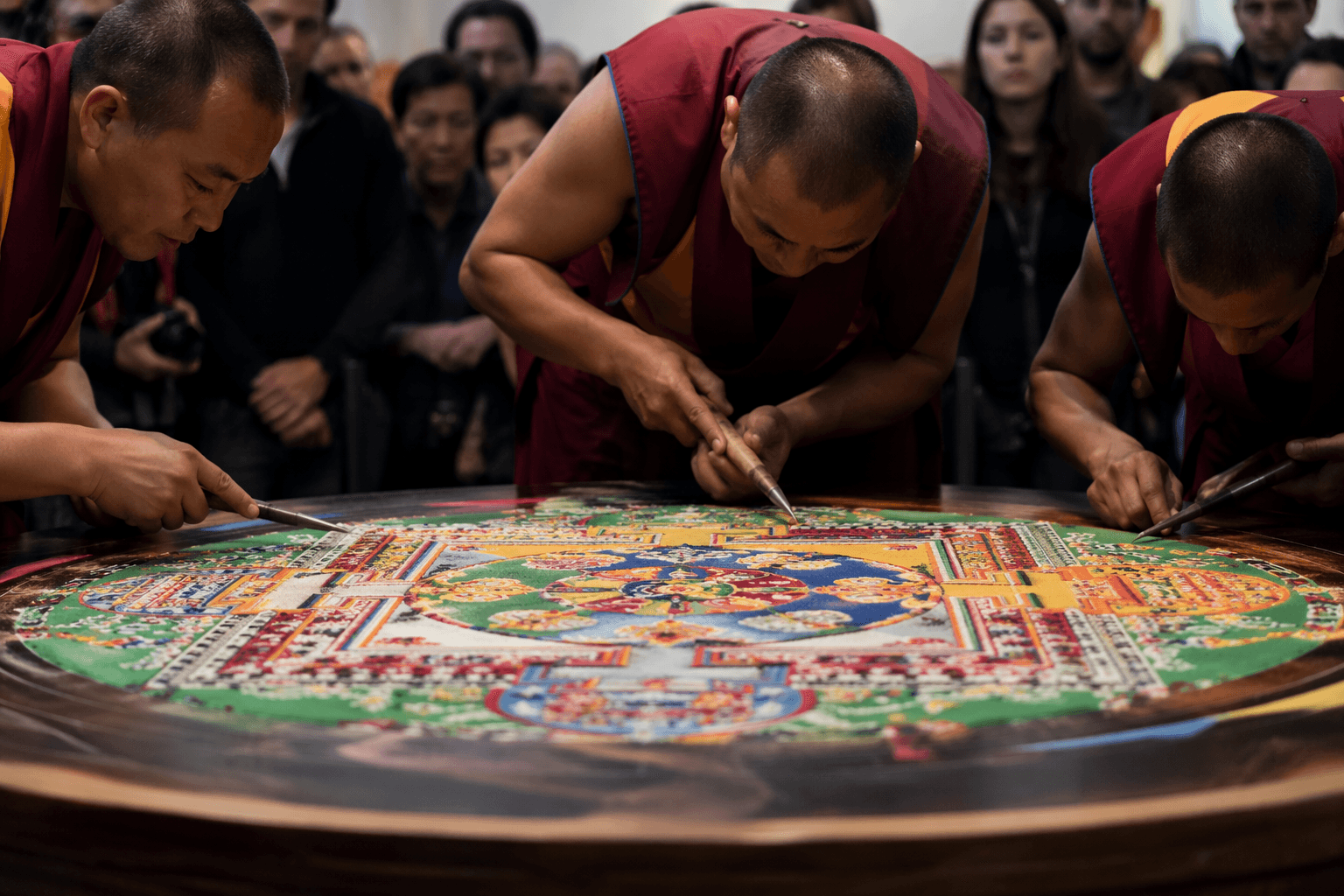
Mandalas have long been described by museum and reference sources as symbolic diagrams of the universe and instruments of meditation. In Tibetan Buddhist tradition, sand mandalas add a second instruction: they are created and then destroyed to teach impermanence and non-attachment. The London installation fit that precedent closely, but in a public urban setting that made the teaching accessible without softening it.
The dissolution is the point
The final ritual on June 21 gave the mandala its sharpest lesson. The completed work was ceremonially dissolved and released into the River Thames, a gesture that made the Buddhist teaching plain: nothing is permanent, including the beautiful things we most want to keep. That act did not negate the days of careful labor; it completed them.
The setting sharpened the effect. OXO Gallery did not feel like a standard exhibition space so much as a shared contemplative environment, one where the pace of ordinary city life briefly loosened. On a busy stretch of the South Bank, the mandala held attention without demanding belief first. It invited people to stand still, watch closely, and notice what happens when beauty is treated as process rather than possession.
Pure Land Foundation and Tricycle framed the project around Buddhist themes that reach well beyond the mandala itself: impermanence, compassion, mindfulness, identity, belonging, and the search for meaning. The installation gave those themes a concrete form. Instead of explaining impermanence in abstract language, it enacted it in sand, ceremony, and release.
How to use a sand mandala as insight practice
For meditation practice, the strongest lesson from the London installation is simple: stay with the making long enough to notice attachment arise. When you watch a mandala form, you can see delight, anticipation, and the wish for the image to remain exactly as it is. When the form is dismantled, you get a second chance to see grasping in real time and to soften it.
A useful way to work with this in your own practice is to bring the mandala into a short contemplation:
- Watch a pattern as it is built, and notice the mind’s urge to jump ahead to the finished result.
- When the image becomes beautiful, register the instinct to hold on, name it as attachment, and let it pass without following it.
- If you witness dissolution, stay with the sensation of loss or relief without trying to fix either one.
That sequence is what made the Oxo Gallery installation more than a visual event. It turned a centuries-old Tibetan Buddhist form into a public lesson in insight, showing that impermanence is not just something to admire from afar. It is something to practice, grain by grain, until letting go becomes part of the view.
This article was produced by Prism’s automated news system from verified source data, official records, and press releases, then run through automated quality and moderation checks before publishing. The system is built and supervised by the people who set the standards it runs under. Read our full AI policy.
Did this article answer your question?