Pomnyun Sunim says life has no inherent meaning, seeks freedom
Pomnyun Sunim reframes emptiness as practice: meaning is made, not found, and the task is to see craving and self-centered stories clearly.

When life feels emotionally flat, Pomnyun Sunim does not offer a better story to believe in. He points straight at the mind that keeps asking life to feel more meaningful, then asks you to notice how that demand itself becomes suffering.
That is the force of the teaching Jungto Society shared from Vancouver, where the conversation began as part of a North American West Coast lecture tour that moved through Sydney, Perth, Seattle, Vancouver, San Francisco, Las Vegas, San Diego, and Los Angeles between September 5 and 21, 2024. The setting matters because the talk was not framed as a rare philosophical event, but as a practical Dharma exchange meant to meet ordinary confusion head on.
What the question of meaning is really about
In the Vancouver transcript, Pomnyun Sunim says life has no inherent meaning and that humans create meaning for themselves. For Buddhist Insight Meditation readers, that lands less like a slogan than a practice instruction: the search for meaning is not an object to find, but a process to observe.
That is why the teaching presses past abstract debate. The Buddha, as Jungto Society presents the point, was not chiefly concerned with whether the world is eternal or what happens after death. His concern was simpler and harder: can people be free from suffering now? That shift changes the whole frame of practice, because the issue is no longer proving a worldview but seeing how the mind manufactures distress in real time.
Why the Casual Conversation format works
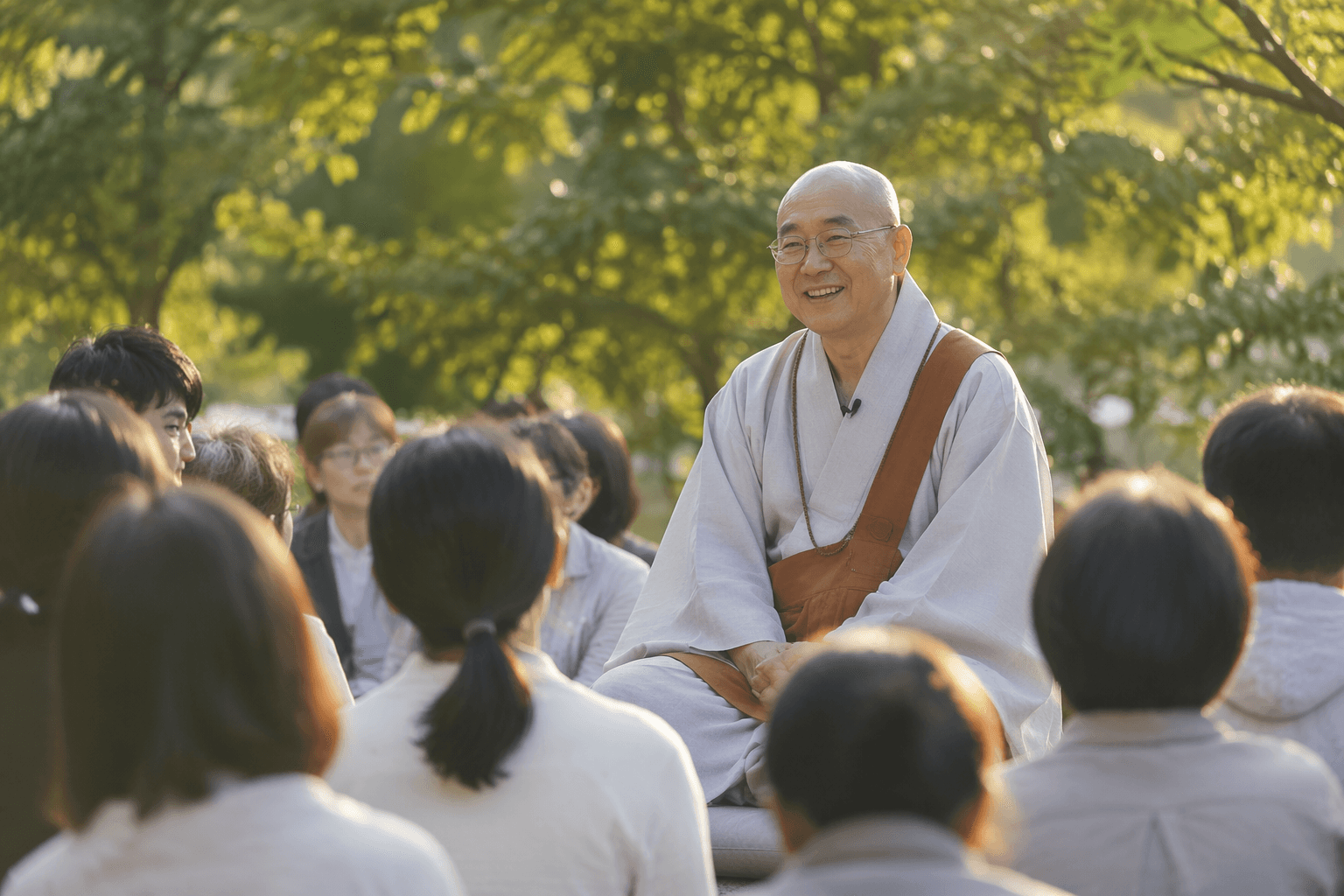
Jungto Society’s Vancouver event used its “Casual Conversation” format, an interactive Q&A in which participants ask about relationships, work, emotions, meaning, and happiness, then receive practical wisdom they can apply immediately to daily life. That structure is important because it keeps Dharma from floating away into theory. The questions come from the same places where craving, disappointment, and self-judgment actually show up.
The organization has long described these sessions as accessible to people around the world through regular Dharma talks and live-streamed Q&A. Since the COVID-19 pandemic, it says many programs moved online, while centers remained open for retreats, cultural activities, and volunteer opportunities. In other words, the practice is not sealed off in a meditation hall. It is designed to travel into kitchens, offices, and family routines, where emotional flatness often appears as boredom, numbness, or the sense that nothing is quite enough.
How to work with emotional flatness in practice
For insight practitioners, the most useful move is to stop treating emptiness as a verdict on your life. In this teaching, emptiness is something to examine: the craving for a stronger feeling, the expectation that practice should produce a recognizable reward, and the self-centered narrative that insists your life ought to feel meaningful on demand.
A simple way to work with that in meditation is to watch the sequence rather than the mood: 1. Notice the flatness without decorating it. 2. See the wish for something more interesting, more spiritual, or more affirming. 3. Identify the story that follows, especially the one that says, “This should not be happening.” 4. Return to the direct experience of the moment, including the body, breath, and the ordinary task in front of you.
That approach fits Jungto Society’s own description of Buddhism as religion, philosophy, and practice, with the emphasis clearly on practice. The organization says its teachings are meant to apply to meals, work, and household chores, not sit apart from daily life. When meaning feels absent, the instruction is not to invent a grander identity. It is to see how the mind reaches for identity in the first place.
A movement built around practice and service
Jungto Society describes itself as a global Buddhist community dedicated to authentic Dharma teachings, meditation practices, and social engagement. That combination is central to understanding why this teaching was presented the way it was. The point is not only inner calm, but a life in which insight and responsibility are not separate projects.
Pomnyun Sunim sits at the center of that world as Jungto Society’s founder and guiding Dharma teacher. The organization says he founded Jungto Society and four NGOs, including JTS, EcoBuddha, Good Friends, and the International Network of Engaged Buddhists. It also says his humanitarian and peace work was recognized with the Ramon Magsaysay Award for Peace and International Understanding in 2002 and the Niwano Peace Prize in 2020.
That broader context gives the Vancouver teaching extra weight. Pomnyun Sunim is not offering a private coping strategy for a bad mood. He is pointing to a way of living in which the question of meaning is folded back into direct experience, then extended outward through service, community, and responsibility. For insight meditation practice, that is a demanding correction: freedom does not arrive when life finally feels full. It begins when you can see the urge to force meaning onto an empty moment.
When the next stretch of your day feels flat, treat that flatness as the place where practice begins. Notice the craving, notice the story, and return to the meal, the email, the chore, or the breath in front of you.
This article was produced by Prism’s automated news system from verified source data, official records, and press releases, then run through automated quality and moderation checks before publishing. The system is built and supervised by the people who set the standards it runs under. Read our full AI policy.
Did this article answer your question?