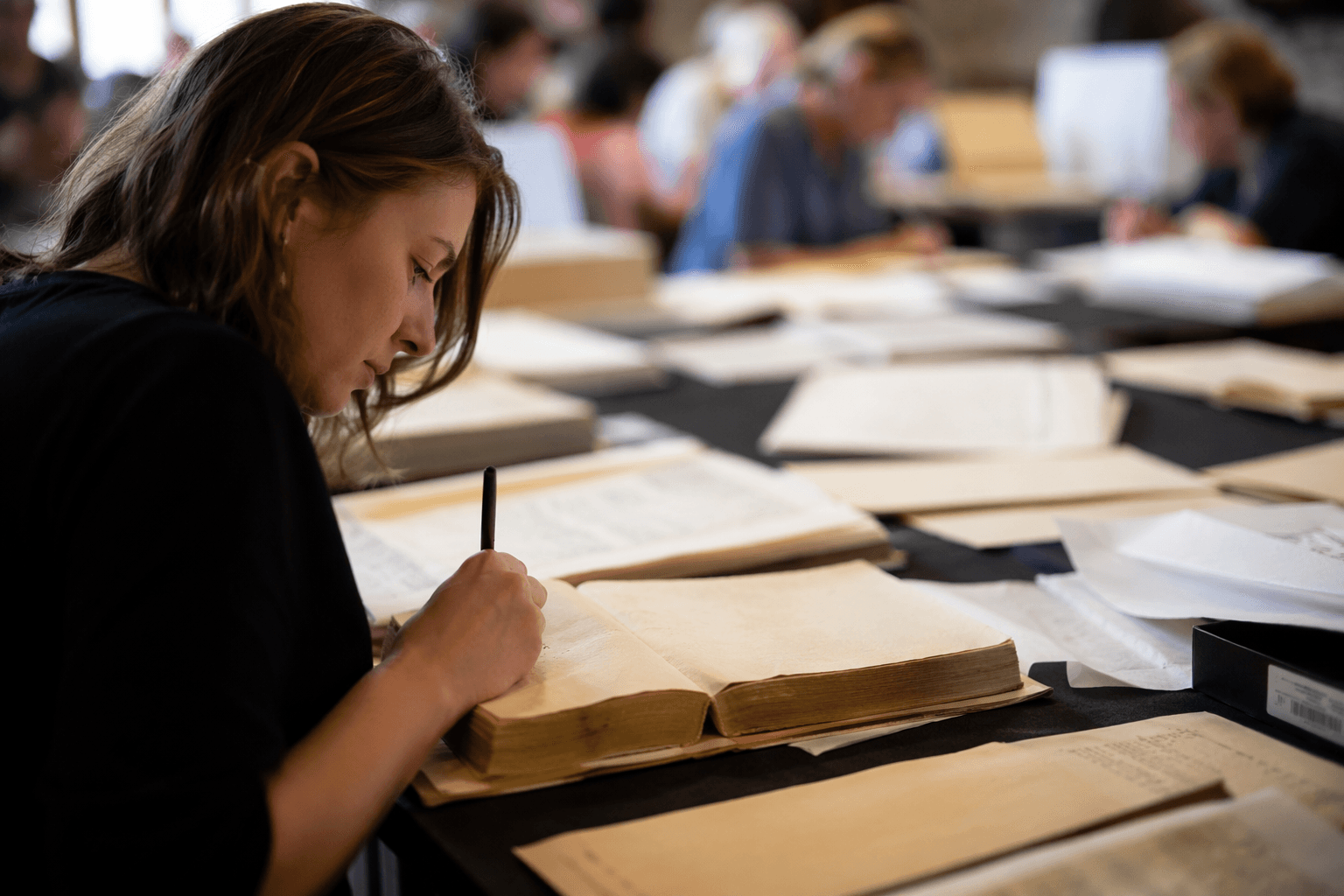
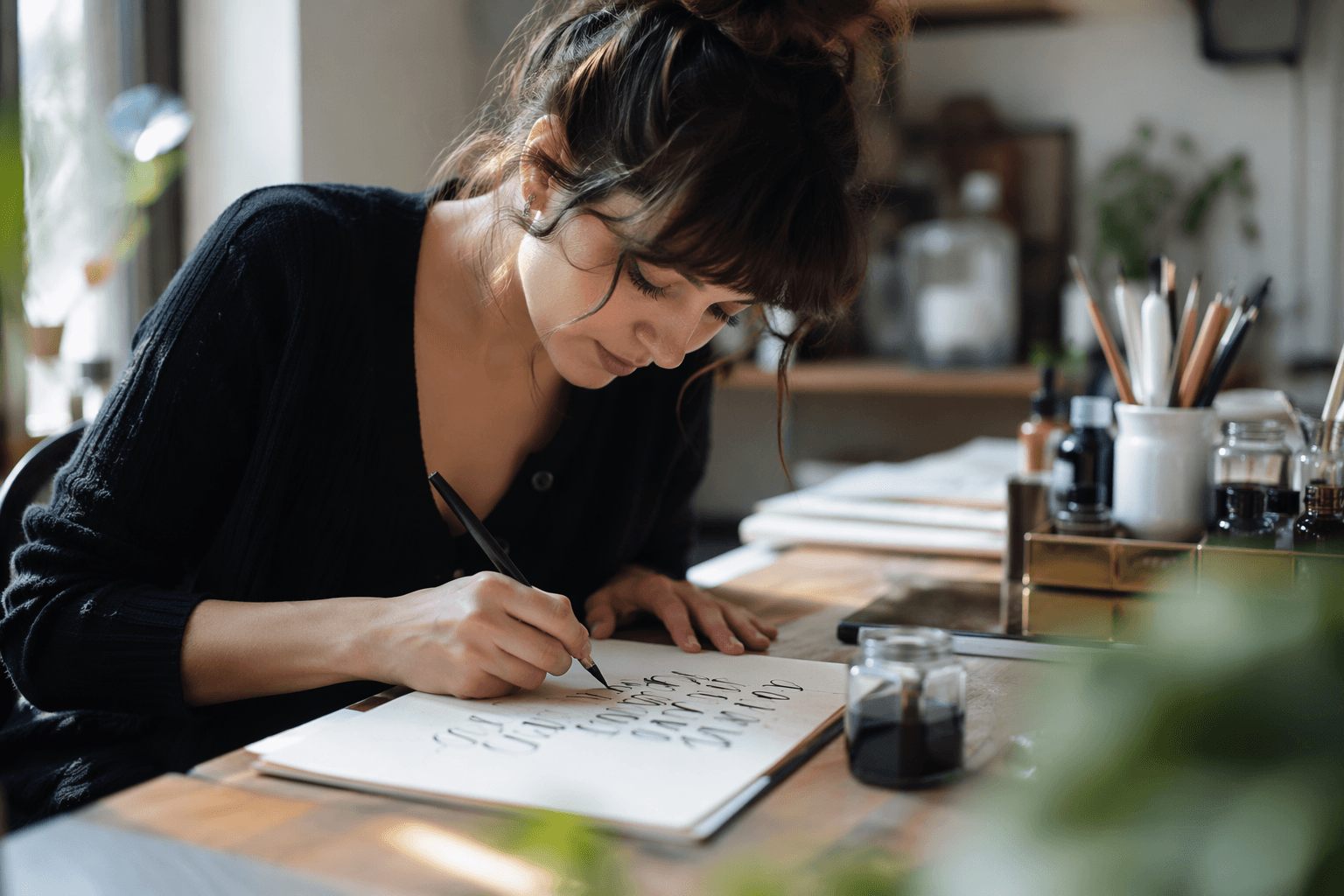
Chicago Calligraphy Collective explores pointed pen beyond copperplate
Chicago Calligraphy Collective’s sold-out Zoom class treats pointed pen as a design tool with range, not a one-script box. Rachel Yallop’s workshop leans into hybrid styles, custom alphabets, and finished work.

Chicago Calligraphy Collective’s Pointed Pen Possibilities turned the pointed pen into something broader than a Copperplate exercise. The sold-out Zoom workshop, led by Rachel Yallop, is built around experimentation: scripts that stretch beyond the usual shaded roundhand look, abstract letterforms, custom alphabets, and finished compositions that use the tool in more than one direction.
Pointed pen as a range, not a rulebook
The clearest idea in the workshop title is the one that matters most to working calligraphers: possibilities. Here, that means using one nib to move between traditions instead of treating pointed pen as locked to a single historical style. The class description points to scripts usually associated with broad-edged pens, which immediately pushes the conversation away from pure Copperplate imitation and toward variation, adaptation, and personal decision-making.
That matters in practice because pointed pen can do more than produce one formal hand. The workshop emphasis on line-weight control and on using letters in words and finished designs puts the focus on application, not just drills. For anyone who already has the basic pen control, this is the next step: learning how to make the same tool support hybrid lettering, contemporary layouts, and work that feels designed rather than copied.
What the online format adds
The class ran June 27-28, 2026, from 9:00 a.m. to 3:00 p.m. Central time, through Zoom. Chicago Calligraphy Collective also noted that the workshop would be recorded, which gives the teaching a second life beyond the live weekend and makes the material easier to revisit while practicing.
That recording detail is especially useful for exploratory learning. A class built around range and experimentation benefits from replay, because the lessons are likely to involve subtle changes in pressure, rhythm, spacing, and structure rather than a single fixed exemplar. In an online setting, that kind of material can be studied again at the bench, where the real work of comparison and revision happens.
Rachel Yallop’s background fits the brief
Yallop’s biography makes her a natural fit for a workshop about expanding pointed pen. She has been doing calligraphy and lettering design since leaving art college in 1985, and she has taught calligraphy and lettering in the UK and internationally since 1988. She studied at Ravensbourne and the Central School of Art & Design in London, earning an MA in 1985.
Her own description of her practice also points to why this class feels less like a beginner primer and more like a workshop for serious makers. Her work explores form, space, tension, and freedom of line, which aligns closely with a course that asks students to push the pointed pen into custom alphabets, abstract forms, and design-led lettering. She also creates logos, titles, promotional material, and hand lettering for print, so the workshop sits comfortably in the world where calligraphy and graphic use overlap.

Registration, pricing, and the workshop’s place in CCC’s 2026-2027 lineup
Chicago Calligraphy Collective opened member registration on Tuesday, December 9, 2025, at 10:00 a.m. Central, and non-member registration on Wednesday, December 10, 2025, at 10:00 a.m. Central. The fee was listed at $109 for members and $159 for non-members.
That structure shows the workshop was aimed at a committed audience rather than a casual drop-in crowd. Chicago Calligraphy Collective says it hosts workshops led by nationally and internationally renowned lettering and book artists, and Pointed Pen Possibilities sat within a broader 2026-2027 schedule that also includes Brody Neuenschwander, Sherri Trial, Amity Parks, Andrea Wunderlich, Suzanne Moore, Andrea Reno, Valerie Weilmuenster, and Elmo van Slingerland. In other words, this was one stop in a larger program built for people who already care about the field’s technical and artistic range.
Why the historical context matters
The workshop’s creative angle makes even more sense against the history of the term Copperplate. Zanerian materials say the modern usage of Copperplate is often too broad and that the historical starting point is English roundhand, linked to George Bickham’s The Universal Penman. Society of Scribes places pointed-pen styles within a longer development from the Italian hand to what is commonly called Copperplate today.
That history gives the workshop its sharper edge. If Copperplate is only one point on a longer line, then a class about pointed pen possibilities is doing more than teaching a style. It is helping practitioners see the tool as a flexible instrument, one that can support formal scripts, experimental alphabets, and finished work that moves beyond the expectations many people bring to their first nib.
A workshop built for expansion
What makes Pointed Pen Possibilities compelling is not that it teaches pointed pen from scratch. It is that it treats the tool as a starting point for variation, not a destination. With a recorded Zoom format, a six-hour weekend schedule each day, a price structure set for members and non-members, and an instructor whose own practice bridges calligraphy and lettering design, the class is set up to support the kind of exploratory learning that turns technical control into creative range.
That is the real draw here: not another Copperplate lesson, but a reminder that pointed pen has always been capable of more than the script most people first learn to recognize.
This article was produced by Prism’s automated news system from verified source data, official records, and press releases, then run through automated quality and moderation checks before publishing. The system is built and supervised by the people who set the standards it runs under. Read our full AI policy.
Did this article answer your question?