AIMS Adds 3m ReefCat Autonomous Catamaran to Boost Marine Monitoring
AIMS has added a purpose-built 3 m ReefCat autonomous catamaran developed with Brisbane-based Pipar Automation to boost reef monitoring and field survey capacity.
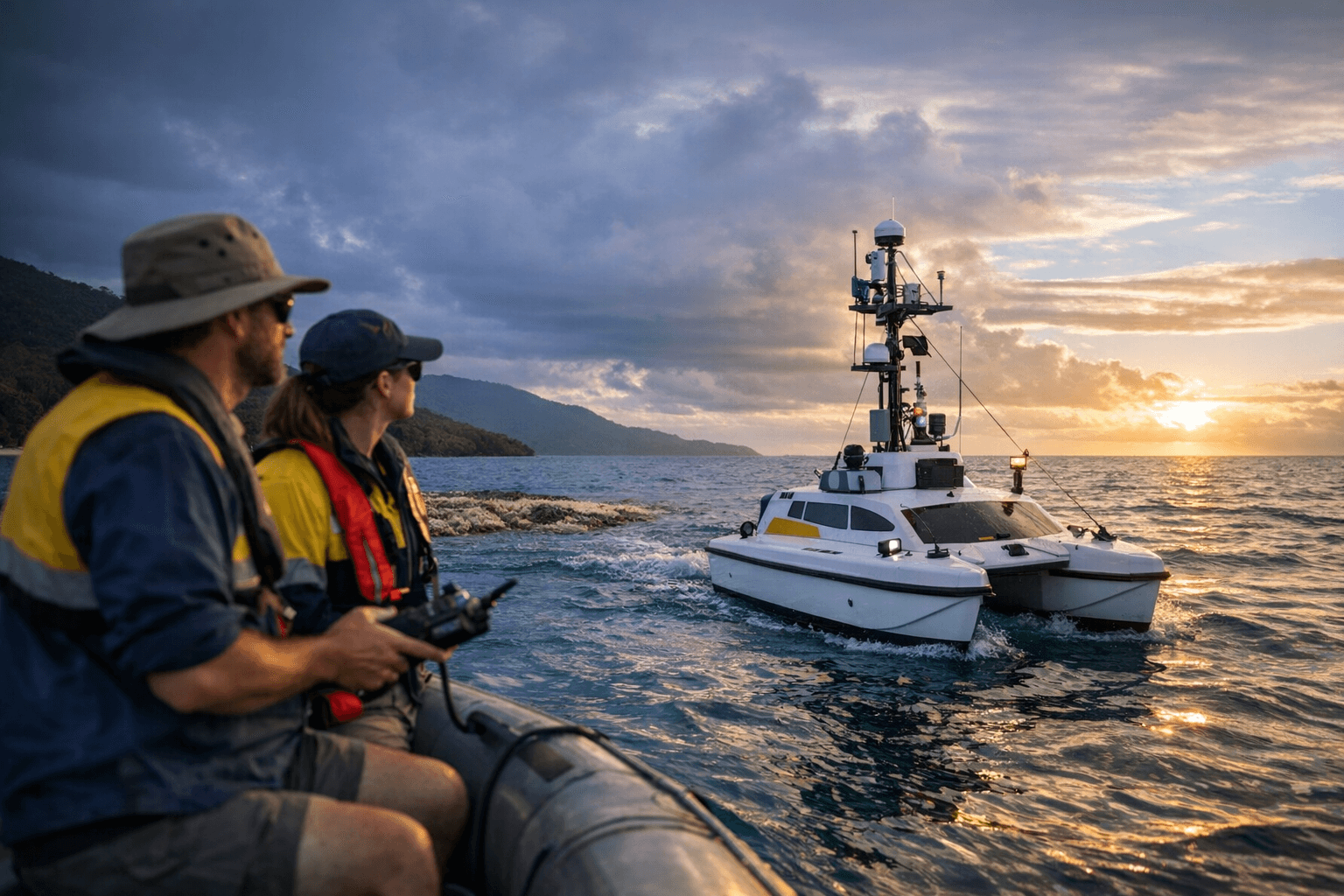
AIMS has taken delivery of a ReefCat-class autonomous surface vehicle, a compact 3 m catamaran built with Brisbane-based Pipar Automation, to expand its marine monitoring work around Cairns. The institute says the ReefCat has already supported field operations, helping scientists pinpoint the optimal locations to deploy baby corals as part of this summer’s mammoth Pilot Deployment Program.
The ReefCat was pressed into service during the September mission, when it "surveyed 10 sites at Moore, Agincourt and Arlington Reefs," according to AIMS Technology Transformation Engineering Manager Shaun Barlow. AIMS describes the vessel as mid-sized and believed to be a world-first in its combination of capability, endurance and payload flexibility.
Designed and built by Pipar Automation in collaboration with AIMS engineers, the ReefCat was sized to suit AIMS research vessels. "We reduced its length from an original 4.2m to 3m, to ensure it could fit on the deck of an AIMS research vessel, without reducing its functional capability. As far as we are aware, there is nothing else in the world that comes close in terms of capability. It is fully electric with a big battery capacity, and it’s jam-packed with instrumentation designed specifically for AIMS payloads, including some with quite a high drag. It has four to five times the power you would normally find in boats of that size. It’s like a tractor; it goes slowly but has a lot of power and battery capacity," Barlow said.
AIMS Technology Transformation Research Team Leader Melanie Olsen emphasized operational reach and survey modes. "The ReefCat ASV could run autonomously for at least 10 hours at a time, at daytime or night." She added that the craft can "navigate a variety of trajectories, including covering an entire reef in a 'mow-the-lawn' pattern carrying cameras or a sonar system for mapping the ocean floor." Olsen also pointed to regulatory limits that shape current launches, noting that "as Australia's regulatory framework evolves, in the future we will be able to launch the ASVs from land to undertake a mission offshore and return."
Pipar Automation framed the project in engineering terms. "It was a design challenge to deliver the demanding requirements," said Russ Morrison, Pipar Automation Senior Principal Engineer. "It's a uniquely capable ASV in terms of performance, operational flexibility and reliability."
Beyond size and endurance, the ReefCat carries a range of scientific payloads, including higher-drag instruments, and features obstacle-avoidance systems and high-bandwidth communications to support real-time survey tasks. Photographs released with the announcement show the ReefCat being lifted onto a research vessel and sitting on deck, underscoring the importance of deck-fit to deployment logistics.
For operators and reef managers, the ReefCat represents a practical tool to stretch ship time, reduce personnel risk during surveys, and gather high-resolution mapping and sensor data to guide coral deployment. As regulatory pathways evolve and AIMS and Pipar refine payload and mission packages, the ReefCat is likely to become a routine asset for reef monitoring and restoration work off Cairns.
This article was produced by Prism’s automated news system from verified source data, official records, and press releases, then run through automated quality and moderation checks before publishing. The system is built and supervised by the people who set the standards it runs under. Read our full AI policy.
Did this article answer your question?