Austal wins A$275m contract to build hydrogen-ready 130m ROPAX catamaran
Austal Australasia signed a A$275 million contract to build a hydrogen-ready 130 m ROPAX catamaran for Sweden’s Gotlandsbolaget, advancing multihull ferry decarbonisation and fleet modernisation.
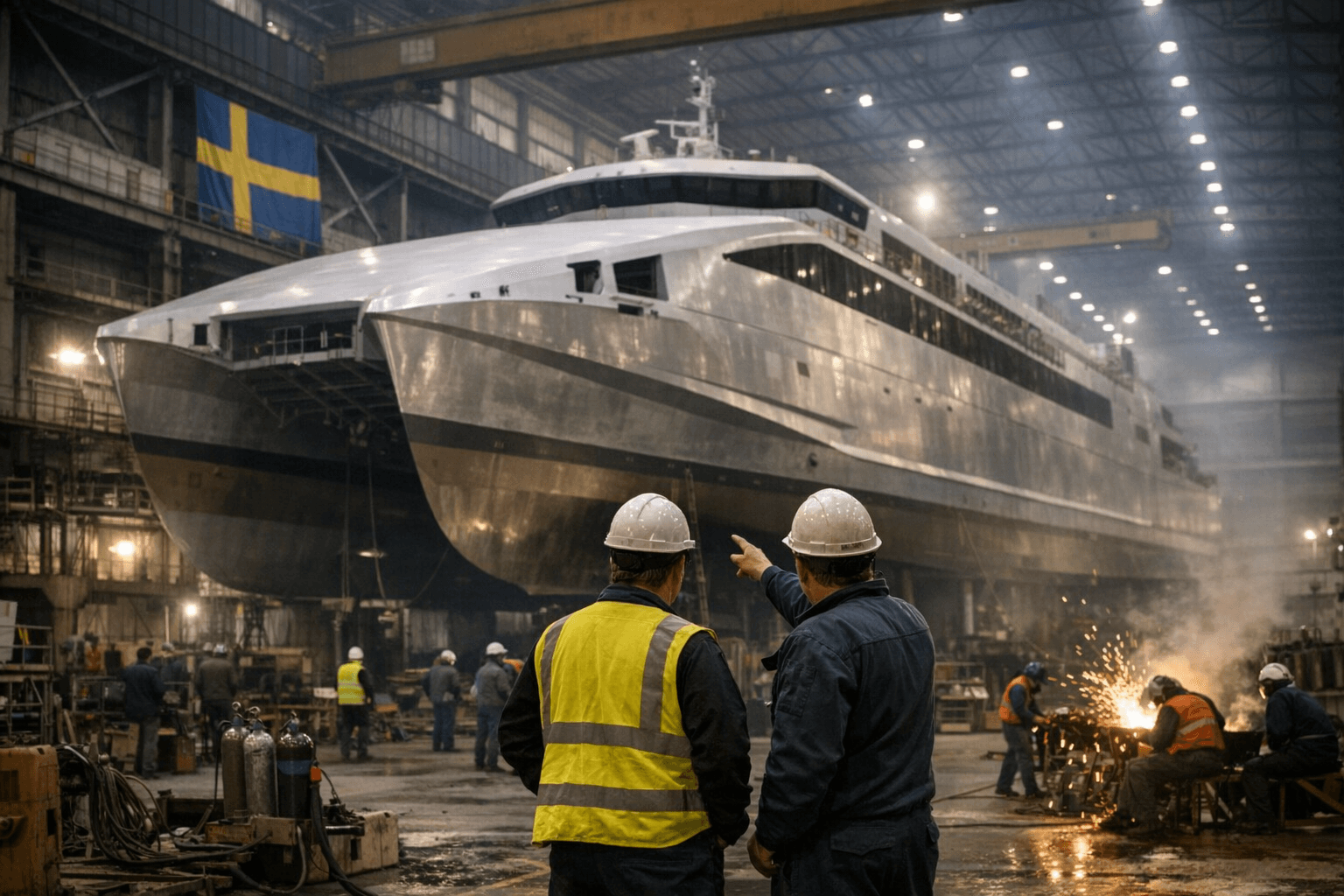
Austal Australasia has been contracted to design and build a 130 metre high-speed vehicle and passenger catamaran for Gotlandsbolaget under the Horizon X programme, in a deal worth about A$275 million (roughly US$172.6 million). The aluminium catamaran is planned to carry up to 1,500 passengers and 400 vehicles and will feature a large, efficient hull form tailored for fast ROPAX service.
The vessel’s propulsion concept is a combined-cycle, multi-fuel arrangement engineered to be hydrogen-ready, giving Gotlandsbolaget flexibility to operate on conventional fuels now and switch to low-carbon fuels as supply and infrastructure mature. That decarbonisation flexibility sits at the heart of the project after the design received approvals-in-principle from DNV in October 2024, signalling early regulatory confidence in the concept’s safety and compliance.
Construction is slated to begin at Austal’s Philippines shipyard in the first half of 2026, with delivery targeted for mid-2028. Building at the Philippines facility leverages Austal’s multihull production experience and capacity for large aluminium structures, while the timeline positions the vessel to join a wave of next-generation ROPAX units entering service during the late 2020s.
Gotlandsbolaget will use the vessel to modernise its ferry offering, combining high passenger throughput and vehicle capacity with a focus on lower lifecycle emissions as hydrogen and other alternative fuels become viable. For operators and shipbuilders who follow catamaran trends, the project is a test case for integrating hydrogen-ready systems into large, high-speed, road-vehicle-carrying multihulls without sacrificing output or safety margins.
The contract also underlines market appetite for multi-fuel ROPAX designs that balance speed, capacity, and decarbonisation potential. Austal’s approach pairs an efficient catamaran hull with a flexible powerplant, giving owners the option to adopt hydrogen fuel cells, hydrogen combustion, or other low-carbon technologies as they are proven and scaled. For ports, fuel suppliers, and naval architects, that flexibility raises near-term questions about bunkering, cold- or cryogenic storage, crew training, and regulatory alignment.
The project will be watched closely by the multihull community and ferry operators planning fleet renewals, because it connects established aluminium catamaran construction techniques with emerging fuel technologies. Key milestones to follow are the start of construction in early 2026, detailed engineering and outfitting phases, and the planned handover in mid-2028.
For owners and yards tracking hydrogen-capable ferries, the Austal-Gotlandsbolaget ROPAX is a practical blueprint: large capacity, high speed, and a powerplant designed to evolve as cleaner fuels and bunkering infrastructure arrive. Expect attention on how the vessel performs in service and how quickly hydrogen logistics and regulation catch up to make the fuel-ready promise operational.
This article was produced by Prism’s automated news system from verified source data, official records, and press releases, then run through automated quality and moderation checks before publishing. The system is built and supervised by the people who set the standards it runs under. Read our full AI policy.
Did this article answer your question?