Navicork cork decking offers cooler, lighter comfort for catamarans
Navicork turns catamaran decks into cooler, quieter, lighter living spaces, with Beneteau already validating it for the Excess 13 cockpit.
Why cork changes the feel of a catamaran
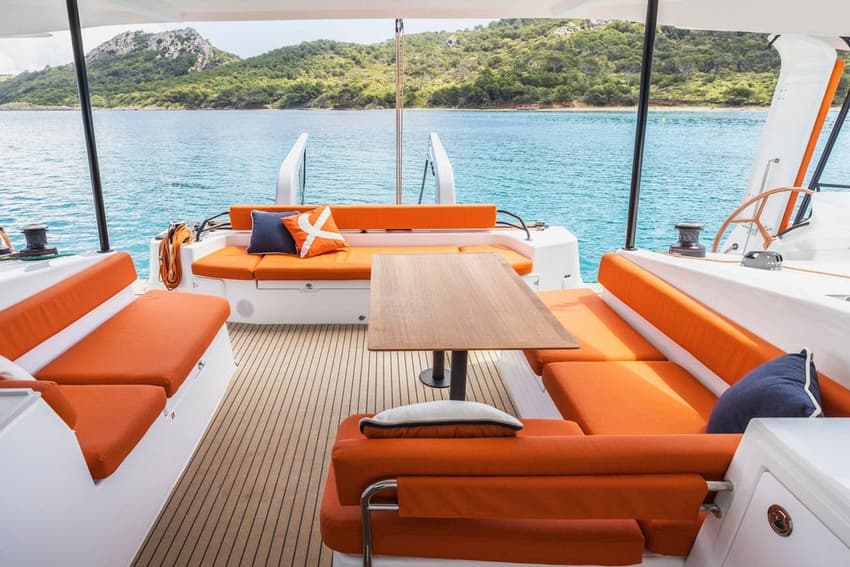
On a multihull, deck material is not a cosmetic decision. It changes how hot the cockpit feels at noon, how sure your footing is when the transom is wet, how much slap and vibration travel through the boat, and how much weight you are carrying above the waterline. That is where Navicork enters the conversation: as a cork-based decking option built for the high-traffic zones catamaran owners actually live on, especially the cockpit, side decks, transoms, helm stations, and foredeck lounge areas.
The appeal is immediate in daily use. Cork stays cooler in the sun, feels softer underfoot, and offers good grip when the boat is damp or moving. It also helps dampen noise and vibration, which matters on a catamaran where people are constantly crossing from hull to hull, stepping out onto the transom, or settling into the lounge while the boat is at anchor. For owners comparing it with teak or synthetic teak, the big question is not whether it looks modern. It is whether it makes the boat easier to enjoy every day.
The practical case for catamarans
Navicork was publicly launched in November 2023 as a sustainable marine decking solution from Corticeira Amorim and Amorim Cork Composites, and it has been positioned from the start as more than a style exercise. The company says its FD01 decking is 100% natural, reusable, and recyclable, and that it is made from high and medium density cork with a binder. For catamaran owners, that combination matters because multihulls often live with more exposed deck surface, more foot traffic, and more emphasis on comfort at anchor than many monohulls.
There is also a real weight story here. Navicork says its decking is 2 to 5 times lighter than conventional decking, a claim that is easy to understand in a multihull context because every kilogram affects performance, loading, and handling. On a catamaran, lighter deck coverings are not just a technical brag. They can support quicker acceleration, easier trim, and less unnecessary mass in the places where people spend the most time.
Where the material fits best aboard
The strongest case for Navicork is on the surfaces that see the most bare feet and the most abuse. That means cockpit soles where crew and guests gather, transom platforms that are constantly wet, side decks that get hot in the sun, and foredeck lounging areas that need both comfort and traction. Those are the zones where traditional teak can deliver a classic look but also adds upkeep, while some composite alternatives can feel harder, hotter, or less forgiving underfoot.
Navicork’s published materials emphasize low thermal conductivity, listed at 0.065 W/mºK. In plain terms, that helps explain why it is being marketed as a deck covering that stays friendlier to walk on when the sun is beating down. It also helps explain the daily-life angle that resonates on catamarans: less frying heat under bare feet, less noise underfoot, and less of the hard, plasticky feel some owners associate with synthetic alternatives.
A hard validation point that matters
The most useful proof point for skeptical owners is the Excess 13. Groupe Beneteau introduced that model in September 2024, and it selected Navicork FD01 for the cockpit after technical validation for abrasion resistance, non-slip performance, and marine durability. That is the kind of decision catamaran buyers can immediately relate to, because the cockpit is where the entire boat experience gets judged. If a major builder is willing to put a cork deck into a new cruising catamaran, the material has moved well beyond curiosity.
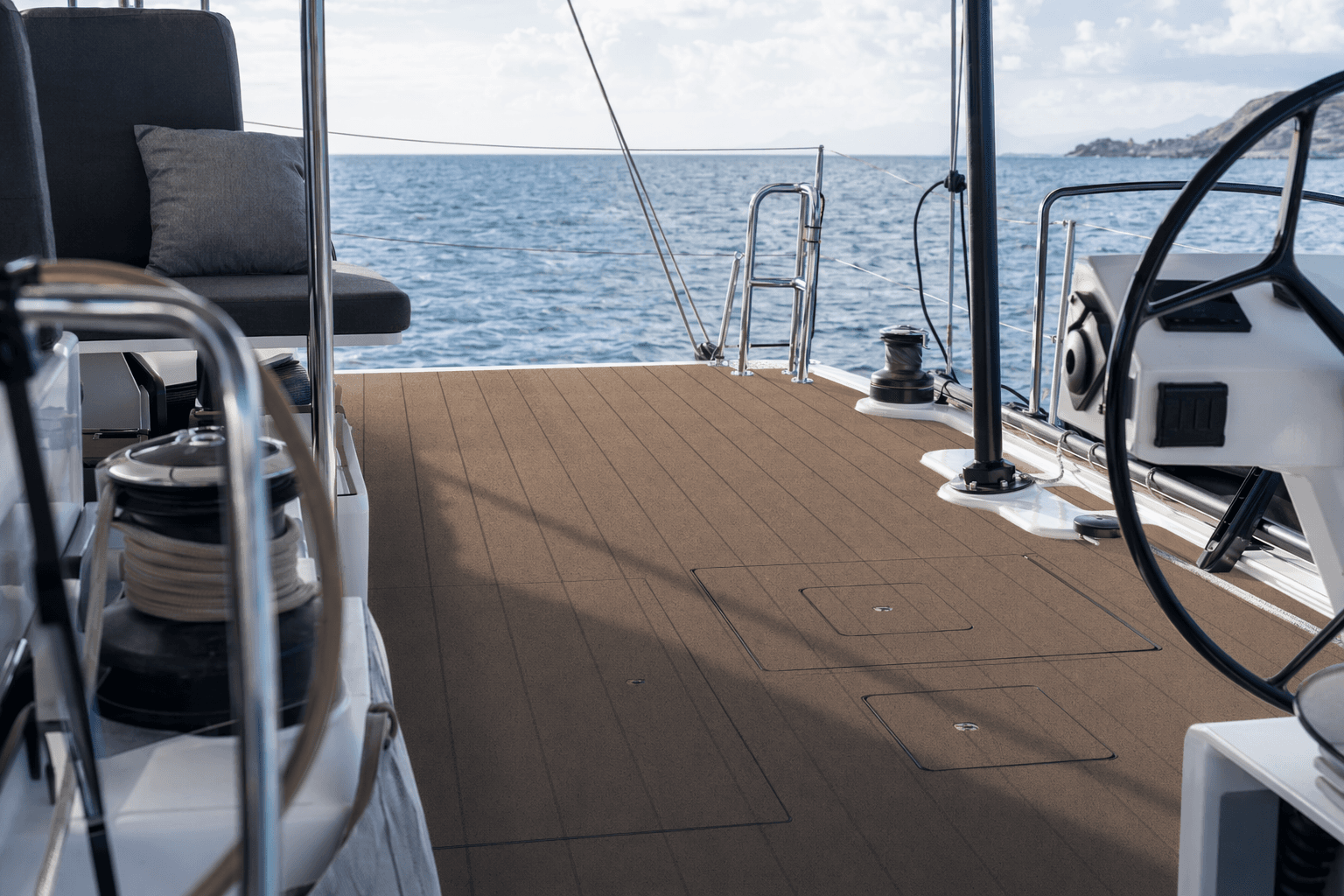
Beneteau’s choice also reflects more than comfort. Navicork says the material can help with production efficiency, faster installation, and more consistent finish quality and supply. It can even be integrated with design details such as engraved logos, which gives builders and refit yards more room to tailor the finished look without giving up the performance and maintenance benefits that drew them to cork in the first place.
What the sustainability numbers say
Navicork’s environmental pitch is unusually concrete. In January 2024, the company said an external life-cycle assessment by ITECONS found that each square meter of Navicork FD01 sequesters more CO2 than it emits during production. Later published figures listed negative carbon footprint values of -4.75 kg CO2 eq./m² for the 6 mm version and -6.34 kg CO2 eq./m² for the 8 mm version.
That is more than a branding exercise. Amorim and Portugal’s trade-promotion materials said the validation was based on EN ISO 14040, EN ISO 14044, and EN 15804 standards, which gives the sustainability claim an audit trail rather than a slogan. For builders and refit yards under pressure to make greener material choices, that kind of documentation can matter as much as the feel of the deck itself.
New-build thinking versus refit reality
Navicork is aimed at both new builds and refits, but those are not the same job. On a new catamaran, a builder can plan the deck layout around cork from the start, which makes finish consistency and production flow easier to manage. In a refit, the equation changes: the deck has to be stripped, prepared, and installed by professionals, because Navicork’s published guidance says it is intended for professional distribution and installation only.
That last point is important for owners who are tempted to treat it like a weekend makeover. Replacing a worn cockpit floor on a catamaran is a technical job, not a casual upgrade. The upside is that a professional fit can deliver a cleaner transition at hatches, curves, and hardware cutouts, which is where deck materials often fail to look or perform right.
Why the market is paying attention now
Navicork is showing up in more than one segment of the marine market. Beyond the Excess 13, it has also been selected for the Origin 71 tender from Evene Tenders and for a Venice Police Department Marine Control unit vessel. That range says a lot about how the material is being positioned: not just as luxury trim, but as a practical surface for boats that need durability, grip, and lighter weight in real service.
For catamaran owners, the lesson is simple. The next deck decision does not have to be a straight choice between classic teak and a hard synthetic substitute. Navicork offers a third path, one that leans into the realities of multihull life: cooler feet, quieter movement, less weight, and a cockpit that feels more like a living space than a maintenance burden. That is a strong argument in any marina, and an especially persuasive one on a boat where the cockpit is the heart of the day.
This article was produced by Prism’s automated news system from verified source data, official records, and press releases, then run through automated quality and moderation checks before publishing. The system is built and supervised by the people who set the standards it runs under. Read our full AI policy.
Did this article answer your question?