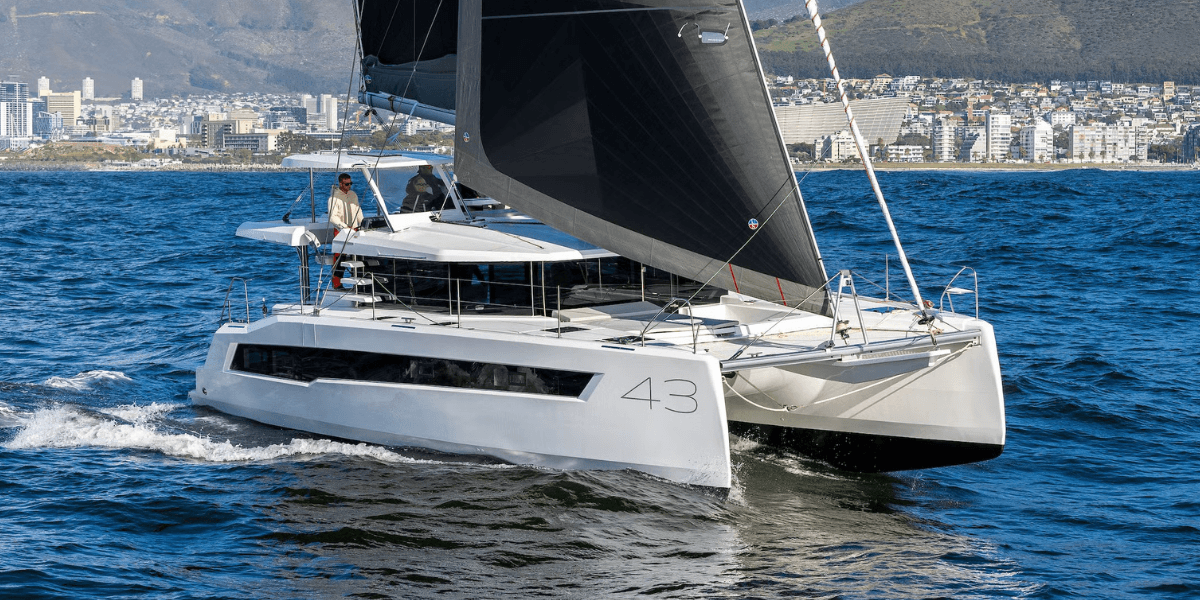
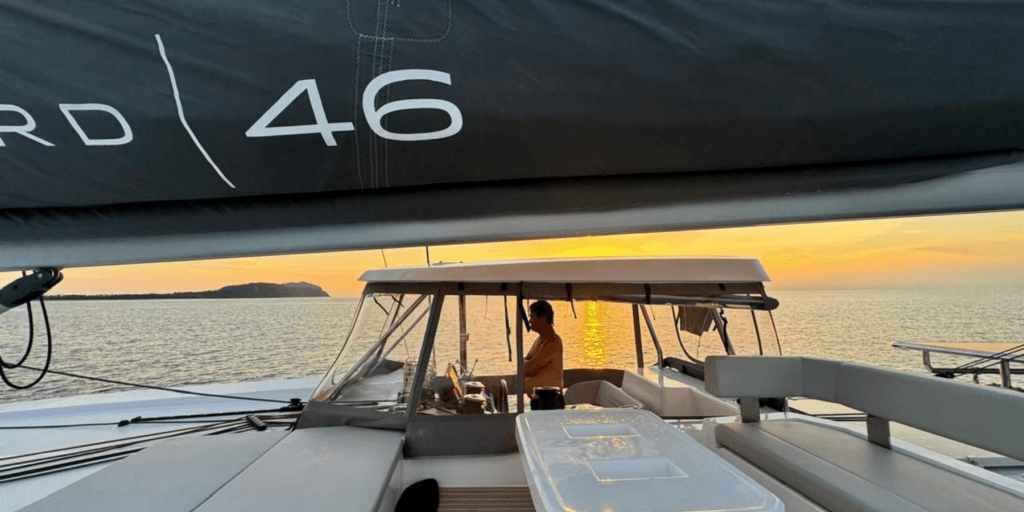
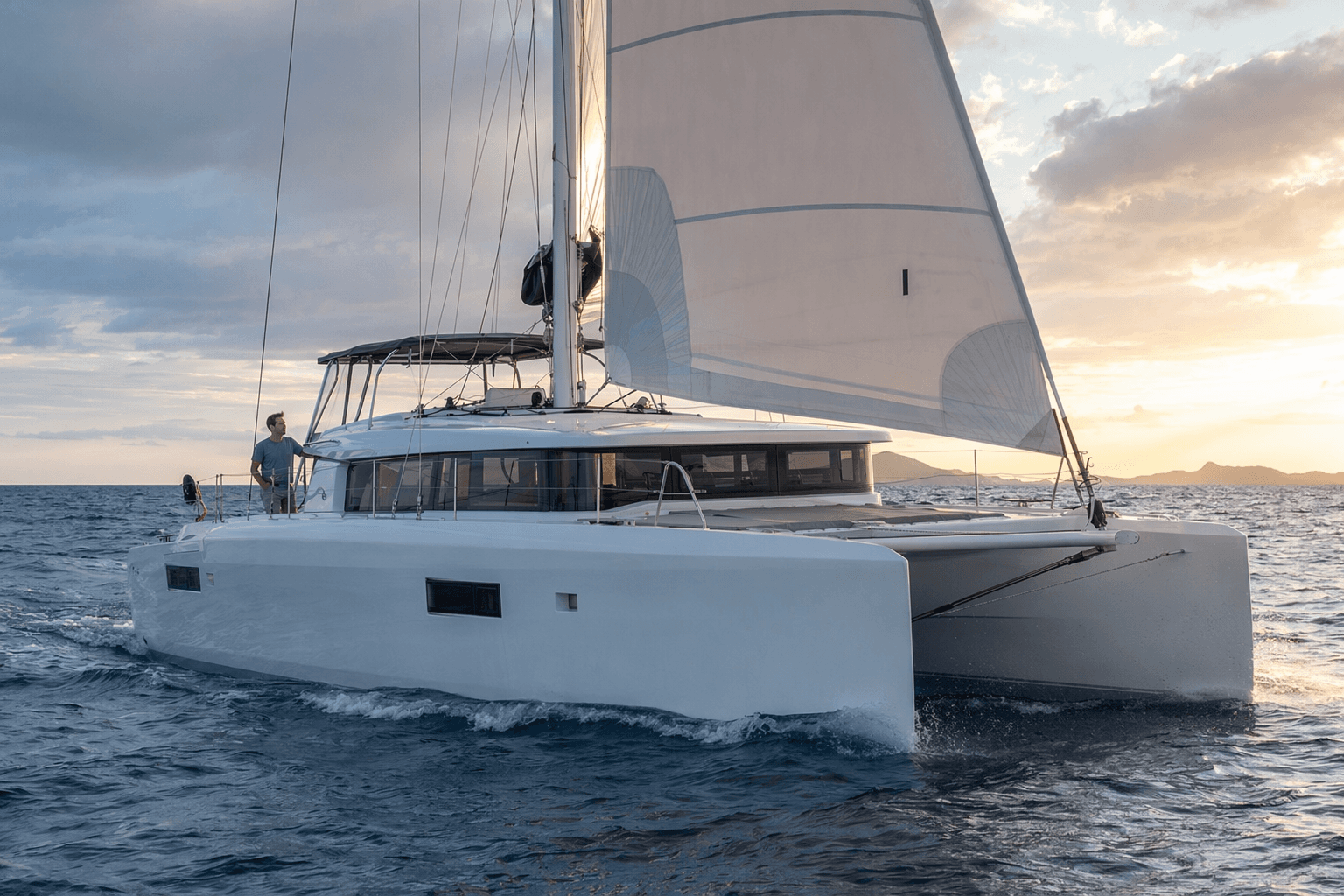
TRM 43 catamaran, built for bluewater efficiency and self-sufficiency
The TRM 43 turns away from floating-condo excess and goes straight at bluewater efficiency, with light displacement, serious autonomy, and a circumnavigator’s brief.
A world premiere aimed at miles, not marina theater
The TRM 43 arrives as counter-programming in a catamaran market still obsessed with volume and resort-style fitout. Presented at La Grande-Motte as a world premiere, it is built for the sailor who cares first about covering ground efficiently, staying self-sufficient, and keeping the boat simple enough to trust offshore.
That focus is not accidental. Trimarine describes the TRM 43 as a response to a gap in the market for a “true blue-water yacht” centered on speed, reliability and autonomy. The boat was drawn by Christophe Barreau and Frédéric Neuman from the brief of an owner who had already completed a round-the-world voyage and wanted a better second boat, which explains why the concept reads like a working passage-maker rather than a showroom statement piece.
Designed from a real bluewater brief
The strongest clue to the TRM 43’s character is the way it was conceived. Trimarine says the project was developed with no preset series constraints, and that matters because it allowed the designers to make choices that serve the miles, not the marketing brochure. The result is a 43-foot catamaran that reflects the hard lessons of long-distance sailing, where speed under load, control in rough weather and low dependence on shore support matter far more than sheer volume.
That pedigree is backed by the team behind it. Barreau and Neuman bring nearly 30 years of performance-catamaran experience across programs including Catana, Outremer and Marsaudon Composites, while Trimarine’s yard background includes work on America’s Cup components and IMOCA 60s. In other words, this is not a builder guessing at light construction or offshore performance. It is a boat launched from a culture that already knows how to make multihulls go fast without losing their sea manners.
Light, fast and built to stay that way
The numbers tell the story clearly. The official Trimarine spec page lists the TRM 43 at 13.1 meters overall with a 7.82-meter beam, a construction year of 2024/2025, and a draft of 2.50 meters with daggerboards down and 1 meter up. A later report described hull No. 1 as 5.6 tons light, with a beam of 7.92 meters and a light structure that keeps the boat firmly in performance territory. The official displacement at DWL is listed at 6.78 tons, which helps frame where the boat sits once cruising stores are aboard.
Construction is just as telling. The hulls are built in fiberglass, carbon and epoxy over Corecell foam, with carbon primary structure and retractable daggerboards. That combination is aimed at stiffness and reduced weight, but also at the kind of efficiency that makes a catamaran feel alive in moderate air and controlled when loaded for a passage. In practical offshore terms, that should translate into better acceleration, less drag under sail, and a boat that is less likely to bog down as cruising gear and water start to pile on.
Trimarine says the TRM 43 is intended to sail on wind alone about 95% of the time. It also says the boat can cover more than 200 nautical miles in a day in average conditions, and sometimes exceeds 250. Those are the numbers that matter to sailors who are done with oversized cruising cats that need too much engine help to keep a meaningful passage pace.
Autonomy without the gimmicks
The self-sufficiency package is as practical as the hull form. The first boat carries two 460Ah lithium battery banks, solar panels, a 40-liter-per-hour watermaker and a rainwater recovery system. That setup is designed to reduce generator dependence and keep the boat going away from marinas, which is exactly where many offshore cats start to feel less like voyaging tools and more like floating houses with complicated power bills.
The propulsion choice follows the same logic. Instead of chasing a headline-grabbing full-electric system, Trimarine specified twin Volvo D1 30hp engines for reliability and endurance. For a bluewater owner, that is a meaningful signal: the boat is meant to have engines that are there when needed, but not to become the center of the design. The TRM 43 is clearly built for sailors who want the rig to do the heavy lifting and the systems to stay lean.
What happened in real weather
Design claims are one thing, but the delivery passage through Gibraltar gave the concept an early stress test. The crew hit 40 knots of wind and still came away feeling secure enough to validate the boat’s direction in hard conditions. That matters because a light cruising cat has to do more than sail quickly in perfect weather. It has to stay composed when the wind rises, the seas stack up, and every system onboard starts to earn its keep.
The combination of light displacement, daggerboards, carbon structure and conservative auxiliary power points to a boat that should be manageable at sea rather than merely impressive at anchor. In offshore terms, that means simpler watchkeeping, less fatigue from unnecessary systems, and a better chance of arriving with energy left for the destination. It also suggests that the TRM 43 is aimed at the kind of owner who measures success by miles made under sail, not square footage in the saloon.
Why the TRM 43 stands out in today’s catamaran market
The bigger story is the one it tells about where multihulls are headed. There is still a strong market for huge-volume cruising cats loaded with hotel-like amenities, but the TRM 43 shows that another audience is still there, and maybe growing louder again: sailors who want efficiency, autonomy and real offshore range. For that group, the appeal is not less comfort so much as better balance, where comfort comes from a boat that stays light on her feet and easy to manage far from support.
Trimarine showed the boat at Stand P8 at the Salon International du Multicoque de La Grande-Motte, the multihulls-only show it calls Europe’s most important of its kind. That was the right stage for a catamaran with this message. The TRM 43 is not trying to win the volume war; it is making the case that a well-engineered, resource-efficient multihull can still be the most convincing answer for serious voyaging.
This article was produced by Prism’s automated news system from verified source data, official records, and press releases, then run through automated quality and moderation checks before publishing. The system is built and supervised by the people who set the standards it runs under. Read our full AI policy.
Did this article answer your question?