Costa Rica tests deforestation-free coffee exports under EU rules
Costa Rica's EUDR pilot shows deforestation-free coffee is a coordination problem, not a theory. Roasters can see exactly which systems are making EU shipments workable.
Costa Rica's edge is a pre-existing coffee system
Roasters sourcing into the EU should read Costa Rica as a systems story, not a legal footnote. The country is showing that deforestation-free coffee moves fastest when cooperatives, exporters, and the national coffee institute are working from the same records, the same maps, and the same rules.
That matters because coffee is no longer being treated as a soft exception. The European Union Deforestation Regulation, Regulation (EU) 2023/1115, entered into force on June 29, 2023, covers coffee alongside cattle, cocoa, oil palm, rubber, soya, and wood, and is designed to keep products linked to land deforested or degraded after December 31, 2020 out of the EU market. The application date was later postponed to December 30, 2025 for large and medium companies, with micro and small enterprises on a later timetable under the revised rollout. For buyers, the message is blunt: traceability is no longer a bonus feature, it is the price of admission.
What Costa Rica shipped first
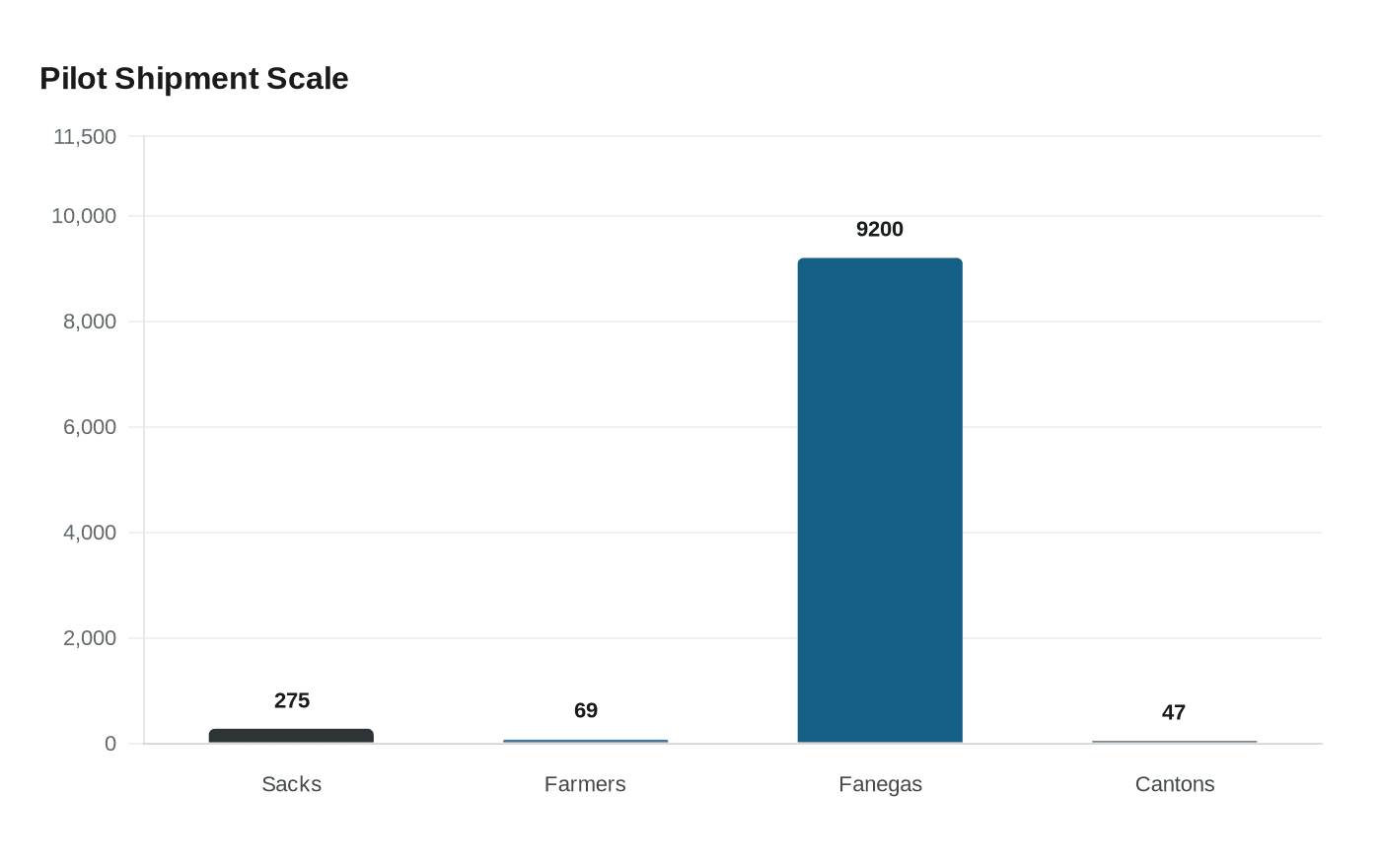
Costa Rica’s proof point came on March 14, 2024, when it announced its first shipment of deforestation-free coffee to Trieste, Italy, purchased by Illy Caffè. The container held 275 sacks of 69 kilograms each, for a total of 18,975 kilograms, or about 19 tonnes, and the coffee came from about 69 farmers in the south of the country. The ceremonial sealing took place at Exclusive Coffees in Alajuela, giving the pilot a very visible finish line.
The first harvest behind that shipment amounted to 9,200 fanegas, which underlines how much local coordination sat behind what looked, from the outside, like a single export transaction. This was not a branding exercise disguised as compliance. It was an operational test of whether farm records, farm boundaries, and export paperwork could line up well enough to satisfy a tougher European market.
The institutional backbone is the real story
Costa Rica did not start from scratch. ICAFE says traceability in the coffee sector has been governed by Law 2762 since 1967, and that long-running framework gave the country a head start many origins simply do not have. On June 20, 2024, ICAFE issued a circular to beneficiaries, exporters, roasters, and traders laying out legal guidelines for deforestation-free coffee exports tied to EUDR requirements.
That is the kind of boring infrastructure the coffee trade often underestimates until it needs it. The pilot, led by UNDP, ICAFE, and CoopeTarrazú, was expanded over the past year so the tools developed for one shipment could be used across the sector and support national-level certification. Costa Rica’s 2024-2025 crop was produced across 47 cantons, which makes the coordination achievement even more impressive and also explains why a shared system matters more than isolated farm-by-farm heroics.
For coffee professionals, the practical takeaway is the architecture, not the headline. Costa Rica’s approach rests on four linked systems:
- Traceability that can follow coffee from farm to export
- Farm mapping that can show where production sits relative to deforestation risk
- Cooperative support that helps smaller producers meet documentation standards
- Export coordination that keeps growers, processors, roasters, and traders aligned before the container moves
Why low-risk status changed the game
The European Commission adopted country benchmarking on May 22, 2025, and ICAFE later described Costa Rica as a low-risk country under the EUDR in a May 30, 2025 circular. That matters because low-risk status should simplify due diligence for operators sourcing from the country, lowering the friction for buyers who still have to prove they did their homework.
This is where Costa Rica becomes more than a success story. It becomes a practical model for specialty buyers deciding where to place long-term volume. If an origin can demonstrate national systems, credible farm data, and a cooperative structure that links smallholders to export channels, the sourcing conversation changes from panic to process. The buyer is still responsible, but the burden becomes manageable.
The warning for the rest of the coffee world
Costa Rica is succeeding partly because it had institutional muscle before the regulation got teeth. That is not the same as saying compliance is easy everywhere else. Countries with weaker traceability, looser land records, or less cooperative capacity may struggle with the very basics: proving farm location, assembling evidence across dozens or hundreds of growers, and getting exporters to speak the same documentation language.
Janina Grabs of the University of Basel captures the bigger point in the way compliance is being discussed now: pilots like Costa Rica’s show that the idea of impossibility is wrong, but the burden will not be evenly distributed. Some origins will be able to absorb mapping, due diligence, and producer training as routine business. Others will hit bottlenecks where data, staffing, or coordination simply are not there yet.
Coffee remains under scrutiny for a reason. It has contributed to forest loss, even if its footprint is smaller than cattle, palm oil, or soy, and newer research and forest-monitoring work continue to place it among the commodities linked to deforestation. That is exactly why EUDR readiness is becoming a basic sourcing question, not a niche sustainability add-on.
Costa Rica’s lesson is not that the rule is easy. It is that the coffee sector can make it work when the systems are already in place, and that may be the standard every EU-facing origin will now be measured against.
This article was produced by Prism’s automated news system from verified source data, official records, and press releases, then run through automated quality and moderation checks before publishing. The system is built and supervised by the people who set the standards it runs under. Read our full AI policy.
Did this article answer your question?