Moderate Coffee and Tea Intake Linked to Lower Lung Cancer Risk, Study Finds
Half a cup of coffee daily correlated with a 28% lower lung cancer risk across 276,209 UK Biobank participants, but the finding is associative, not causal.

Half a cup of coffee per day was associated with a 28% lower risk of lung cancer in a prospective cohort analysis of 276,209 UK Biobank participants, one of the largest datasets ever applied to this question, though the authors themselves are first to warn the result does not establish cause and effect.
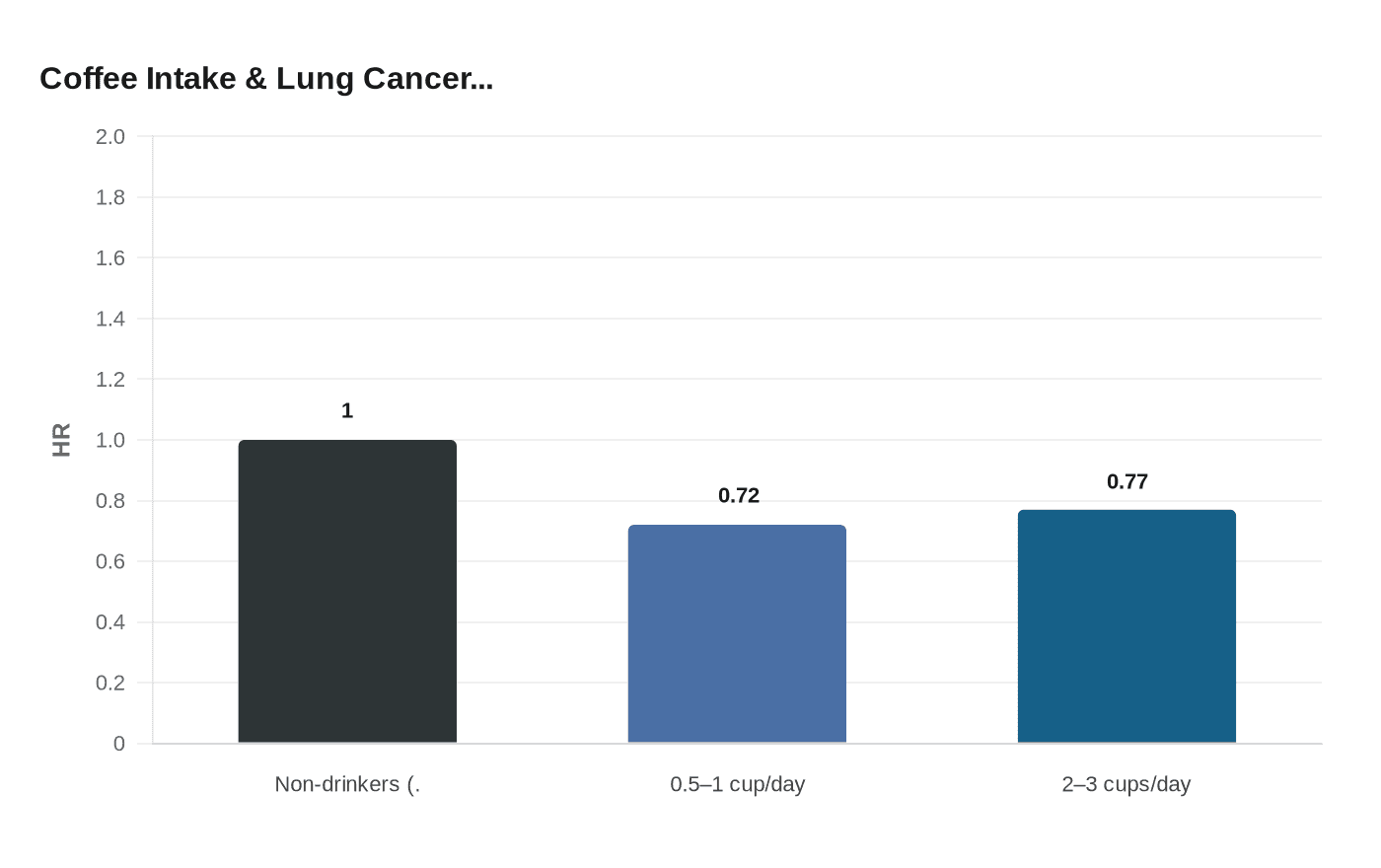
The study, led by S. Shaozhong Zheng and colleagues at Puyang People's Hospital and Zhengzhou University, followed participants for a median of 13.26 years, during which 3,821 developed lung cancer. Coffee drinkers in the 0.5-to-1-cup-per-day range had an adjusted hazard ratio of 0.72 versus non-drinkers; those at 2 to 3 cups daily had an adjusted HR of 0.77. The non-linear shape of the dose-response curve matters here: risk reduction did not scale upward with every additional cup, which means the data provides no justification for increasing intake.
Tea followed a similar arc. Across intake levels of 0.5 to 1 cup, 2 to 3 cups, and 4 or more cups daily, adjusted hazard ratios ranged from roughly 0.67 to 0.86 compared to non-tea drinkers. The consistency across both beverages suggests a possible shared mechanism, most likely involving antioxidants, polyphenols, or other bioactive compounds common to both, though the study cannot confirm which compounds are responsible or whether they are causally involved at all.

What makes this result both compelling and genuinely limited is the architecture of observational epidemiology. Dietary intake was self-reported at baseline through a touchscreen questionnaire, the kind of measurement that no statistical adjustment fully corrects. More critically, residual confounding by smoking history and occupational exposures remains a standing concern in any lung cancer study, and the UK Biobank cohort, while large, skews predominantly British and does not represent all populations. Zheng and colleagues call explicitly for further research to confirm the associations and clarify the underlying biology.
For anyone behind a portafilter or standing at a café counter fielding questions about this: the study was not designed to compare brewing methods, roast levels, or caffeinated versus decaffeinated preparation, so none of those variables can be read into the findings. The risk reduction appeared at moderate consumption levels that most daily coffee drinkers already hit without thinking about it.
What a quarter-million-person dataset tracked across more than 13 years does contribute is a credible, large-scale data point to the growing body of evidence that moderate coffee consumption is not the health liability it was once framed as. That is a defensible framing. A prescription for any particular number of cups is not.
This article was produced by Prism’s automated news system from verified source data, official records, and press releases, then run through automated quality and moderation checks before publishing. The system is built and supervised by the people who set the standards it runs under. Read our full AI policy.
Did this article answer your question?