Rabobank Warns Climate Change Could Render 20% of Arabica Land Unsuitable by 2050
Honduras could lose nearly all its arabica-suitable land by 2050 as Rabobank warns climate change will render a fifth of global arabica areas unviable.
One in five acres currently used to grow arabica coffee could become climatically unviable by 2050, and Honduras is facing something close to a total collapse of its suitable growing land. A new analysis from Rabobank puts the headline figure at 20% of global arabica land turning unsuitable by mid-century, up from 8% already classified as unsuitable today. That doubling over 25 years carries radically different consequences depending on where you're sourcing.
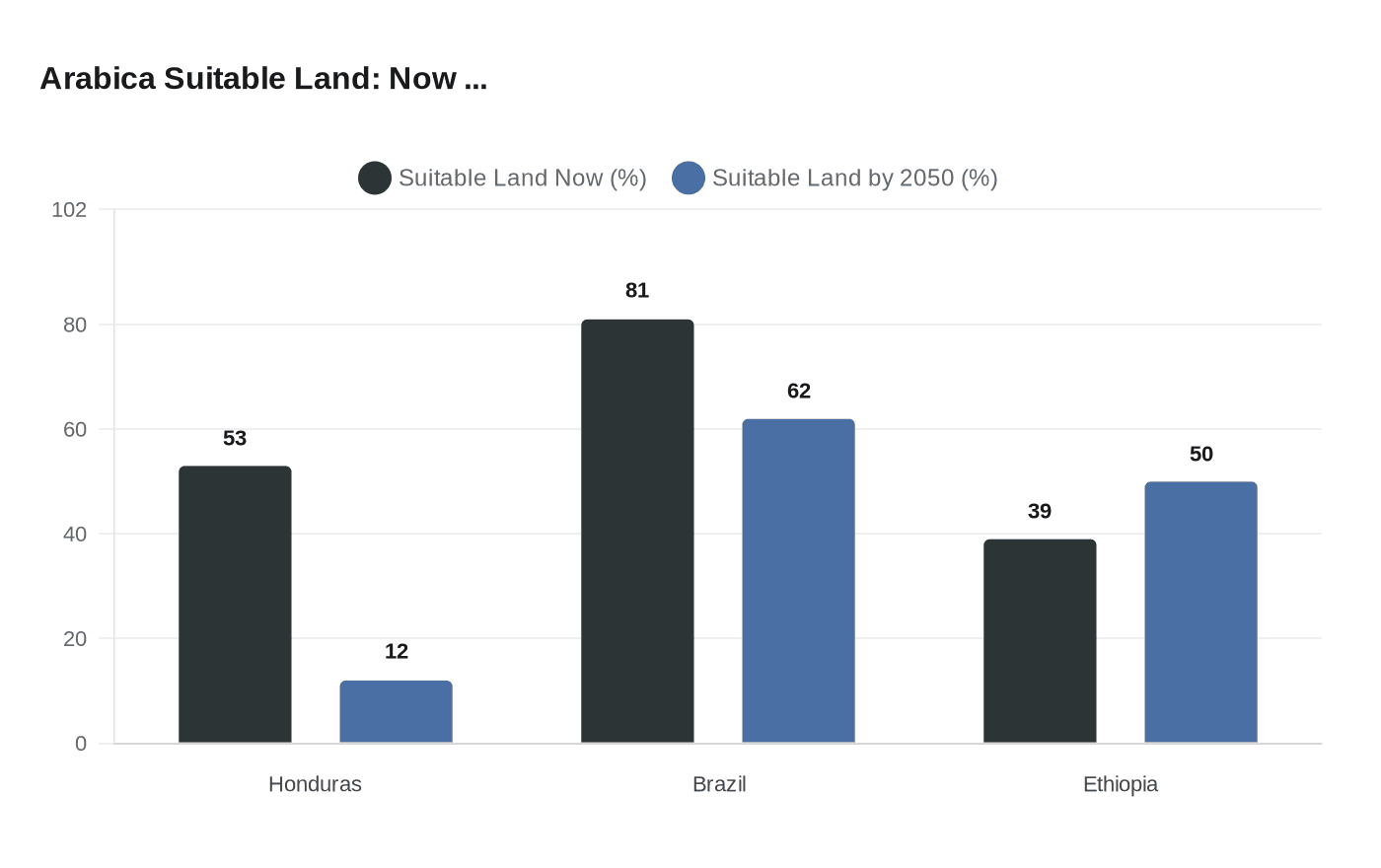
The report was authored by Rabobank climate risk specialist Camila Bonilla-Cedrez, data scientist Lilian Lin, and beverages analyst Guilherme Morya, who applied a four-category suitability classification to current arabica production zones and projected how they shift under the bank's warming scenario. Honduras, the world's eighth-largest arabica producer, takes the hardest hit: suitable growing areas collapse from 53% of current production land to just 12%, leaving an estimated 85% of Honduran arabica in marginal conditions by 2050. Colombia faces severe losses as well. These are not peripheral origins in the specialty world. Honduran arabica, particularly from high-grown regions like Opalaca and Montecillos, is prized for its tropical fruit brightness, caramel sweetness, and wine-like complexity. Colombian lots underpin a global specialty market built around balanced acidity, milk chocolate, and clean stone fruit. A contracting suitable land base in both countries threatens exactly the cup characteristics that have made Central and South American coffees the default reference point for roasters worldwide.
The report frames the stakes directly in terms of terroir: the conditions under which coffee grows, including soil type, altitude, sunlight, rainfall, and temperature, shape its flavour profile "much like terroir in wine. As climate change alters these factors, the distinctive flavours associated with specific origins may also change." Brazil, the world's largest producer, sees its suitable area fall from 81% to 62% of currently harvested land, significant but less catastrophic than what Honduras faces.
Not every origin story is bleak. Ethiopia, where arabica originated, is projected to gain ground, with suitable zones expanding from 39% to 50% of production land and highly suitable areas tripling from 4% to 13%. Ethiopian coffees, already coveted for floral jasmine, blueberry, and complex natural-process profiles, are becoming an increasingly reliable anchor as Central American supply narrows.
The report also surfaces a market paradox worth tracking. Near-term arabica commodity prices are under heavy pressure from record global harvests: May delivery contracts fell 3% on March 30, breaking through the $3 per pound level. But the long-term structural picture for premium arabica supply is quietly worsening, which means price pressure on specific high-quality lots could intensify even when commodity averages soften.
Bonilla-Cedrez noted that growers are already adapting through "heat-and-drought tolerant varieties, irrigation, shade trees, and soil-management practices that deepen root systems and improve water retention," and she was direct that "suitability maps signal risk, not the end of production." On robusta, she described it as "naturally more tolerant of heat, drought, and disease," and fine robusta from Vietnam or Uganda increasingly rewards serious engagement rather than reflexive dismissal.
The report closes with a warning that applies equally to traders and to anyone curating a home rotation: "The next decade will be decisive." Ask your roasters what altitude their Honduran and Colombian lots come from, what varietals they're buying, and whether farm partners are investing in shade management and climate-resilient cultivars. The roasters who can answer those questions in detail are building supply chains designed to outlast what Rabobank is projecting. The ones who can't are sourcing on borrowed time.
This article was produced by Prism’s automated news system from verified source data, official records, and press releases, then run through automated quality and moderation checks before publishing. The system is built and supervised by the people who set the standards it runs under. Read our full AI policy.
Did this article answer your question?