Starbucks Distributes Nearly 100 Million Climate-Tolerant Trees to Protect Coffee Supplies
Starbucks has hit 100 million climate-tolerant arabica trees distributed to farmers, with another 50 million pledged, as the company warns more than half its sourcing land could be gone by 2050.

Starbucks controls roughly 3 percent of global green coffee production, sourcing an estimated 5 million bags of arabica beans annually from more than 400,000 farms across the coffee belt. More than half of the land used to grow the arabica beans on Starbucks menus could be unusable by 2050. That single projection explains why the company just quietly reached one of the more consequential supply-chain milestones in modern coffee history.
Starbucks has reached a major milestone in its work to support the future of high-quality arabica coffee: donating 100 million coffee trees grown from varieties selected for their performance in climate-adverse conditions. Beginning in 2017, the company began distributing trees to farmers in El Salvador, Guatemala, and Mexico, and is now committing to donating an additional 50 million trees to farms in strategic origins such as Ethiopia, Tanzania, Indonesia, Colombia, Costa Rica, and Honduras.
The trees are not symbolic. At an agronomic research hub called Hacienda Alsacia in Costa Rica, Starbucks researchers test climate-resistant strains drawn from the 600 varieties in its core coffee collection. The trees distributed to farmers have been bred specifically to handle higher temperatures and drier conditions. Coffee leaf rust, a fungal disease that devastated Central American farms after entering Guatemala in 2012, was the original catalyst. In 2015, Starbucks teamed with Conservation International so that for every bag of coffee sold in participating U.S. stores between September 2015 and December 2016, one new rust-resistant coffee tree went to farmers in the regions most affected. That partnership became the seed of the 100 million tree commitment formalized two years later.
The threat matrix the trees are designed to address keeps widening. Arabica trees typically grow in cool mountain climates between 2,000 and 6,500 feet above sea level, and up to 2,500 liters of water are needed to produce a single kilogram of green coffee beans. As temperatures rise across the belt, farmers are being forced to shift production to higher elevations, which carries its own consequences, including deforestation.
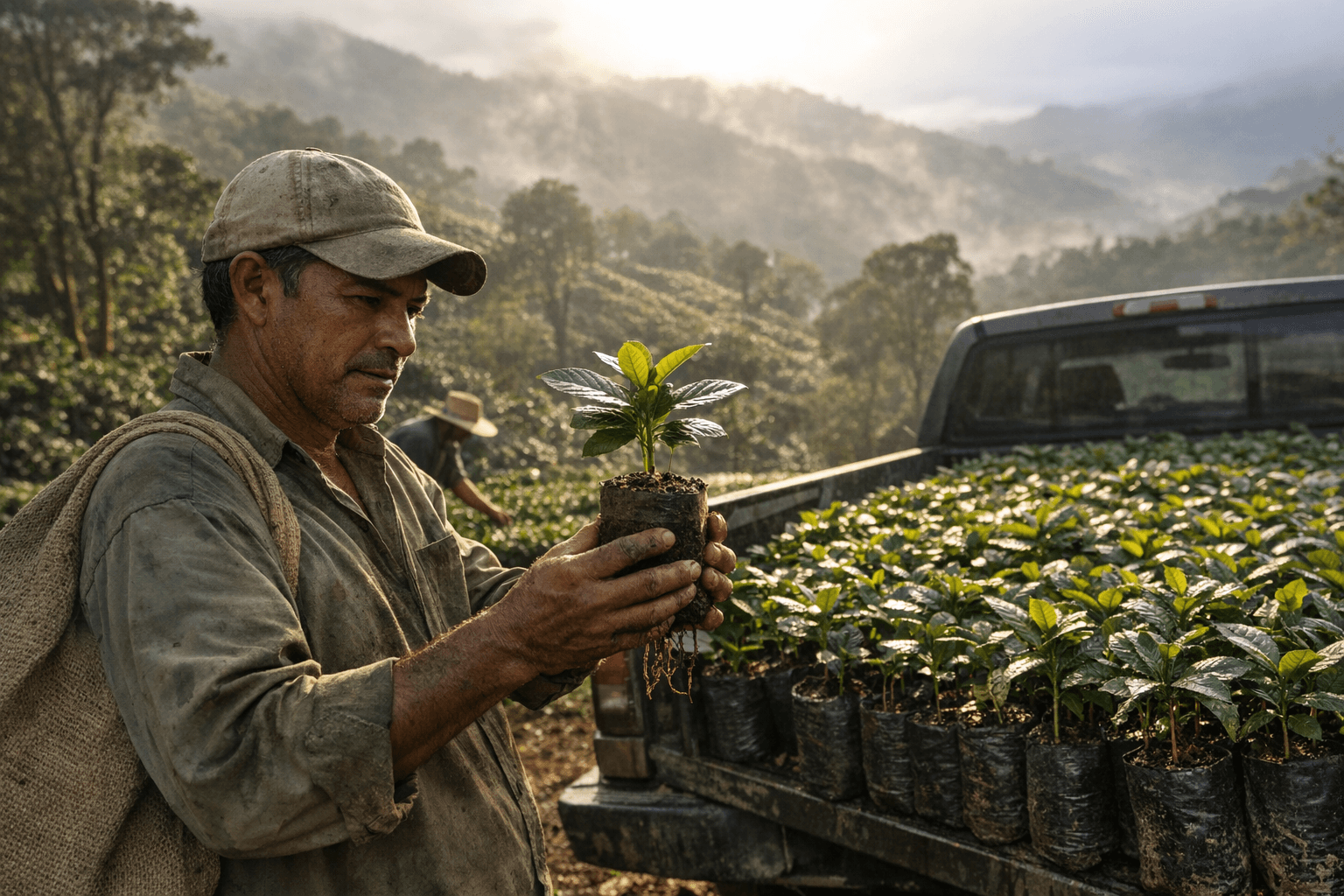
The tree program sits alongside a broader infrastructure Starbucks has built around farmer adaptation. Coffee growers receive training at Starbucks' network of 10 Farmer Support Centers and 70 model farms located in key growing regions, with close to 37,000 people having completed such courses by the end of 2024. At one point, farmers could also draw from a $100 million loan fund Starbucks created in 2000 to aid with on-farm improvements and advisory services, though that fund was depleted in May 2025. In Colombia alone, Starbucks distributed 55 million seedlings through 2024 on top of the 100 million tree count.
For the wider coffee market, Starbucks' buying power gives this program an outsized downstream effect. When the company that purchases 3 percent of global arabica production hedges its supply chain this aggressively, the varieties it selects at Hacienda Alsacia and the growing regions it prioritizes for replanting effectively set a template that smaller roasters and traders watch closely. The additional 50 million tree commitment builds on the company's long-standing focus on responsible sourcing and on-farm innovation, extending the viability of coffee production in regions experiencing climate stress. Whether 150 million trees is enough to hold the arabica supply line against a 2050 deadline is a question the industry will be answering in real time, one harvest at a time.
This article was produced by Prism’s automated news system from verified source data, official records, and press releases, then run through automated quality and moderation checks before publishing. The system is built and supervised by the people who set the standards it runs under. Read our full AI policy.
Did this article answer your question?