Five-Step Sewing Guide for UK Crafters and Beginners
This practical guide breaks learning-to-sew into five clear, project-focused steps that build skill and confidence. You’ll get a compact tool list, a staged learning path, project suggestions, fabric and pattern guidance, and ways to track progress from hobby sewing to small craft sales.

1. Start with the essentials and set a modest budget
Begin by gathering a small, focused set of tools that will actually get you sewing without overspending. Prioritise fabric scissors, a seam ripper, basic pins or clips, a tape measure, and an iron, these tools cover most beginner tasks and make mistakes less painful. Set a modest budget and buy quality where it counts (scissors and iron), while sourcing other supplies from discount stores, charity shops, or online sales to keep costs low and flexible.
2. Learn a small set of foundational skills first
Focus on a handful of repeatable techniques, straight seams, hemming, and simple topstitching, that appear in nearly every garment or accessory. Practise each skill on scrap fabric until your stitch length, seam allowance, and finish feel consistent; short, frequent practice sessions beat one long day of frustration. These base skills make more complex techniques easier to pick up and dramatically increase your chance of success on first projects.
3. Choose forgiving fabrics and beginner-friendly patterns
Pick materials that hide mistakes and are easy to handle: midweight cottons, quilting cottons, and stable linen blends are ideal starting fabrics because they don’t slip or stretch unpredictably. Avoid slippery synthetics, light sheers, or heavy knits when you’re learning; these can distort seams and teach bad habits. Look for patterns described as “beginner,” “easy,” or “simple” with limited pieces and straightforward construction; many free or low-cost patterns online fit this brief and let you practise without financial pressure.
4. Start with approachable first projects and learn one new technique per project
Choose small, satisfying projects that teach a little and finish quickly: drawstring bags, simple tops, and elastic-waist pants are reliable first projects that each introduce a core technique. Commit to learning only one new technique per project, for example, drawstring casing on a bag, setting elastic in pants, or inserting simple facings on a top, so you can celebrate completion and retain the lesson. Finishing items builds confidence and gives tangible goods you can gift or sell, reinforcing progress.
5. Use a staged learning path that mixes short practice pieces with incremental challenges
Plan a learning route that alternates quick practice pieces with slightly tougher builds so you keep momentum while stretching skills. Example sequence: practise straight seams on scraps → make a drawstring bag to learn casings → sew a simple top to practice seams and hemming → try elastic-waist pants to learn elastic insertion and basic fitting. This step-up approach prevents boredom, reduces overwhelm, and produces a visible portfolio of rising competence.
6. Keep a skills checklist and measure your progress
Make a simple checklist of skills you want to master, seam allowance accuracy, even hemming, neat topstitching, inserting elastic, and reading pattern markings, and tick them off as you practise. Use before-and-after photos, timed sewing sessions, or small quality benchmarks (e.g., seam allowance within 2–5 mm) to see improvement objectively. A checklist helps you identify weak spots to revisit and gives structure to learning sessions.
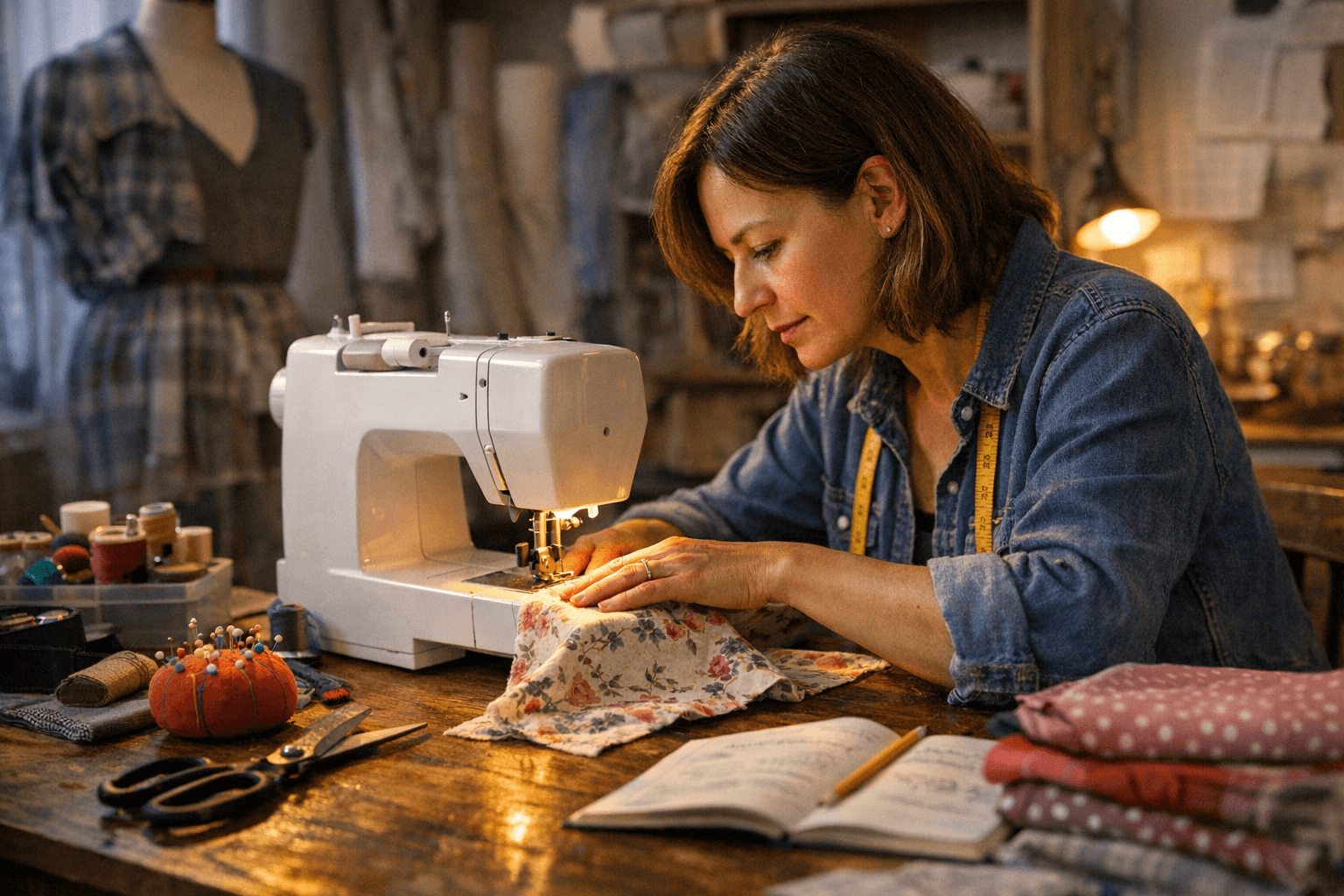
7. Use free and low-cost patterns to practise without pressure
There are plenty of usable free and inexpensive patterns that are perfect for learning: many independent designers and sewing communities publish simple patterns you can download and print at home. Reusing low-cost patterns reduces hesitation about mistakes and allows repeated attempts until you’re satisfied. Keep a library of patterns that scale in difficulty so you can move up naturally as skills improve.
8. Toolbox specifics and maintenance
Invest in a few durable items that will save time and frustration: a good pair of fabric scissors kept only for fabric, a reliable seam ripper for quick corrections, a steam iron for pressing seams and giving garments a professional finish, and a basic sewing machine that handles the fabrics you choose. Regularly clean and oil your machine per the manual, replace needles after several projects, and keep scissors sharp; simple maintenance keeps results consistent and learning enjoyable.
9. Practical UK-focused tips for community and small business steps
Take advantage of local community resources, fabric shops with friendly staff, sewing groups, community centre classes, and maker markets, to learn in person and test your work with real customers. Start small if you want to sell: market test simple sewn goods like drawstring bags or basic tops at local craft fairs or online platforms, price to cover materials and time, and use feedback to refine patterns and finishes. Building a dependable maker skill in the UK benefits from tapping into local networks for sourcing, teaching, and selling.
- Keep projects small and frequent so you finish regularly and learn from complete garments.
- Treat mistakes as lessons, use your seam ripper early and often to understand construction.
- Aim for progress, not perfection; consistent practice turns sewing from a hobby into a reliable craft you can scale for gifts or small sales.
10. Final tips to keep momentum and enjoy the journey
This five-step, project-focused approach gives you structure, measurable progress, and enjoyable outcomes. Start small, practise foundational skills, pick forgiving materials and patterns, and use community resources to grow your craft into a steady, satisfying making habit.
This article was produced by Prism’s automated news system from verified source data, official records, and press releases, then run through automated quality and moderation checks before publishing. The system is built and supervised by the people who set the standards it runs under. Read our full AI policy.
Did this article answer your question?