Krochify crescent moon amigurumi pattern solves shaping with hanging stars
A 20 cm crescent moon with hanging stars turns amigurumi shaping into nursery-ready wall art, with a clean silhouette and a smart answer to sagging curves.
A small moon with designer-level payoff
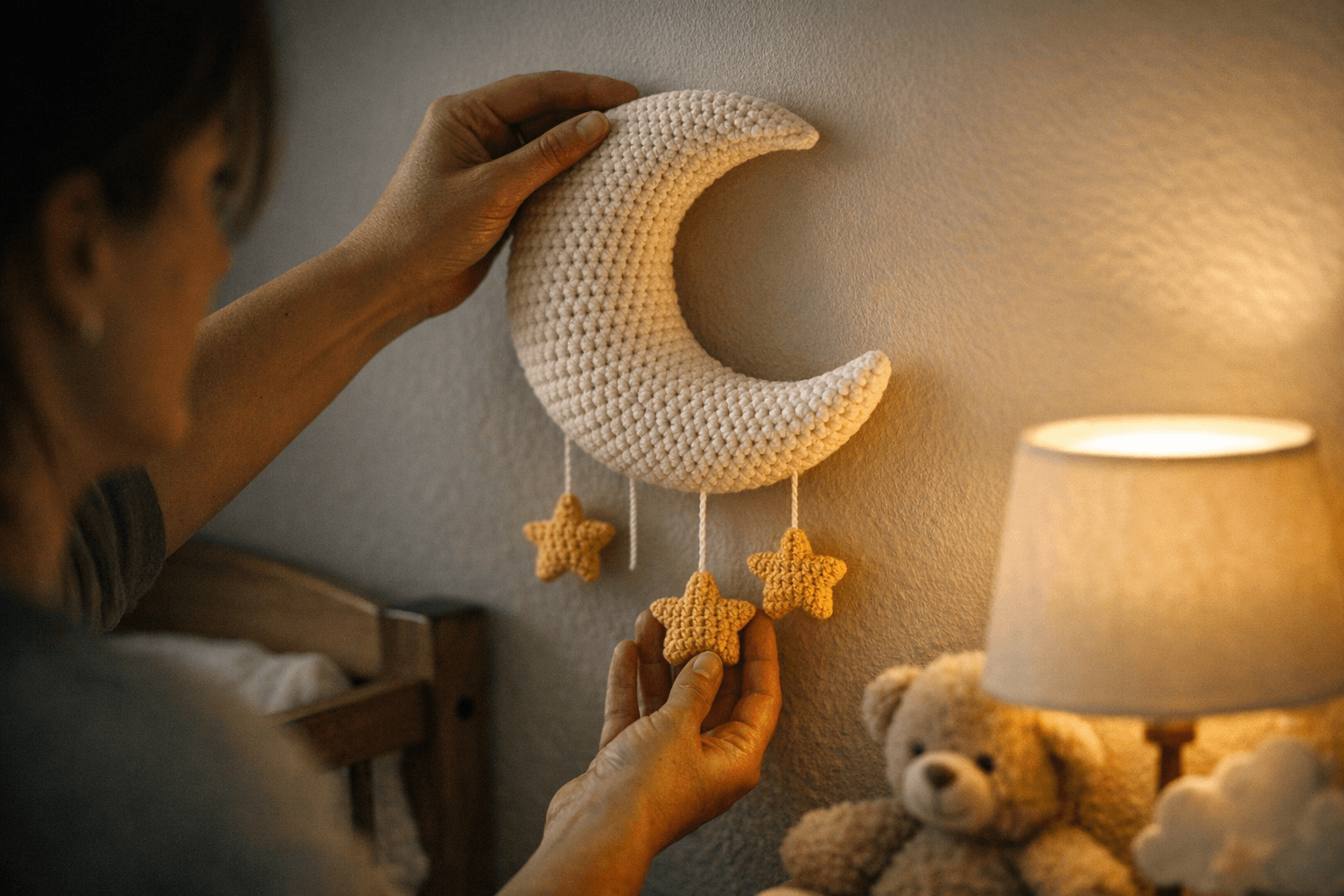
Krochify’s crescent moon amigurumi is the kind of make that looks simple from across the room and surprisingly engineered up close. At about 20 cm wide, it lands in that sweet spot where a project feels quick enough to finish, but substantial enough to read as boutique nursery decor rather than a tiny novelty.
What gives it that lift is the decision to treat the moon like a structure, not just a silhouette. The hanging stars do more than decorate the curve. They pull the eye downward and make the whole piece feel composed, balanced, and intentional, which is exactly why this pattern feels like a display object first and a toy second.
Why the shaping works
Crescent moons are deceptively difficult in crochet because the inner curve can collapse, flatten, or look pinched if the shaping is off. This pattern solves that problem with two matched crescent panels instead of a folded disc, so the seam sits on the edge and the outline stays crisp. That detail matters more than it sounds like it does, because a clean seam is what keeps the moon from reading as bulky or lopsided.
The other smart move is how the stuffing is distributed. The lower belly carries the fullness, while the points stay narrow and graceful, which keeps the crescent from looking blunt. A common mistake in moon projects is stuffing the tips too firmly and leaving the belly too soft, a combination that can make the curve look dented instead of smooth. Here, the shaping is doing the visual heavy lifting.
The result is a pattern that feels like a small design lesson in amigurumi construction. It shows how stitch placement, panel matching, and fill density all affect the final silhouette, especially when the goal is a decorative object that has to look good from across a nursery or bedroom.
Materials and scale that make it display-ready
The finished moon uses worsted yarn, a 4 mm hook, embroidered details, and three mini stars. Those choices keep the texture readable without making the piece fussy, which suits a wall-hanging or shelf accent better than a soft toy meant for rough handling. The embroidery gives the face and surface detail enough definition to hold up in a photo, while the stars add movement without cluttering the moon’s outline.
Scale is part of the appeal here too. A comparable crescent-moon amigurumi listing from Allat describes a moon that is about 7 cm, while this one is about 20 cm wide. That difference changes the entire feel of the finished piece. The smaller version reads as a charm or token, while Krochify’s version is large enough to command a wall, a bedroom nook, or a styled nursery corner.
Where the hanging stars belong
The stars are suspended from the lower curve rather than clipped to the tips, and that choice is doing a lot of visual work. Hanging them below the moon keeps the crescent itself as the focal point, while the stars act almost like a mobile trail beneath it. The arrangement feels lighter and more balanced than dangling extra pieces from the points, where they could visually fight the curve.
That placement also makes the piece feel more polished. In a field where many moon patterns are sold as nursery decor, keychains, stroller charms, or gifts, this one leans fully into the decor side. It is not trying to be everything at once. It knows it is a hanging accent, and that clarity gives it presence.
A pattern that fits right into amigurumi culture
Amigurumi, the Japanese term for crocheted or knitted stuffed figures, has become closely tied to kawaii-style craft culture, and this moon fits neatly into that aesthetic. The appeal is in the mix of softness, stylization, and charm. A celestial piece like this works because it feels familiar, but the construction gives it a little more intention than a plain stuffed shape.
That is also why moon-and-stars designs keep showing up across the crochet world. They are recognizable, easy to style, and adaptable to everything from nursery decor to gift making. Some crescent moon patterns even lean toward mobile charms or tiny accessories, and a few emphasize tight amigurumi stitching to keep the curve from sagging or flattening. Krochify’s version takes that familiar idea and enlarges it into something that feels more finished and room-ready.
How to use it safely in a nursery
The hanging-star concept is especially strong as wall art, a supervised nursery mobile, or a bedroom accent. It is not the kind of piece you want within a baby’s reach, and the U.S. Consumer Product Safety Commission warns that hanging crib toys and mobiles should be kept out of reach and removed when a baby begins pushing up on hands and knees or by about 5 months. The agency also warns never to use strings to hang any object, such as a mobile, toy, or diaper bag, on or near the crib where a child could become caught.
That means the best placement is one that preserves the visual idea without creating a crib hazard. Hung high on a wall, suspended well away from the sleep area, or used as a supervised decorative mobile, it delivers the intended look without crossing into unsafe territory. For makers who want a nursery piece with handmade warmth, that distinction matters as much as the stitch count.
A small make with a big visual return
This crescent moon works because every choice supports the final silhouette. The paired panels solve the shape, the stuffing keeps the curve graceful, the hanging stars bring movement, and the 20 cm scale gives it enough presence to matter in a room. It is the kind of project that rewards attention to structure while still staying approachable for a confident beginner or intermediate crocheter.
For anyone who wants a handmade accent with a polished, boutique look, this is a smart place to land. It delivers the charm of amigurumi, the clarity of good construction, and the decorative payoff of a piece made to hang, not just sit on a shelf.
This article was produced by Prism’s automated news system from verified source data, official records, and press releases, then run through automated quality and moderation checks before publishing. The system is built and supervised by the people who set the standards it runs under. Read our full AI policy.
Did this article answer your question?