Petal Loop Stitch Crochet Trays Blend Texture, Structure, Everyday Function
Petal loop stitch trays turn rope and a wooden base into sturdy catchalls for keys, yarn, and clutter, with texture that looks polished and works every day.
A catchall that earns its spot
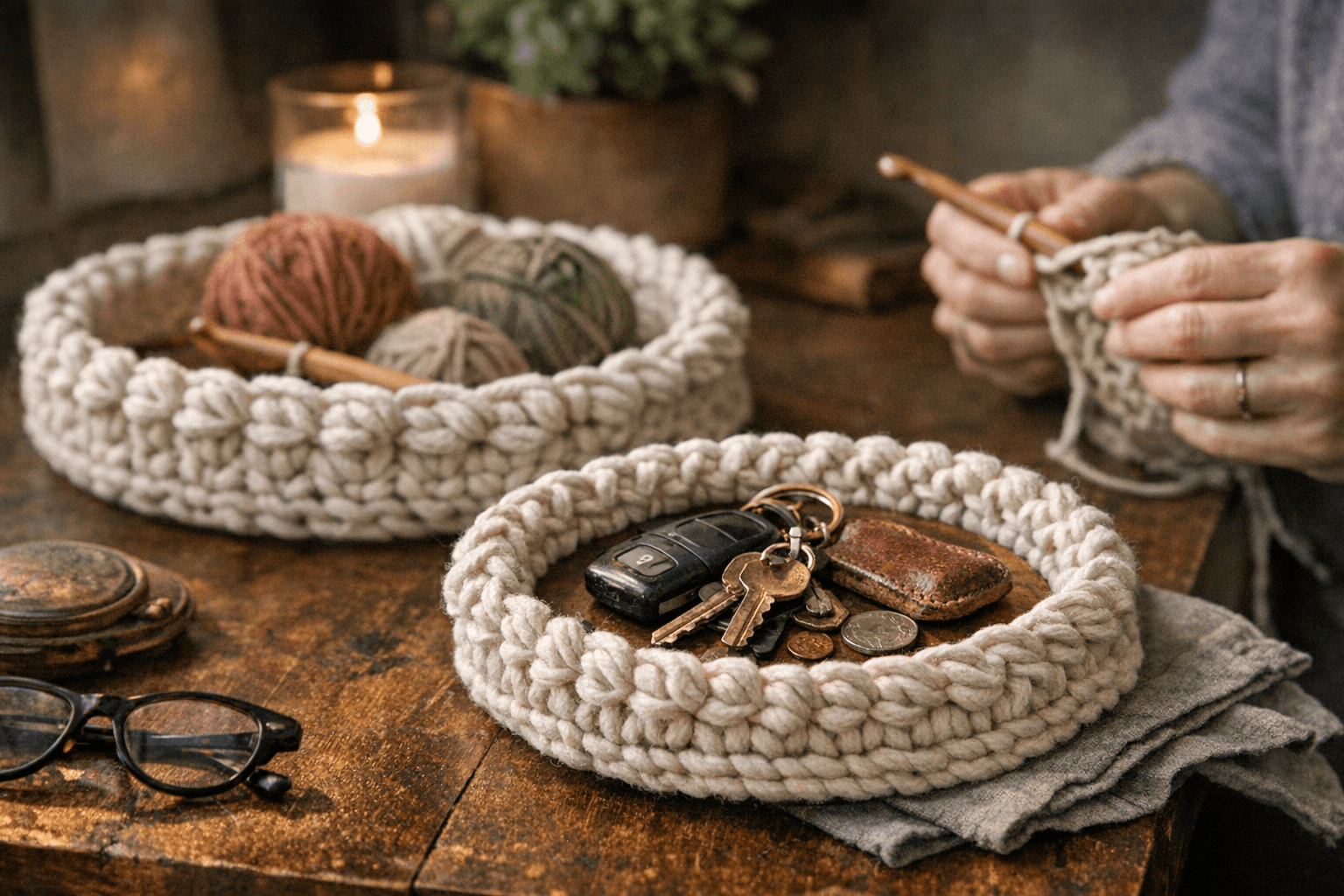
The appeal of Briana K Designs’ Petal Loop Stitch Crochet Nesting Trays is simple: they solve the small messes of daily life without looking like storage bins. Worked directly into a wooden base, the trays get the kind of structure that keeps them from slumping, while the Petal Loop Stitch adds a textured finish that feels decorative but still practical. Published on April 11, 2026, the pattern is built for the moments every home has, keys dropped by the door, loose change on a dresser, yarn tools on a side table, or kitchen odds and ends that need a home.
That balance of polish and usefulness is what makes the project stand out in a crowded field of crochet home-decor patterns. These trays are not meant to sit there pretending to be useful. They are designed to be reached for, filled up, stacked, and put back into service.
Why the structure works
The wooden base is the detail that gives the project its backbone. Instead of relying on stitches alone to hold shape, the design anchors the crochet to a firm foundation, which makes the finished trays feel stable enough for real use. That matters in a pattern meant for organization, because a tray that buckles or curls would quickly turn into decoration only.
The Petal Loop Stitch builds on that base with a surface that looks elevated without becoming fussy. Briana K Designs says the stitch was introduced and named in 2026, and the pattern uses it in a way that highlights its repeatable texture. The result is a tray that reads as modern and handmade at the same time, with enough visual detail to sit on open shelving and enough firmness to live on a desk or countertop.
What the pattern gives you
The pattern is set up as a digital download and is listed in the Briana K Designs shop and on Etsy. It is also described on Ravelry as charted, worked in the round, and supported by both video tutorial and written instructions, which makes the construction easier to follow from more than one angle. The suggested hook size is 4.0 mm, and the yarn weight is listed in the super bulky range, so the finished pieces have the heft needed for a tray that is meant to function.
The materials note is just as practical. The pattern calls for 3 mm macrame cord or cotton rope yarn, and it includes five sizes with yardage of about 20, 35, 45, 60, and 70 yards. That range makes the project easy to scale, whether the goal is a small catchall for jewelry or keys, or a larger organizer for bathroom and kitchen items.
The five sizes, and how they fit real life
Those five sizes are one of the smartest parts of the design because they make the trays feel adaptable instead of decorative-only. A small tray can land on a nightstand for rings and earbuds. A medium one can collect crochet hooks, stitch markers, or scissors. The largest sizes can handle yarn, plants, or a fuller display of decorative accents without losing their shape.
The Ravelry description goes even further, noting that the trays can hold yarn and crochet tools, keys, bathroom or kitchen items, decorative accents, and even plants. That range is what gives the pattern its everyday payoff. It is not a one-room project; it moves easily from entryway to craft room to bathroom shelf.
How the nesting set changes the usefulness
The nesting idea is not just a nice styling detail. Because the trays are designed to be used individually or stacked as a cohesive set, the pattern gives makers a built-in system for organization. One tray can live on a desk, another beside the sink, and the rest can stay nested together until needed. That makes the project especially appealing for anyone who likes a coordinated look without giving up flexibility.
This is also where the stitch choice pays off again. Texture makes the set feel intentional, but the repeated construction makes each tray part of a family. The visual consistency is what lets the pieces work as a display, while the different sizes let them work as storage.
A stitch with a growing footprint
Briana K Designs has been building a recognizable Petal Loop Stitch line around this pattern. Around the same time as the nesting trays, the same stitch appeared in a washcloth, a trivet, a blanket, and a cardigan. That matters because it shows the stitch is not being treated as a one-off novelty. It is becoming a design language of its own, one that can move from kitchen utility to wearables to home goods without losing its identity.
The trivet, published April 4, 2026, leans into the same practical texture in a kitchen setting, while the blanket, published April 6, 2026, shows how the stitch can stretch into a larger surface. The washcloth and cardigan extend the idea even further. Together, they make the nesting trays feel like part of an evolving collection rather than a single isolated pattern.
Why this pattern lands with makers now
There is a strong reason these trays feel especially current: they offer visible payoff fast. The construction is clear, the texture is immediate, and the finished object does something useful the minute it is done. That combination is exactly what pulls a lot of crocheters toward home-decor projects now, especially when they want something they can keep, gift, or sell without spending weeks on shaping or finishing.
The pattern also fits the sweet spot between beginner-friendly and polished. The charted instructions, video support, written pattern, and in-the-round construction all lower the barrier to entry, while the wooden base and Petal Loop texture lift the final result far above a basic basket. It is the kind of project that looks at home on a shelf, but behaves like a tool in the rooms where clutter always seems to gather.
In the end, the Petal Loop Stitch Crochet Nesting Trays show what crochet does best when it is tied to everyday life: it turns a little yarn, a sturdy base, and a smart stitch into something that quietly keeps a house working.
This article was produced by Prism’s automated news system from verified source data, official records, and press releases, then run through automated quality and moderation checks before publishing. The system is built and supervised by the people who set the standards it runs under. Read our full AI policy.
Did this article answer your question?