The Priscilla filet crochet book shows crochet as image-making craft
The Priscilla filet crochet book shows how open and filled squares still teach crocheters to turn charts into images. Its old vocabulary and motif logic remain useful now.
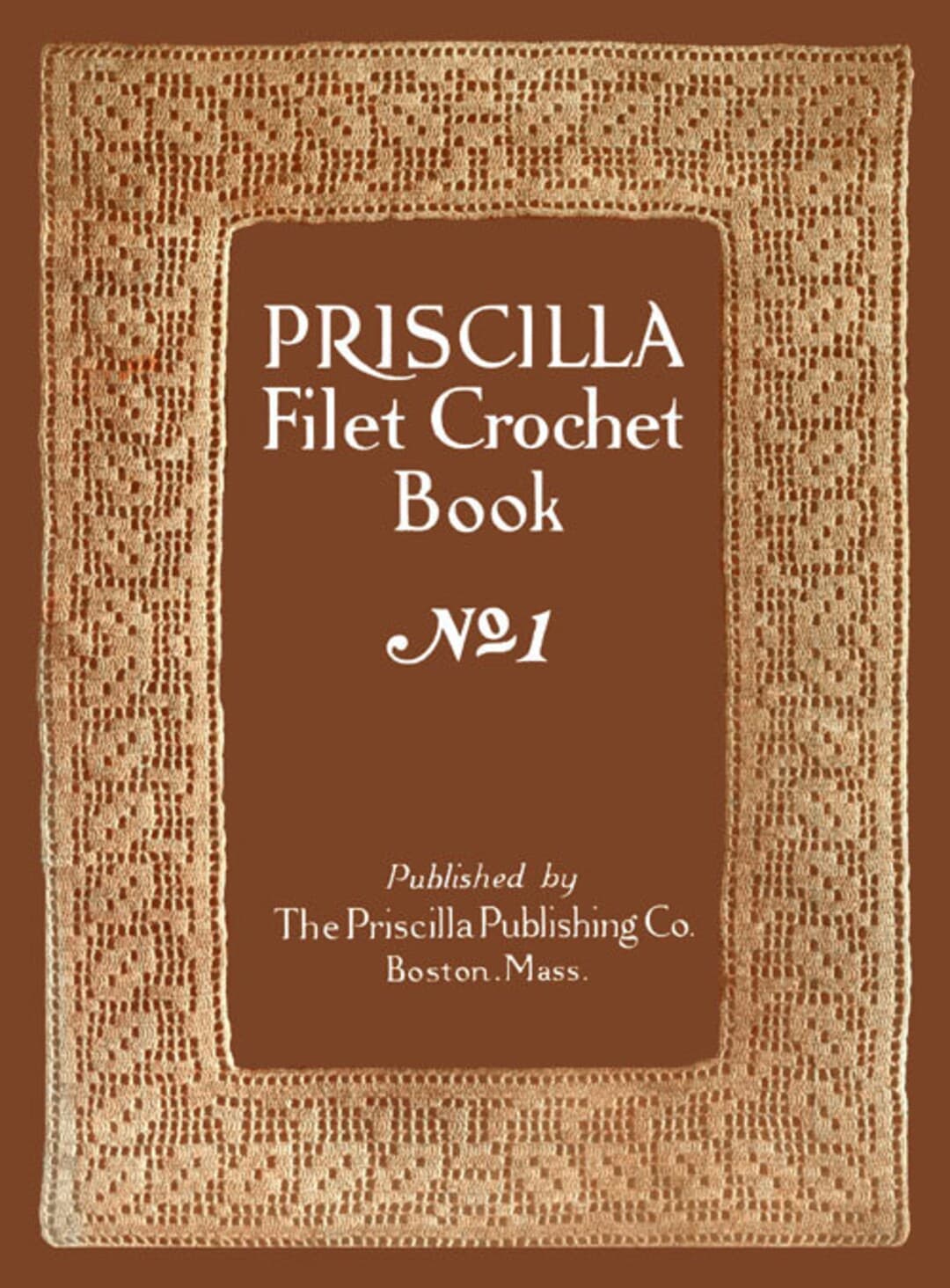
Belle Robinson’s *The Priscilla filet crochet book* turns a simple grid of open and filled squares into words, flowers, borders, and pictorial blocks with real precision. In it, crochet becomes a way to draw in thread, not just a way to make fabric, and that is exactly why filet crochet still reads clearly to modern makers.
Filet crochet still works because the logic is so clear
Filet crochet is built on one of the cleanest systems in the craft: open squares, filled squares, and charts. Once you learn to count the mesh and follow the diagram, you are reading an image the same way you would read a graph pattern today. That makes the method especially useful when you want to understand how crochet can translate a design onto fabric without relying on freehand improvisation.
The Priscilla book captures that system in a form that is easy to recognize now. Its structured motifs and charted layouts show why filet has long been used for table linens, curtains, pillow covers, decorative inserts, and garment panels. The open mesh gives the work a lace-like look while still carrying readable shapes.
What the Priscilla volume preserves
Smithsonian Libraries records *The Priscilla filet crochet book* as published in 1915 by the Priscilla Publishing Co., with Belle Robinson credited as the author. An Internet Archive title-page scan shows copyright 1911 by The Priscilla Publishing Company in Boston, Massachusetts. The book circulated in more than one form, with a 1911 copyright and a 1915 library record for the title.
It shows how crocheters were learning to work from repeatable instructions, where the chart itself was the key to getting the picture right. Smithsonian Libraries also holds a digital record for *The Priscilla filet crochet book, no. 2*, placing it within a broader, organized pattern line rather than a one-off pamphlet.
The older language behind the method still echoes in modern filet
*The 1912 New Filet Crochet Book* says the term “filet crochet” appeared in pattern books for the first time in 1912. It also says the technique had previously been known as “square crochet.” That old name makes the construction even more obvious: the craft is built from squares, and the squares are what let the image emerge.
The same 1912 preface reaches further back and places the method in a medieval lineage. It references medieval darned netting, also called lacis, and says Cluny guipure was “one of the earliest forms,” known in the Middle Ages as “Spider Work.” The book frames filet crochet not as a novelty, but as a modern adaptation of older lace and net traditions.
A 1913 Antique Pattern Library entry for *Le Filet Ancien au Point de Reprise II* identifies it as a second Filet Ancient volume with charted designs for darned net, useful for filet crochet, cross-stitch, and beadwork. That cross-craft overlap is familiar: a good chart can move between needles, hooks, and beads because the underlying design language is so structured.
Why chart reading is still the skill that matters most
If you crochet filet now, the most useful thing the old books still teach is chart reading. The technique depends on counting, not guesswork, and that makes it a strong entry point for learning how crochet diagrams work across the wider craft. Once you understand how a filled square changes the picture, you can move between motifs, borders, and full panels with much more confidence.
Vintage filet books remain practical. They show how to build a motif so it reads clearly at a distance, how to repeat a border without losing the image, and how to balance negative space against solid blocks. Those are the same design decisions contemporary filet patterns still rely on, whether the final piece is a curtain panel or a smaller home accent.
What modern makers can borrow from the archive
Modern filet crochet still works from grids of filled and open spaces, and that basic description has not changed. What has changed is the context: today you may be working from a tablet or a printed PDF instead of a bound book, but the chart logic is the same. The old pattern books make that continuity visible and remind you that filet is a design system as much as a stitch pattern.
These books are still being sold and collected in vintage-pattern marketplaces. Makers still want clear motif charts, classic layouts, and the kind of structured instruction these books provide. If you are exploring archive patterns now, you can borrow three things immediately from the Priscilla approach:
- Read the chart before you read the prose, because the image is the plan.
- Count every square, especially at motif edges, where small errors change the picture fast.
- Treat open space as part of the design, not as leftover background.
Why this book still matters on a shelf and in a project bag
Smithsonian Libraries keeps this material accessible. Its system unites 20 libraries into one network serving the Smithsonian Institution and the public.
This article was produced by Prism’s automated news system from verified source data, official records, and press releases, then run through automated quality and moderation checks before publishing. The system is built and supervised by the people who set the standards it runs under. Read our full AI policy.
Did this article answer your question?