CrossFit Says Coaching Matters More Than Perfect Programming
A polished whiteboard does not guarantee better results. CrossFit says the coach on the floor, not the plan on paper, is what turns training into progress.
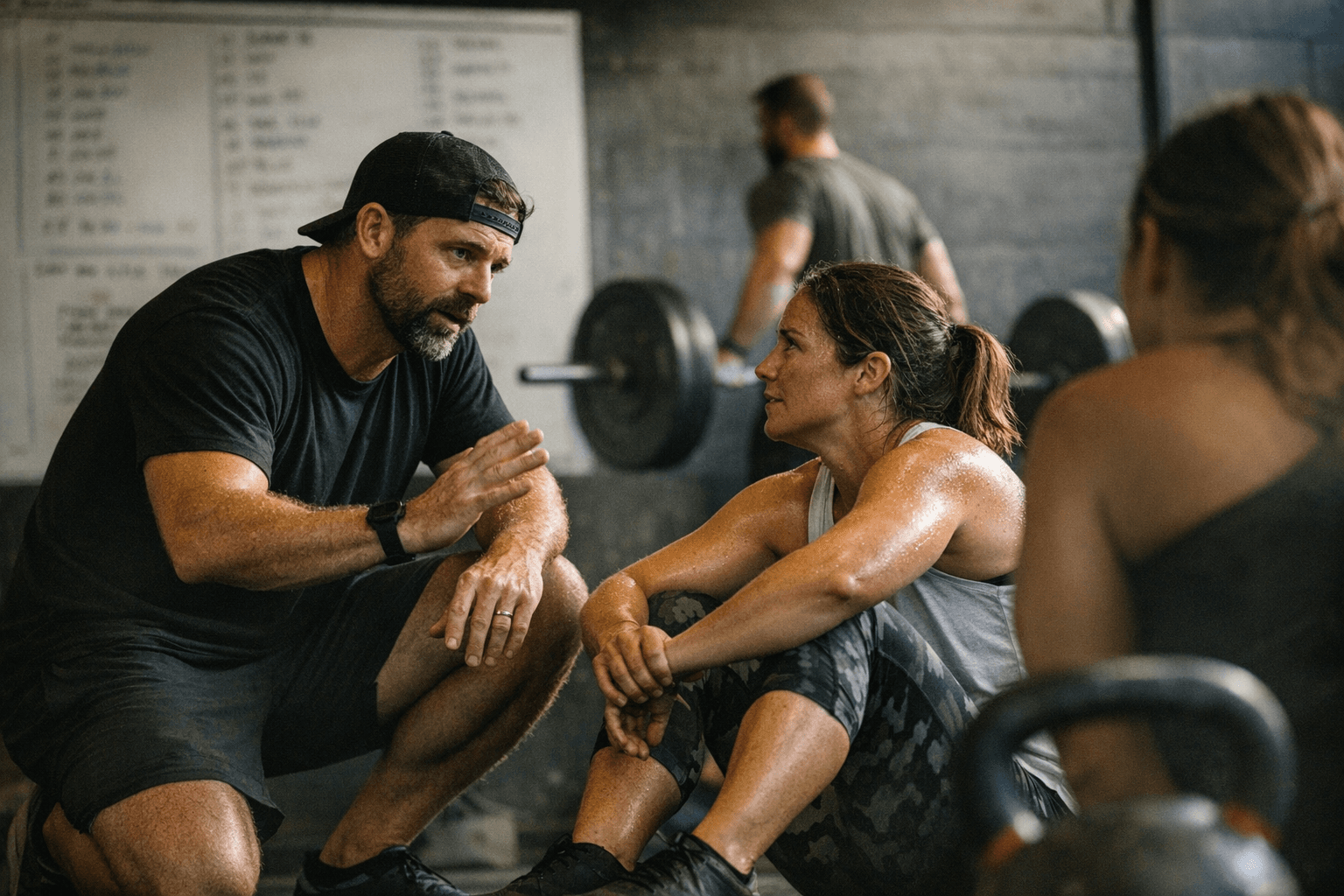
The best workout is only as good as the person running it
The best gym hour is not always built on the cleverest whiteboard. CrossFit’s latest coaching explainer, written by Stephane Rochet, CF-L3, makes a blunt case: coaching matters more than perfect programming because the plan only works if it is delivered well on the floor.
That is the real test for any box. A beautifully designed workout can still fall flat if the coach cannot scale it, spot faults early, manage the room, or keep athletes moving with the right pace and intent. CrossFit’s message is simple and useful: judge your class by what happens after the warm-up starts, not by how impressive the written session looks.
Programming sets the target, coaching gets people there
CrossFit draws a hard line between programming and coaching. Programmers handle the architecture of training: sets, reps, loading, rest intervals, movement pairings, and the bigger arc of adaptation over time. Coaching is the in-room work, the cueing, correcting, group management, presence and attitude, and demonstration that make the session actually happen.
That distinction matters because athletes often only see the whiteboard. They see the workout, not the decisions behind it. CrossFit’s argument is that even a basic plan, if implemented well, will usually outperform a more polished program that is delivered poorly. In other words, a coach who can keep a room of mixed abilities moving safely and purposefully will do more for your results than a fancy plan that no one can execute.
The practical takeaway is easy to apply in your own class. If the coach is adjusting loads without drama, breaking movements into useful progressions, and giving you a target pace instead of vague encouragement, that is coaching doing real work. If the plan looks smart but the room feels chaotic, the program is not the whole story.
What good coaching actually looks like on the floor
CrossFit’s coaching fundamentals are built around six criteria: teaching, seeing, correcting, group management, presence and attitude, and demonstration. Those are not abstract virtues. They are visible behaviors you can watch in any class.
A coach who teaches well can explain the movement in a way that makes sense fast. A coach who sees well notices when knees cave, when the bar path drifts, when someone is protecting an old injury, or when a new athlete is lost in the middle of a complex movement. A coach who corrects well does not just shout louder; they give a fix that changes the rep right away.
The other three criteria matter just as much. Group management keeps a room from turning into a traffic jam. Presence and attitude set the tone so athletes trust the session and stay engaged. Demonstration matters because some movements need to be seen before they can be understood. If your coach hits all six, your class is probably getting better at the exact things CrossFit claims should define training quality.
How to judge whether your class is improving because of coaching
The easiest way to evaluate your box is to ask what the coach changes in real time. A strong coach does not just repeat the day’s plan; they make the plan fit the athletes in front of them. That means better scaling, better movement correction, better pacing advice, and a sharper eye for injury prevention.
Look for these signs:
- scaling that changes the workout without changing the intent
- cues that fix a rep immediately instead of after the set is done
- pacing advice that helps you finish strong instead of blowing up early
- clear attention to movement quality when fatigue starts to show
- smart substitutions for athletes who need them, without making them feel sidelined
CrossFit’s point is that the coach is the force multiplier. A simple workout can challenge beginners, competitors, and masters athletes all at once if the coaching is good. That is especially important in CrossFit, where one class often blends people chasing the Games with people trying to move better for life outside the gym.
The system behind the coaching standard
CrossFit does not treat coaching as a soft skill. Its Level 1 Certificate Course includes two days of classroom instruction, small-group training sessions, and coach-led workouts. That structure matters because it ties knowledge to movement, and movement to teaching.
The Level 2 training materials go further, with practical exercises focused on teaching and seeing movement faults, plus teach-backs and real-time feedback. That is the difference between knowing the terminology and actually running a room. CrossFit’s own materials make the same point from a different angle: the best coaching is learned by watching athletes train, reviewing how scaling choices worked, and adjusting from there.
That is also why the company describes affiliate programming as a service meant to support coaches’ professional development. The written plan is only one part of the product. The other part is the coach development system wrapped around it.
Why the affiliate model puts coaching at the center
CrossFit’s affiliate structure makes the same argument in business terms. The annual affiliate fee is US$4,500, and a valid Level 1 Certificate is required to officially open an affiliate. CrossFit says affiliates exist all over the world, and the model is built around local gyms, trainers, and communities.
That matters because it shows how central coaching is to the brand. If the affiliate is the front door to the CrossFit experience, then coach quality is what determines whether people keep walking through it. CrossFit’s own materials frame affiliation as a grassroots movement with a results-based, community-driven approach, which only works if the coach can deliver the plan in a real room with real people.
The company’s recent messaging points in the same direction. On January 21, 2026, CrossFit argued that mentorship is the affiliate’s thriving strategy. On March 4, 2026, it focused on the gap between Level 1 knowledge and real coaching on the floor. The through line is obvious: knowing CrossFit is not the same as coaching CrossFit well.
The next place this gets tested
CrossFit is also putting that coaching emphasis on display at the 2026 Owners and Coaches Conference, scheduled for July 22 to 23 in San Jose, California. That schedule signals where the company continues to invest: coach education, affiliate leadership, and the gap between theory and practice.
For anyone trying to judge their own box, the standard is already clear. The best gym is not the one with the fanciest programming language or the cleanest whiteboard. It is the one where the coach can teach, see, correct, manage, and adapt fast enough that the workout works for the people in the room.
Know something we missed? Have a correction or additional information?
Submit a Tip