Trump administration uses Cuba terror label to justify escalation
Washington is using Cuba’s terror label as a pressure lever, and the consequences now reach travel, banking, sanctions, and Havana’s standing.

The terror label is doing more than naming a threat. It is helping Washington harden the screws on Cuba, one policy move at a time.
What the label actually does
The State Department’s State Sponsor of Terrorism designation is not just rhetoric. It sits on top of three legal authorities: section 1754(c) of the FY2019 NDAA, section 40 of the Arms Export Control Act, and section 620A of the Foreign Assistance Act of 1961. Once a country is placed on that list, the label can ripple into sanctions pressure, banking compliance, travel rules, and the broader diplomatic case Washington makes to allies and companies.
That is why Cuba’s case matters so much. A terrorism designation gives the White House a ready-made justification for escalation, and the current fight over Cuba shows how quickly a legal label can become a political weapon. It also explains why banks, airlines, and foreign ministries treat the issue as more than symbolism.
How Cuba got back on the list
The modern version of this fight began on January 12, 2021, when the State Department designated Cuba as a State Sponsor of Terrorism. The Trump administration said Cuba had repeatedly provided support for acts of international terrorism by granting safe harbor to terrorists. That designation then became part of the policy baseline inherited by the next administration.
Biden reversed course on January 14, 2025, certifying rescission of Cuba’s SST designation. His administration said Cuba had not provided any support for international terrorism during the preceding six-month period and had given assurances it would not support international terrorism in the future. The White House tied that move to a Vatican-facilitated deal aimed at securing prisoner releases, which gave the decision a humanitarian and diplomatic frame.
Trump reversed that decision on January 20, 2025, putting Cuba back on the terrorism list. Six days later, Marco Rubio said the administration had moved within the first two weeks of Trump’s term to keep Cuba on the SST list. That sequence matters because it shows the label is not being treated as a static legal judgment. It is being used as an instrument of policy choice, with each reversal signaling a different posture toward Havana.
Why the new rhetoric feels like escalation
Jason M. Blazakis, who previously managed the State Department office that handled state sponsor of terrorism designations, argues that the current framing is not a neutral security assessment. His point is blunt: the factual basis for keeping Cuba under the label expired long ago, and the administration is leaning on the designation to justify harsher pressure on the island.
That pressure is not abstract. Blazakis draws a comparison to the way the Trump administration built a rhetorical runway before confronting Iran, suggesting the Cuba label can function as a prelude to more extreme coercive measures. In other words, the designation is not just an endpoint. It can normalize a next step: tighter financial restrictions, deeper diplomatic isolation, and even a wider opening for military escalation if the political mood in Washington keeps moving that way.
For Cuba-watchers, that is the alarming part. The argument is no longer only about whether Cuba belongs on a list. It is about what Washington wants the list to do.
What has already changed in practice
The White House fact sheet released in January 2026 shows that the label is already being used as part of a broader enforcement package. It said Trump imposed partial travel restrictions on Cuban nationals in June 2025 because of Cuba’s SST status, its failure to cooperate on law enforcement information, its historical refusal to accept removable nationals, and its high visa overstay rate.
That matters because travel restrictions are one of the fastest ways a designation turns into daily disruption. They affect family visits, business trips, church travel, academic exchanges, and the flow of people who keep the Cuba relationship alive even when governments are at odds. The policy is not just about keeping Cubans out of the United States. It also helps shape how airlines, intermediaries, and compliance teams calculate risk.
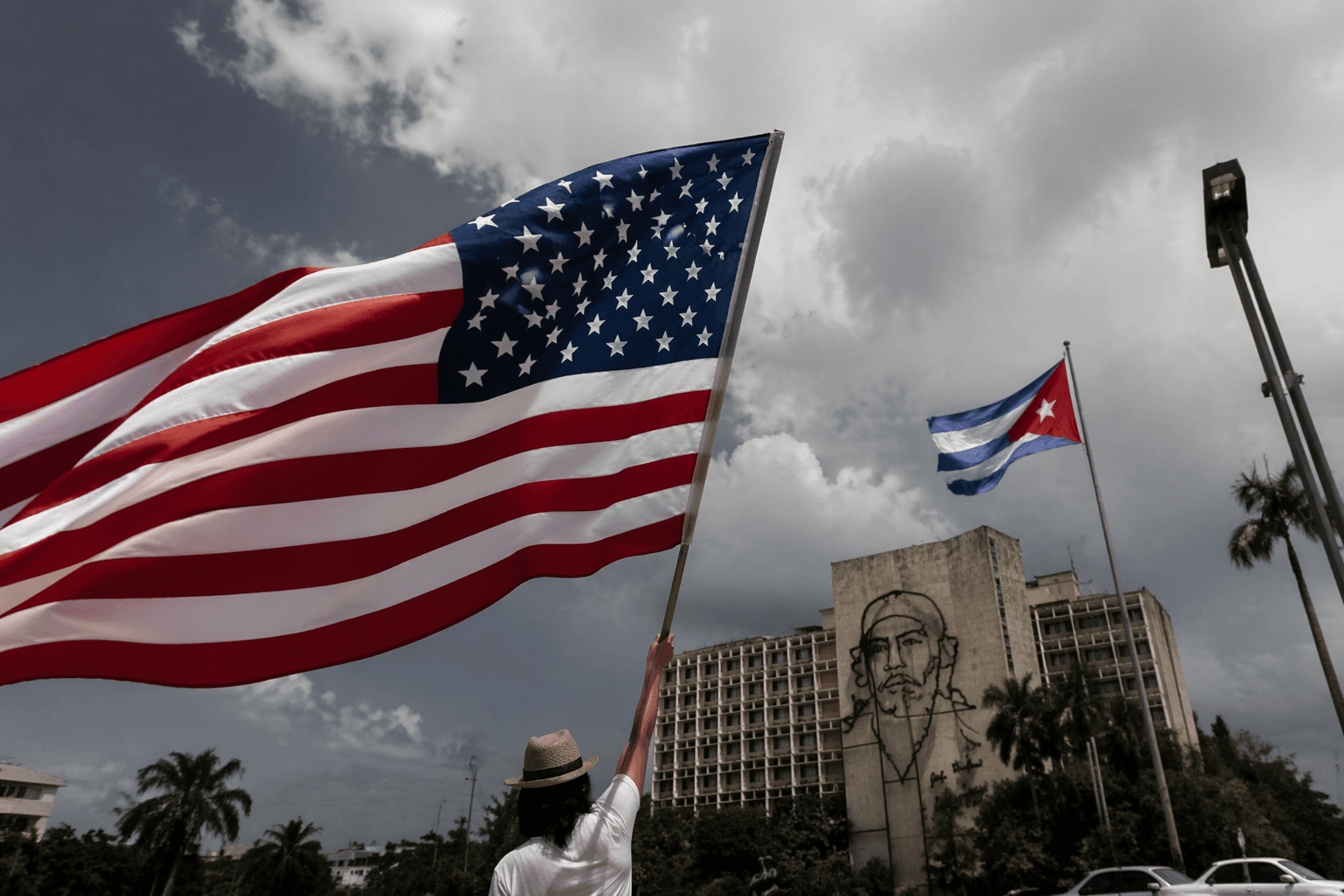
In May 2026, the State Department added another layer by sanctioning 11 Cuban regime-aligned actors and three entities, describing them as part of a broader campaign against threats posed by the Cuban regime. Taken together, the travel restrictions and the sanctions show how the terror label can be used as a launch point for successive rounds of pressure rather than a single administrative move.
How Havana and others read the move
Havana responded to the January 14, 2025 rescission by saying the step was limited but in the right direction, while stressing that the U.S. blockade remained in place. That response captures the Cuban government’s central complaint: even when the terrorism label shifts, the larger architecture of pressure stays standing.
Russia later weighed in too. AFP’s reporting in The Moscow Times said Russian officials criticized Trump’s reversal as an attempt to destabilize Cuba and push regime change. That reaction is important because it reflects how the label plays internationally. Countries do not just see a terrorism designation. They see a Washington tool that can be used to isolate Cuba diplomatically and justify stronger measures.
For Cuba, the international standing problem is real. A country tagged as a terrorism sponsor has a harder time reassuring partners, lenders, and commercial actors that normal relations are safe. The label gives skeptical governments and cautious companies an excuse to step back.
Why banks and companies feel the chill immediately
The financial fallout is one of the least visible parts of the story, but it may be the most consequential. Cuba’s foreign ministry said in a 2025 report that 40 foreign banks refused to process transactions with Cuban banking entities between March 2024 and February 2025, affecting 140 transactions. That is the practical meaning of a terror label in a sanctions-heavy environment: even when a payment is lawful, institutions may avoid it because the risk is too high.
That kind of de-risking can squeeze imports, remittances, and everyday commercial life. It also reaches beyond formal sanctions, because banks and companies often act more conservatively than the law strictly requires. A label tied to terrorism makes the compliance instinct stronger.
For Cubans, this comes on top of a battered domestic economy. Reuters reported that Cuba received 2.2 million international visitors in 2024, well below a target of 3.2 million and less than half of pre-pandemic levels. Tourism was already struggling under blackouts, food shortages, fuel shortages, and labor shortages. In March 2024, protests erupted in eastern Cuba, including Santiago de Cuba, over outages and food shortages. The external pressure lands on top of internal scarcity.
The politics behind the label
This is why the Cuba terror designation is best understood as political escalation rather than detached security policy. It gives the Trump administration a ready lever for sanctions pressure, travel restrictions, and financial tightening while signaling toughness to domestic supporters who want a harder line on Havana. It also helps frame Cuba not as a complicated neighbor but as a target.
Blazakis’s warning is that this kind of framing can make the next escalation feel normal. Once Cuba is cast as a terror sponsor, stronger actions become easier to defend, even when the evidence base is thin. That is what makes the label dangerous: it can reshape policy, influence institutions, and isolate Cuba further, long after the headline move has passed.
The label is back, the pressure is widening, and the real effect is no longer theoretical. It is showing up in travel rules, bank refusals, sanctions lists, and a Washington posture that treats escalation as the point.
This article was produced by Prism’s automated news system from verified source data, official records, and press releases, then run through automated quality and moderation checks before publishing. The system is built and supervised by the people who set the standards it runs under. Read our full AI policy.
Did this article answer your question?