Baka Women Transform Central African Rivers Into Percussive Instruments
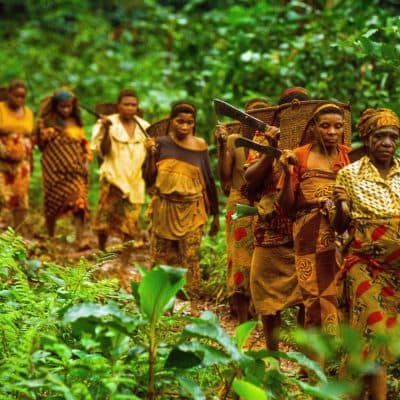
Baka women in Central Africa wade waist-deep into forest rivers and strike the water with cupped hands, turning tributaries of the Congo River Basin into polyphonic percussion.
Standing waist-deep in a shallow forest tributary, a Baka woman raises her cupped hands above the water's surface and brings them down with precision. The slap traps a pocket of air against the river, releasing a resonant percussive tone that carries through the dense rainforest canopy. She is not alone. Around her, other women are doing the same, each with her own rhythm, each part of something larger. What emerges from their collective motion is a complex polyphony that no single drum could produce. This is Liquindi, and the instrument is the river itself.
What Liquindi Is
Liquindi is a unique musical tradition of the Baka Forest People of Central Africa, where women use the river as a percussive instrument, striking the water with their hands to create rhythmic sounds. The practice belongs to the Baka, an indigenous forest people whose communities span Cameroon, Gabon, and Congo. It is ancient, described consistently as a preserved tradition that has survived alongside the ecosystems that make it possible. Its purpose is rooted in daily and communal life: the rhythms produced serve songs and gatherings, functioning as both musical expression and a marker of women's key cultural role within Baka society.
The tradition has reached wider audiences partly through a viral video that has introduced viewers outside these forest communities to the practice. That video, whatever its specific origins, functions as an educational window into something that most of the world has never encountered: a fully developed percussive musical form built entirely around a natural body of water.
The Rivers Themselves
The rivers that cradle the Liquindi tradition are likely tributaries and smaller waterways within the vast Congo River Basin, winding their way through the dense rainforest. These are not necessarily mighty rivers, but rather bodies of water that are shallow enough for the women to wade in and accessible from the forest banks. That accessibility is essential. The performance is impossible without direct physical entry into the water, so the rivers must be gentle enough to stand in safely while leaving the upper body free to play.
The geography matters musically, not just logistically. The specific characteristics of each river, its flow, depth, and surrounding vegetation, likely influence the unique sonic landscape of Liquindi. A faster current changes the resistance the hands meet at the surface. A deeper pool alters the resonance of the trapped air. The vegetation lining the banks shapes how sound travels and reflects through the environment. The varied flow of these rivers, changing with the seasons, may even add a dynamic layer to the music itself, meaning that Liquindi performed in the dry season and Liquindi performed during high water are not necessarily the same sonic experience. With their intimate knowledge of their environment, Baka women likely choose specific locations along these rivers based on the river's condition and how it resonates with their rhythmic drumming.
The Technique
The mechanics of Liquindi are precise. Baka women wade into the river and use their cupped hands to strike the water's surface, trapping air and creating percussive sounds. The cupping is not incidental. A flat palm slapped against water produces a different sound entirely, a sharp smack without depth. A cupped hand creates a small compression chamber on impact, and the air trapped inside produces a fuller, more resonant tone. Varying the cup angle, the speed of the strike, and the force applied all change the resulting pitch and timbre, giving each woman a range of tonal options without any additional instrument.
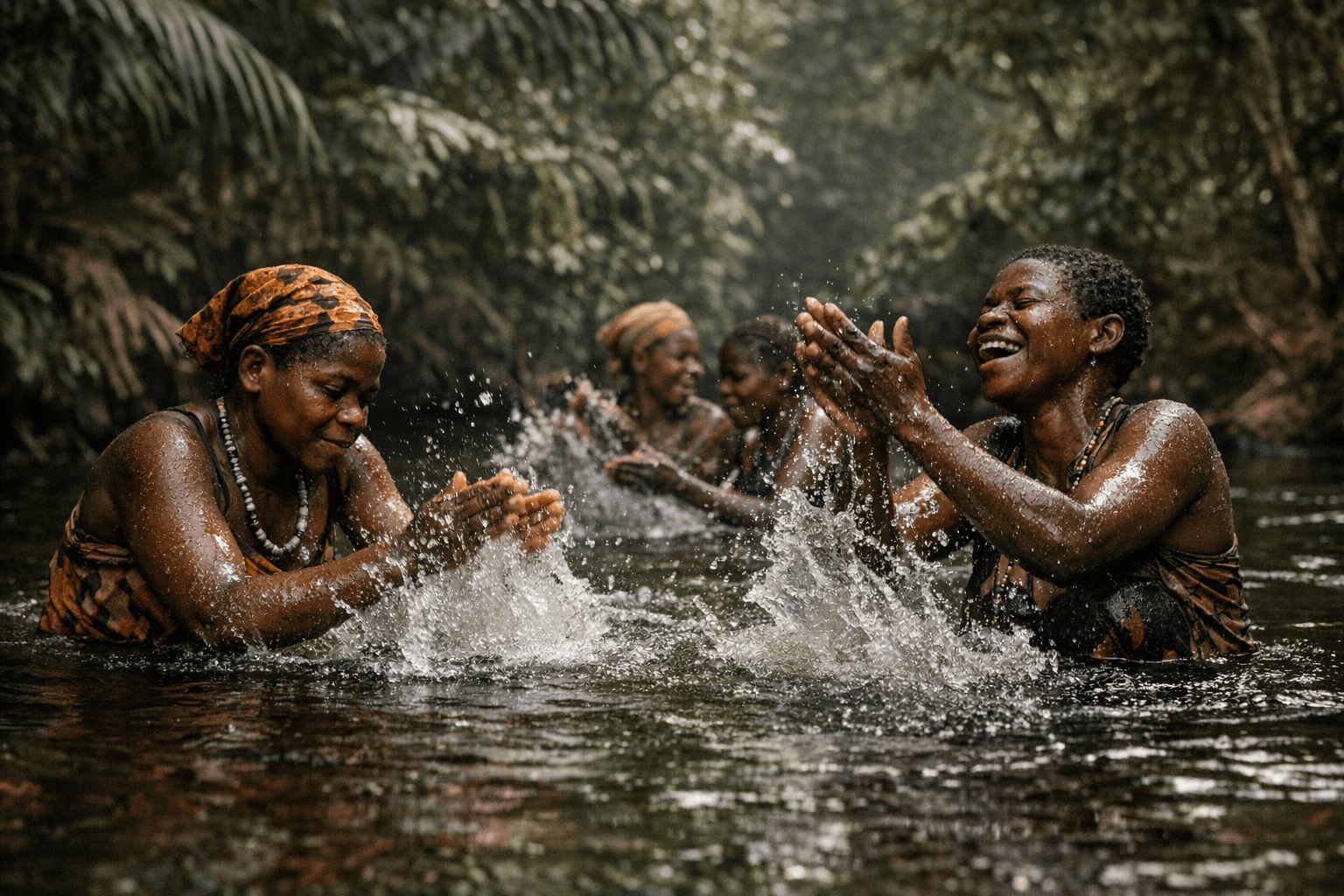
What makes Liquindi remarkable as a percussive tradition is what happens when multiple players perform together. Each woman creates her own rhythm, weaving together a complex polyphony. In most Western drumming contexts, polyphony of this kind requires multiple instruments. Here, it requires multiple people, a river, and a sophisticated understanding of how individual rhythmic patterns layer and interact. The intricate rhythms that result are not improvised chaos. They reflect deep musical knowledge passed through generations within the community.
Cultural Weight
Liquindi is not simply a musical curiosity. This ancient practice reflects harmony with nature and women's key cultural role in Baka life. The fact that it is performed exclusively by women, in a space that is both physical (the river) and communal (the gathering), marks it as a tradition with clear social structure and meaning. The river is not a backdrop. It is a collaborator.
The academic record supports this framing. A scholarly article published in Before Farming, the journal of prehistoric and early farming studies, examined Baka water drums and the practice of playing rivers and streams in the rainforest of Cameroon and Gabon. That kind of scholarly attention, combined with educational resources developed around the tradition and the interest of organizations such as the Indigenous Peoples of Africa Co-ordinating Committee, signals that Liquindi occupies a significant place in the broader study of indigenous musical and environmental knowledge.
Why This Matters Now
The rivers that make Liquindi possible are not abstractions. They are living waterways within the Congo River Basin, one of the most biodiverse and ecologically significant regions on earth. The rhythmic pulse of Liquindi, the river's song, is a powerful reminder of the interconnectedness of life and the importance of preserving our natural world. The same deforestation pressures, shifting water tables, and seasonal instability that threaten rainforest ecosystems also threaten the conditions that Liquindi requires: clean, accessible, shallow tributaries running through intact forest.
As one source on the tradition puts it directly: "Just as the Baka women coax music from the flowing water, we too must listen to the river's voice and take action to protect these vital ecosystems. Let the rhythms of Liquindi inspire us to become guardians of the rivers, ensuring that their songs continue to resonate for generations to come."
For drummers and percussionists who have spent years chasing tonal nuance through hardware, technique refinement, and equipment, Liquindi reframes the entire conversation. The instrument was always there. It took the Baka women of Central Africa to show the world how to play it.
Know something we missed? Have a correction or additional information?
Submit a Tip